Flush with excitement: Hello again, dear readers, and a joyous Thomas Crapper Day to you, as we wipe away the competition and reclaim the innovation throne.

Coocoo for cocoa: Lots to get through today … so, let them eat cake.
All over the place: It’s Jan. 27 out there, a date that truly ricochets around the human spectrum – not only Crapper Day but International Holocaust Remembrance Day and National Chocolate Cake Day, not to mention World Breast Pumping Day.
Mouses that roared: Before we dive in, a tip of the cap to intrepid reader Tom Mariner, the chief operating officer of Stony Brook-based SynchroPET and founder of Bayport-basedKommercialization LLC, who wrote in after Friday’s newsletter to point out that Xerox Data Systems was actually the first mouse-driven commercial computer (followed by the Apple Macintosh, the first with a mouse and a graphic user interface).
Never lacking Long Island references, Tom also noted that General Instrument Microelectronics – known now as Hauppauge’s Microchip Technology Inc. – used those “beast” XDS computers in the 1970s to design some of the most widely used chips of the day. Always a treat, Tom.
Golly geo: Also networking nicely was the diverse group of geographers, explorers, teachers, lawyers, cartographers, military officers and financiers who formed the National Geographic Society on this date in 1888.
Wave as you go by: Wave mechanics – a quintessential concept of quantum theory that describes the behavior of elementary particles (and, therefore, everything else) in terms of wave-like properties – became a thing on Jan. 27, 1926, thanks to Erwin Schrödinger.
Play it again: The first magnetic tape recorder – a reel-to-reel machine with a built-in oscillator and a then-whopping retail price of $149.50 – was introduced on this date in 1948 by the Wire Recording Corp. of America.

Equal time: In addition to Nutrasweet, aspartame also sweetens Equal.
That’s sweet: Nutrasweet, a.k.a. aspartame, was patented on Jan. 27, 1970, by James Schlatter, who was researching ulcer treatments.
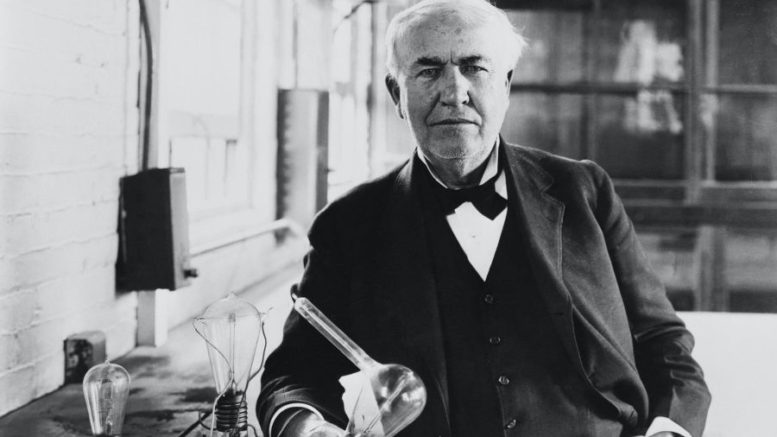
Also patented on this date, in 1880, was the electric lamp, by Thomas Edison, who was just doing his thing.
The longest yard: And engineers blew a hole in a yard-thick rock wall some 800 feet below the surface of the Tsugaru Strait on Jan. 27, 1983, opening a narrow pilot tunnel between Japan’s main island and Hokkaido island to the north.
The delicate operation was a critical step toward the completion of the 33-mile, largely subsea Seikan Tunnel, a dual-gauge railway passage that reigns today as the world’s longest manmade tunnel.

From Russia, with thighs: Baryshnikov, on twinkle toes.
You had us at “Wolfgang”: Prolific Austrian composer Wolfgang Amadeus Mozart (1756-1791) – who essentially shaped classical music and is known best by his singular surname (but is there really a more famous “Wolfgang” or “Amadeus”?) – would be 265 years old today.
Also born on this date were British astronomer Isaac Roberts (1829-1904), who pioneered nebula photography; “Alice’s Adventures in Wonderland” author Lewis Carroll (a.k.a. logician and mathematician Charles Lutwidge Dodgson, 1832-1898); American music man Jerome Kern (1885-1945), the “Godfather of the American Musical” who penned such classics as “Ol’ Man River,” “Smoke Gets In Your Eyes” and “The Way You Look Tonight”; Norwegian mineralogist Victor Moritz Goldschmidt (1888-1947), considered the founder of modern geochemistry; and Russian American dancer, choreographer and actor Mikhail Nikolayevich Baryshnikov (born 1948).
You be the judge: And take a bow, John Glover Roberts Jr. – the Buffalo-born 17th Chief Justice of the United States Supreme Court turns 66 today. (More on the birthday boy below.)
Rock us, Amadeus – story tips and calendar events, along with well wishes for these and all the other Jan. 27 innovators, always welcome at editor@innovateli.com.
 About our sponsor: New York Institute of Technology’s 90-plus, profession-ready degree programs incorporate applied research, real-world case studies and professors who bring decades of industry knowledge and research into the classroom, where students and faculty work side-by-side researching cybersecurity, drone design, microchips, robotics, artificial intelligence, app development and more. Visit us.
BUT FIRST, THIS
The path of Kon: Northwell Health has recruited a topflight cardiothoracic surgeon to head up two critical transplantation programs.
Zachary Kon, a renowned expert of heart and lung transplants with long experience in numerous forms of advanced cardiac surgery, has been named surgical director of Northwell’s Advanced Heart Failure and Cardiac Transplantation program and the health system’s Advanced Lung Failure and Lung Transplantation program. Kon – who previously directed NYU Langone’s lung transplantation, pulmonary hypertension and pulmonary thromboendarterectomy programs – will be based at the North Shore University Hospital’s Sandra Atlas Bass Heart Hospital.
The author of more than 125 peer-reviewed scientific articles and a recognized authority on ventricular-assist devices and extracorporeal membrane oxygenation (external life support) machines, the cardiothoracic surgeon has also managed heart and lung surgical programs for the University of Maryland Medical Center in Baltimore. “We are thrilled to have Dr. Kon join the health system,” said Northwell Senior Vice President Alan Hartman, the health system’s executive director of cardiovascular and thoracic surgery, noting Kon’s “expertise, research and innovations in heart and lung transplant.”

Mixing it up: Diversity (and a healthy dose of financial incentives) will key New York’s energy future, according to NYSERDA Acting CEO Doreen Harris.
The search for spark: An ambitious, large-scale procurement program will address several New York State economic and renewable-energy goals, while simultaneously promoting Albany’s Community Choice Aggregation strategy.
Deepening the Cuomo Administration’s link between clean energy and economic development, the Competitive Tier 2 Program – administered by the New York State Energy Research and Development Authority – will work to retain New York’s existing renewable energy resources and support a post-pandemic economic recovery by increasing in-state competition and reducing energy costs. Leading the effort are three annual competitive solicitation processes; the first, underway now, seeks proposals from existing private hydropower and land-based wind generators that entered commercial operation before 2015.
New York’s overarching goal is to encourage the aggregation of numerous, smaller clean-gen sources, with Competitive Tier 2 solicitations measured by price and carbon footprint. “This new program will diversify our energy mix and incentivize resources to continue operation and keep their renewable energy here in New York State,” said NYSERDA Acting President and CEO Doreen Harris.
TOP OF THE SITE
Wire report: Recent rebrand TiniFiber’s next-generation fiber-optics are lighting up Penn Station’s Moynihan Train Hall.
Subscription medication: Is your innovation team a bit off its feed? Our thrice-weekly newsletters will cure what ails them – have them click here (and call us in the morning).
Innovation in the Age of Coronavirus: Interracial inoculations at church, key clinical trials at Stony Brook Medicine and critical extensions for the uninsured – keep up with Long Island’s one-and-only pandemic primer.
VOICES
Online gambling may be a win for revenue-starved Albany, but the gambling-addiction risks are real, with real fallout throughout the socioeconomic spectrum. Fortunately, nonprofits anchor Jeffrey Reynolds knows how to even the odds.
STUFF WE’RE READING
Speed boost: From Israel, electric car batteries with five-minute charge times. The Guardian plugs in.
Chop chop: Lab-grown wood is big news for logging, agriculture and biomaterials production. MIT News digs in.
Quick score: To catch up with China, America must dramatically increase science funding. The Hill goes all in.
RECENT FUNDINGS
 + Bear Flag Robotics, a California-based agtech company, raised $7.9 million in a seed extension funding round led by True Ventures, with participation from Graphene Ventures, AgFunder, D20 and Green Cow VC.
+ Mivi Neuroscience, a Minnesota-based medical device company focused on improving clinical outcomes for ischemic stroke patients, closed a $35 million Series B funding led by Perceptive Advisors, Deerfield Management, Aphelion/Cardeation Capital, Concord Health Partners and “a major multinational med-tech company.”
+ BlueNalu, a California-based food company producing seafood products directly from fish cells, closed a $60 million debt financing led by Rage Capital, with participation from Agronomics, Lewis & Clark AgriFood, McWin, Siddhi Capital, Radicle Growth, Rich Products Corp. and Stray Dog Ventures, among others.
+ Verve Therapeutics, a Massachusetts-based biotech pioneering gene-editing medicines to treat cardiovascular disease, closed a $94 million Series B financing led by Wellington Management, Casdin Capital, Redmile Group, Janus Henderson Investors and others.
+ Simporter, a Georgia-based SaaS startup that uses AI to predict consumer demand for new products, closed a $600,000 seed funding round led by Startup Wise Guys, with participation from angel investors in Denmark, Estonia, Japan and other regions.
+ Brigit, a New York City-based provider of a holistic financial-health app, raised $35 million in Series A funding led by Lightspeed Venture Partners, with participation from Abstract, Brooklyn Bridge Ventures, Secocha, Ashton Kutcher’s Sound Ventures, Flourish Ventures and others.
BELOW THE FOLD (Chief Justice Edition)

Bench player: Roberts, impeachment observer.
Taking a pass: Why John Roberts benched himself for Trump Impeachment II.
Taking a risk: SCOTUS wades into troubled waters as big firms drown in patent challenges.
Taking a hard look: From analytics to AI, where does legal technology go from here?
Taking no chances: Please continue supporting the amazing institutions that support Innovate LI, including the New York Institute of Technology, where remote instruction and smart facility-access policies keep communities safe across two thriving campuses. Check them out.