By GREGORY ZELLER //
Abraham Lincoln’s iconic top hat, Dorothy’s ruby slippers from “The Wizard of Oz” and Sandra Lindsay’s Northwell Health employee ID badge.
 These are just three of the more than 1.8 million objects on display at the National Museum of American History, now that the Washington museum – one of 19 exhibition centers comprising the vast Smithsonian Institution – has been gifted items from America’s very first COVID-19 vaccination.
New Hyde Park-based Northwell Health administered the first non-clinical U.S. dose of the Pfizer-BioNTech COVID-19 vaccine Dec. 14 to Lindsay, a Long Island Jewish Medical Center intensive care nurse and director of the hospital’s critical-care services.
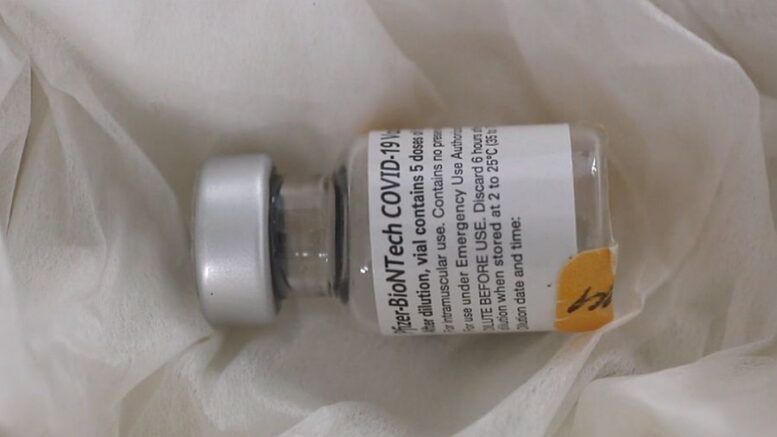
This week, the health system donated items from that historic event – including the now empty Pfizer-BioNTech vial that contained the first dose, along with Lindsay’s scrubs and ID badge – to the NMAH, which will add them to its impressive Health & Medicine collection.
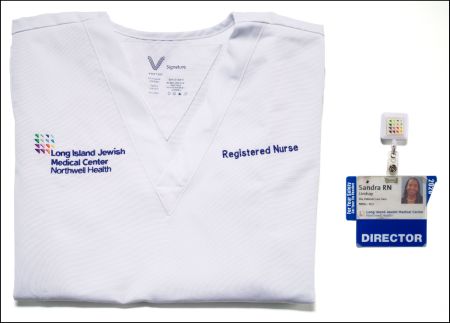
For posterity: Sandra Lindsay’s scrubs and badge.
The donation was made in response to a “rapid-response collecting task force” the NMAH formed last spring to document COVID-19, with particular attention paid to scientific and medical developments and the pandemic’s effects on politics, business and culture. Northwell’s contribution also includes used syringes, vaccination-record cards and additional empty vials from other early inoculations, formerly carrying both the Pfizer-BioNTech and Moderna vaccines.
The health system also donated shipping materials that help document the Herculean effort behind those early vaccinations, including specialized vaccine-shipping materials designed to maintain and monitor temperature.
Those objects will now be preserved alongside a sample of Jonas Salk’s original polio vaccine and other all-time breakthroughs in the NMAH’s Health & Medicine collection – an honor worthy of Northwell’s behind-the-scenes efforts, the very public Dec. 14 vaccination and its role in American history, according to Northwell Health President and CEO Michael Dowling.
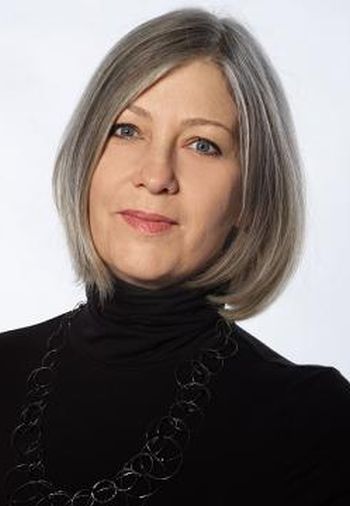
Anthea Hartig: Worthy addition.
“It was our first real sign of hope after so many dark months,” Dowling said Tuesday. “When Sandra Lindsay rolled up her sleeve, we weren’t just showing our team members the safety and efficacy of this groundbreaking vaccine – we were telling the world that our country was beginning a new fight back to normalcy.
“It was an extraordinary moment, and I thank the Smithsonian for preserving this important milestone.”
Anthea Hartig, who as the NMAH’s Elizabeth MacMillan Director oversees the museum’s $40 million-plus budget and three shelf-miles of archives, agreed that the donated items deserve recognition among the most elite remnants of American medical history.
“The urgent need for effective vaccines in the United States was met with unprecedented speed and emergency review and approval,” Hartig, one of several U.S. under-secretaries for museums and culture, said in a statement. “These now historic artifacts document not only this remarkable scientific progress, but represent the hope offered to millions living through the cascading crises brought forth by COVID-19.”