
By GREGORY ZELLER //
The New York Institute of Technology is living on the edge.
 Forget the Aerosmith jokes – this is serious business concerning “edge computing,” a distributed-computing paradigm that brings computation and data storage ever closer to data sources, perchance to improve response times and save bandwidth.
Jerry Cheng, an assistant computer sciences professor in the New York Tech College of Engineering and Computing Sciences, will share in a $1.5 million National Science Foundation grant advancing research into mobile edge-computing protocols – an effort designed to ensure that smart-device advancements don’t outpace critical laboratory experimentation.
Cheng will collaborate with researchers from Indiana University, Temple University and Rutgers University – the PhD’s alma mater – on edge-computing research that may lead to safer autonomous vehicles, more secure smart cities and other mobile-computing innovations.
“The outcomes from this project will connect individual research groups and speed up interdisciplinary research in areas such as the Internet of Things, smart healthcare, the smart home and city, and augmented and virtual reality,” Cheng noted.
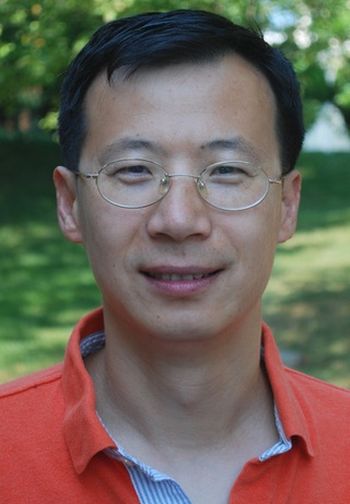
Jerry Cheng: Edge booster.
Mainstream technologies such as smartphones, cloud-connected kitchen appliances and voice-controlled systems (try saying “Alexa, what is a voice-controlled system?”) all use edge-computing network architectures. This brings the actual computing physically closer, dumping traditional cloud-computed processes onto local servers and, ostensibly, relieving network congestion, while speeding up reaction times.
Autonomous vehicles and your new iPhone 13 therefore become more responsive to real-time events, functioning on “the edge” of what’s really happing here, there and everywhere.
Mobile edge-computing technology has advanced rapidly in recent years – perhaps too rapidly, according to some observers, who suggest significant programming efforts are needed to create a proper simulation environment. Testing new edge-computing parameters is critical, critics say, before unleashing these technologies on the world.
Enter Cheng and friends, who will build a large-scale, configurable and programmable mobile-edge sensing and computing infrastructure – an amalgam of sensors, edge devices and robots ideal for large-scale experiments on what Old Westbury-based New York Tech calls “low-effort, privacy-preserved data collection.”
“Our efforts may help to unlock innovation that was once beyond reach,” Cheng added, trumpeting “safer autonomous vehicles and more secure, responsive smart-city infrastructure.”
The NSF-funded work will also allow academic, industrial and government professionals to easily share their findings, ensuring that edge-computing research keeps pace with evolving technologies.
The project – part of a larger collaborative effort led by Rutgers University’s Wireless Information Network Laboratory – focuses on one of several emerging technologies in play at New York Tech’s CECS, according to College of Engineering and Computing Sciences Dean Babak Beheshti.
“Through these highly focused and collaborative projects, New York Tech contributes to the creation of knowledge as well as involving our students in research,” Beheshti said in a statement. “[We] congratulate Dr. Cheng on this grant.”