
By GREGORY ZELLER //
A 2020 tech startup born in the fires of the pandemic is quickly making a name among regional architects – and is helping a new generation of New York Institute of Technology students grasp the next level of computer design.
 The brainchild of New York Tech Associate Professors Jason Van Nest and Michael Nolan, Nullary() Group (not a typo) answers specific Age of Coronavirus needs – including the universal focus on remote work – with the founders’ deep understanding of Building Information Modeling, which incorporates various tools and technologies to generate digital representations of physical spaces.
The science of architecture is in the midst of a years-long transition to BIM from Computer-Aided Design, which creates, analyzes and modifies two- and three-dimensional designs for a vast range of applications, from advertising logos and animated characters to automobile and building frames, and just about everything in between.
The transition hit the gas in 2020, when remote work became paramount – in the case of architects, the ability to digitally represent the functional characteristics of a physical space, including new constructions and existing spaces ripe for renovation.

Michael Nolan: Transitional technologist.
Enter Nullary() Group, which calls upon the Virtual Design and Construction and BIM experience of Van Nest (a licensed general-practice architect) and Nolan (founder and managing partner of New York City-based design/construction consultancy Gridley Consulting) to address remote-work challenges faced by architects and contractors, especially during the pandemic.
“For the last decade, we had been busy applying lessons from our classrooms at New York City-area architecture firms, helping design teams transition from CAD to BIM,” Nolan said. “But even before the epidemic, many of those architects were already asking us how to help their partner contractors build with the same data systems, and not paper drawings.”
The primary challenge, according to the associate professors in New York Tech’s School of Architecture and Design, was getting high-quality, real-world data into practical design models, then accurately projecting architectural and design solutions back into reality.
Always a difficult – and valuable – skill, this ability was suddenly prioritized by the pandemic.
“Our clients kept returning and asking for virtual design and construction services,” Van Nest said. “And with so many architects now working from home, we needed help with the increase in collaborative modeling demand.”

Jason Van Nest: Collaborative creator.
Recognizing a burgeoning vertical market, the long-experienced architects contacted 2016 New York Tech architecture graduate Michael Ferraro, a former student who specializes in modular-building solutions and is also well-versed in BIM standards.
“Michael found novel and exciting ways to apply the tools we taught him in our Construction Documents course and Project Integration Studio,” Van Nest noted. “He was a natural choice as a partner to expand our capacity and tool use.”
With Ferraro adding his expertise in 3D-LiDAR scanners and Robotic Total Stations – both critical to remote conceptualization – the trio officially flipped the switch on Nullary() Group in September. They were immediately busy, and one of their very first clients was a big one: MiTek, a multinational services provider for the global building industry (and Berkshire Hathaway company since 2001).
MiTek was so impressed with Nullary() Group’s services that it snapped up Ferraro, putting him in charge of their Modular Building Solutions division.
“At first, I turned down their offer, because of the commitment I made to Jason and Mike,” Ferraro noted. “When I told them about it, their only concern was to ensure my future was positioned to be as successful as possible.
“It’s beyond gratifying to have professors in your corner … and always putting the growth of their students first, even six years after graduation,” he added.
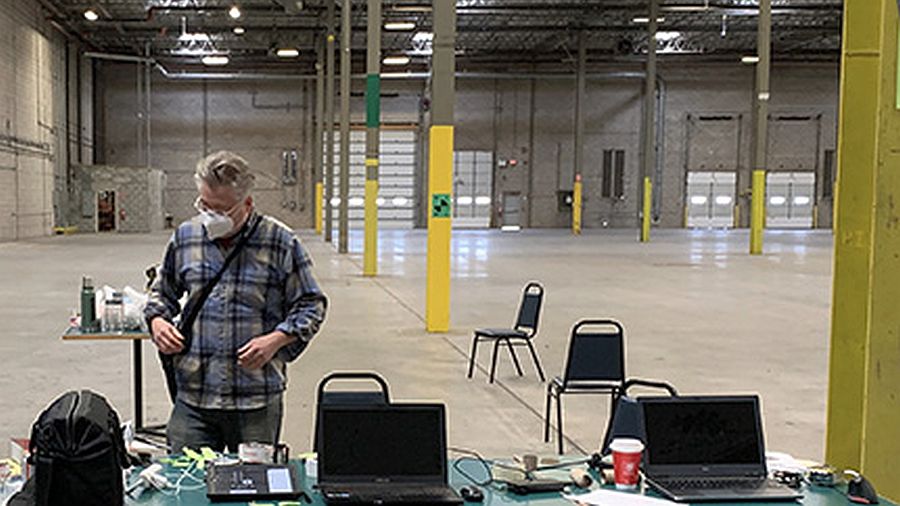
Measuring up: Van Nest, spaced out in Pennsylvania.
Sharing their young associate with the world has not slowed Van Nest or Nolan or their fledgling firm. In December, Nullary() Group scanned a 250,000-square-foot factory in Pennsylvania, first step in transforming the space into a state-of-the-art construction facility.
And as 2021 evolves, the associate professors have big plans for their startup, literally: In addition to bringing Nullary() Group’s high-tech tools into their New York Tech classrooms, the entrepreneurs plan to scale up quickly.
In particular, they aim to generously deploy tools like the Robotic Total Stations, which help fewer human operators create more detailed scans in less time – sure to remain a commodity even after the pandemic abates.
While helping the business grow, the proliferation of that cutting-edge tech will actually doom Nullary() Group, especially as more architecture and design students gain hands-on experience in Van Nest and Nolan’s workshops.
“We have to start training the next generation of architects on these technologies today, so that adapting to technologically rich design workflows comes as second nature – and not from a consultant,” Van Nest said. “As an educator, my biggest success would be watching the Nullary() Group slowly go out of business.”
Nullary() Group
What’s It? Next-level Building Information Modeling, key for architects in a remote-work world
Brought To You By: New York Tech Associate Professors Michael Nolan and Jason Van Nest, and former student Michael Ferraro
All in: About $15,000, for business-formation and new equipment
Status: Working hard to put itself out of business, forever