
By SCOTT BURMAN //
Long Island’s aging, diversifying and increasingly mobile population is reshaping demand for its real estate products.
 While the overall Nassau/Suffolk population remains stable – just under 3 million residents – the people who live here today do not look, or live, like the Long Islanders of past decades. If we fail to plan and build for this evolving population, we risk falling behind regions competing for our talent, our business base and our long-term vitality.
The 65-plus population has surged 24 percent in the past decade, making the “silver market” a major-demand category and one of Long Island’s most influential demographic groups.
Seniors want to age in place – near their families, doctors, faith communities and familiar services – and increasingly seek modern, amenity-rich housing that supports this lifestyle. At the same time, Long Island’s Hispanic and Asian populations have grown significantly, with immigrant communities revitalizing corridors in Brentwood, Hempstead, Hicksville and other areas by opening businesses, expanding the labor pool and adding cultural vibrancy.
The influx to Long Island from New York City that began with COVID remains a major force reshaping regional demand. This new population favors walkable downtowns, high-quality rentals and condos, and proximity to transit, retail, dining and basic services.

Scott Burman: Theories on evolution.
Not surprisingly, downtowns such as those in Patchogue, Bay Shore, Huntington and Wyandanch have emerged as magnets for young professionals, empty nesters and downsizers, becoming the region’s most reliable engines for new housing growth. Developers are responding accordingly with mixed-use, amenity-rich projects where people can live, work and play in a campus-like setting.
Despite evolving demand, Long Island remains one of the country’s most challenging development environments.
Thirteen towns, two cities and nearly 100 villages – multiplied by layers of county and state regulation – form a labyrinth that adds years and millions of dollars to even straightforward projects. That complexity is further compounded by civic groups and special interests that continue to champion outdated NIMBY frameworks.
While community involvement is essential to smart development, the result is often a system predisposed to inaction rather than thoughtful, forward-looking growth. Other geographies with more progressive land-use policies have moved aggressively to produce innovative multifamily, mixed-use and commercial developments, but Long Island has not kept pace.
There are encouraging signs, however. Multifamily rentals, once viewed as “transient” housing, are now widely accepted as indispensable housing stock. Today’s Long Island renters sign 14-month leases and stay an average of 40 months, while vacancy rates remain extremely low and rents reflect strong demand. As a result, investors increasingly see Long Island as a premier multifamily market.
The senior-living sector over the past two decades has managed to deliver a diverse range of options, from active-adult lifestyle communities and independent-living residences to assisted-living and memory-care products. After years of navigating zoning hearings, environmental reviews and school-district politics, my developments alone have brought thousands of these units online.
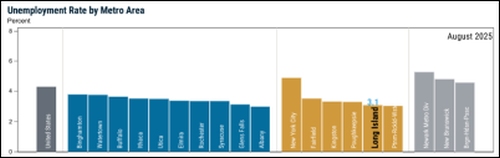
Strength in numbers: A relatively low unemployment rate is one of several strong socioeconomic factors working in Long Island’s favor. (Source: Federal Reserve Bank of New York)
These projects required years of zoning and environmental review, but they met a crucial regional need. Large mixed-use projects continue to encounter political resistance, but attitudes are beginning to shift as lifestyle patterns evolve and long-held concerns over traffic and parking diminish. More municipalities are now reevaluating restrictive codes that have constrained commercial development for decades.
Without meaningful policy reform, Long Island will struggle to compete with regions that are building for the populations they serve today. Westchester, for instance, has dramatically outpaced Long Island in multifamily and mixed-use development while simultaneously strengthening its commercial base.
Meanwhile, the Federal Reserve Bank of New York reports Long Island’s economic fundamentals remain among the strongest in the country: a GDP larger than that of 20 U.S. States, median incomes and wage rates above national averages, and relatively low unemployment and crime rates. Our schools consistently outperform statewide and national benchmarks, and Nassau and Suffolk rank among New York’s most economically productive counties.
Most regions would envy what Long Island possesses: a diverse and growing population, proximity to New York City, strong schools, a vibrant economy and a coastline unmatched anywhere in the region. The question now is whether we will allow demographic realities and market demand to guide what we build next, or whether we will remain tethered to a nostalgic version of Long Island that no longer reflects how people actually live.
Those of us committed to the region’s future must continue advocating for smart, well-located, well-designed development that serves all residents. Only then will the next generation truly thrive in the communities they call home.
Scott Burman is the founder and president of Burman Real Estate.