By GREGORY ZELLER //
As the cinema-quality visuals of the Mars 2020 mission fill your screens, some of the most important data beaming back from the Red Planet may escape your notice – at first.
 But the information is paramount to two Stony Brook University faculty members, who are knee-deep (and deeper) in NASA’s search for ancient alien life. And if the data provided by the Planetary Instrument for X-ray Lithochemistry – just one of the mission’s tools involving the SBU scientists – shows what researchers hope, it may become front-page news indeed.
Scott McLennan and Joel Hurowitz – distinguished professor and associate professor, respectively, in SBU’s Department of Geosciences – both worked on the PIXL, a micro-focus X-ray fluorescence device attached to the arm of NASA’s Perseverance rover.

Scott McLennan: Happy returns.
McLennan is also part of the space agency’s Returned Sample Science Working Group, which will coordinate the selection, collection and storage of rock and soil samples in sealed containers, to be cached on the Martian surface and picked up by future NASA/European Space Agency missions.
“The ultimate return of carefully selected samples by future missions will provide unparalleled opportunities for studying Mars by applying the most sophisticated scientific analyses available in the world’s finest laboratories,” McLennan said.
The technology and tasks all support Mars 2020’s three-year mission to explore a strange, new world, to seek out new life and, maybe, old civilizations.
As Roddenberry-ish as it sounds, that is indeed the prime directive of Mars 2020, which is searching for signs of past extraterrestrial life with the ground rover Perseverance, the sky drone Ingenuity and a starship’s worth of next-generation tech.
Among other nifty tools, the remote-controlled away team is packing the laser-firing SuperCam, which provides both imaging and detailed chemical-composition analysis from distances up to 20 feet; the PIXL, which Hurowitz designed in collaboration with partners at SBU’s Center for Planetary Exploration and NASA’s Jet Propulsion Laboratory; and SHERLOC, handy handle of a word-salad spectrometer/ultraviolet mapping device with a mind for mineralogy.

Joel Hurowitz: Veteran Martian.
McLennan and Hurowitz’s fingerprints are all over the mission’s tech and operations. In addition to their PIXL contributions, McLennan is part of the SuperCam instrument team; Hurowitz is part of the mission’s scientific leadership and deputy principal investigator of the PIXL project, which focuses powerful light beams on tiny spots of rock or soil and analyzes the induced X-ray fluorescence.
And both have been to Mars before. McLennan is a member of the science teams for NASA’s still-active 2011 Mars Science Laboratory mission – which delivered the ground rover Curiosity – and the 2018 InSight Lander mission, currently digging deep into the Elysium Planitia.
Hurowitz, meanwhile, first visited the Red Planet in 2004 as an SBU graduate student, contributing to NASA’s Mars Exploration Rover program; he returned as a JPL employee, also working on that uber-successful Curiosity mission.
After last week’s tense landing – the culmination of a busy week on Mars, with three new Earth missions arriving from the United States, China and the United Arab Emirates, marking the first Arab interplanetary mission – the SBU scientists will focus their attention on the Jezero Crater.
That’s where Perseverance and Ingenuity will spend at least two years exploring an ancient lakebed for traces of extinct Martian life. Their primary target: sedimentary rock deposited in the lakebed roughly three-and-a-half billion years ago.
Earth was teaming with microbial life at the time; studying Jezero Crater’s ancient sedimentary layers will give researchers a good idea of what was happening one planet over, according to Hurowitz.
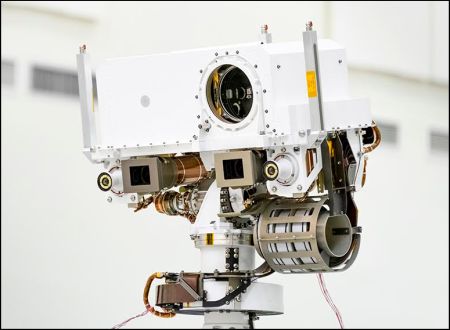
Face on Mars: This is a job for SuperCam.
“We’re going to be studying each one of those layers one by one, because each contains a … snapshot of the environment on Mars through time,” the associate professor said. “We’re hoping that it also contains some fossilized remnants that may tell us whether or not life started on Mars at one time in its history.
“It’s going to be a really exciting geological and astrobiological investigation for us.”
In addition to helping determine if ET (whether single-celled or more advanced) ever called Mars home, the Mars 2020 mission may also provide critical insights into Earth’s own ecological destiny, McLennan noted.
“Results obtained from the rover will address many of the highest priority scientific questions about Mars, including … why the climate of Mars dramatically changed during the planet’s geological history,” the distinguished professor added.