By GREGORY ZELLER //
It’s innovation squared at Smithtown West High School, where a brilliant idea designed to address an important social issue has a team of big thinkers in the running for prestigious national honors – and may provide unexpected benefits in the Age of Coronavirus.
 Meet the Personal Distance Monitor, a wearable-technology concept that has landed a team of 10 SWHS forward-thinkers (and their advisors) an uber-competitive Lemelsom-MIT InvenTeams grant – bestowed annually upon a handful of high school teams (including students, teachers and mentors) by the Massachusetts Institute of Technology’s Lemelson-MIT Program, which celebrates outstanding inventors and inspires young people to pursue creative careers.
In addition to funding carefully vetted qualifiers with a $10,000 grant to pursue their real-world solutions, the InvenTeam initiative greases the skids on academic and industry partnerships – stressing collaboration and teamwork within each team and beyond.
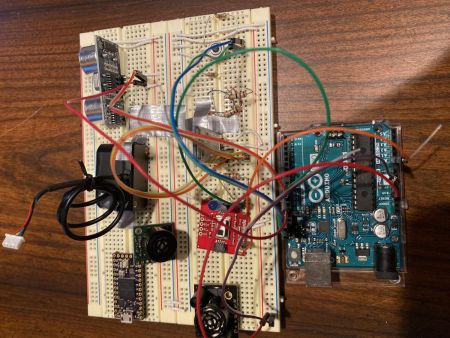
Pocket protector: The PDM, coming soon.
Last fall, 13 teams from New York, Texas, Michigan, Massachusetts, Florida, New Jersey, Minnesota, California, Georgia and Wisconsin qualified for the 2020-21 academic year program – including the SWHS squad, which initially conceived its PDM device as a high-tech tool for classmates with a common nervous system disorder.
“This was originally envisioned to aid students with Autism Spectrum Disorder, who oftentimes have trouble maintaining an appropriate personal space,” noted team advisor Joanne Figueiredo, the SWHS research coordinator. “However, our device also becomes beneficial in social distancing during our current global pandemic.”
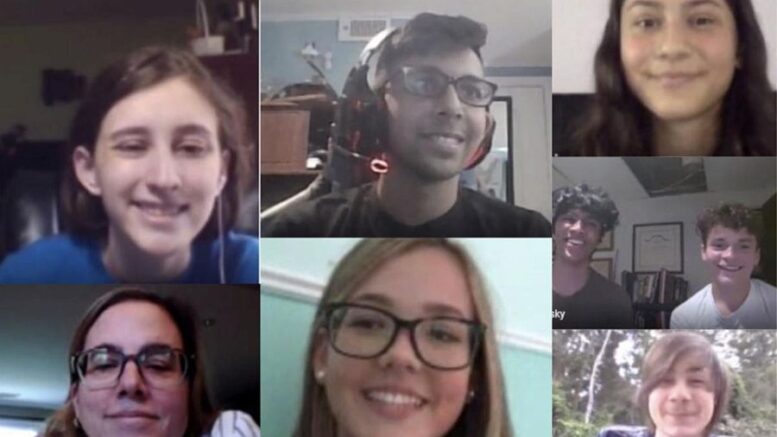
Students Sinead Doyle, Jensen Herbst, Liza Lleshaj, Rehan Mian, Kelsey Most, Tyler Nagosky, Patrick Noto, Eric Pentecoste, Madeline Raeihle and Aaquib Syed have spent the last several months designing a functional prototype device that sends real-time alerts when the user’s personal space (about a 4-foot radius) is breached. The Bluetooth-enabled PDM – which incorporates an IR imaging camera and ultrasonic distance sensor, among other miniaturized gizmos – fits in the user’s pocket and synchronizes with his or her smartphone through a downloaded app.

Stephanie Couch: Collaboration celebration.
The team plans to test the prototype on volunteers both diagnosed with ASD and not diagnosed with ASD. It’s also planning a live online virtual event beginning at 6:30 p.m. Feb. 24 to showcase its progress and solicit feedback (more information here).
The hometown presentation is a dress rehearsal of sorts for the big finale: All 13 teams are expected to showcase their inventions in the Lemelson-MIT Program’s annual culminating event, EurekaFest!, scheduled to take place virtually June 15-17.
“Since 2006, the InvenTeam initiative has been changing the way educators teach and providing young people – especially young women and students from underrepresented backgrounds – with creative problem-solving skills,” Lemelson-MIT Executive Director Stephanie Couch said in a statement. “InvenTeam students rely on inquiry and hands-on problem-solving as they integrate lessons from science, technology, engineering and math to develop invention prototypes.
“Interactive, self-directed learning is essential for experiencing invention,” Couch added. “The InvenTeam initiative teaches students to work in teams, while collaborating with intended users of their inventions.
“Most of all, students learn to move forward through challenges and celebrate ‘Eureka!’ moments.”