
By TOM MARINER //
Lasers are everywhere: medicine, communications, pointers, Hollywood ray guns.
 “LASER,” of course, is an acronym for “Light Amplification by Stimulated Emission of Radiation,” coined by Gordon Gould on the front page of a nine-page notebook he had notarized in 1957. Thirty years later, those pages would help prove he was the inventor of the laser, helping him win a patent battle that wound its way through many courtrooms – and across Long Island.
Gould wrote the notebook when he was a PhD student at Columbia University, under the tutelage of Charles Townes, whom he met at the 1956 Molecular Beams Conference at Upton’s Brookhaven National Laboratory. Townes invented the MASER (“Microwave Amplification by Stimulated Emission of Radiation”) and later received a Nobel Prize in physics; the laser was an offshoot of his work.
After abandoning his PhD pursuit, Gould joined the Technical Research Group, a Long Island-based defense-research firm that lived off military grants (like many on Long Island at the time). Soon after Gould joined, they moved to a laboratory in Syosset, where they worked on bringing his laser dreams to life.
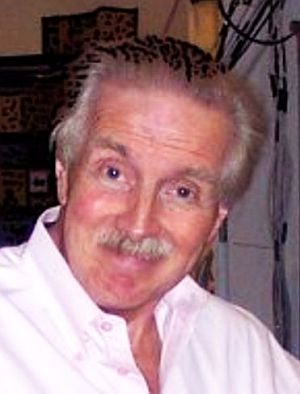
Tom mariner: On the beam.
Unfortunately for him, Gordon had dabbled in Communism with his first wife – and this came up when he was denied a role in the atom bomb-spawning Manhattan Project. It also denied Gould the security clearance he’d need to work on military products based on his laser work.
He was finally denied entry into the laboratory where his seminal laser experiments were ongoing. Even his personal notebook was now classified, and locked away in a safe.
Gould filed his main laser patent in 1959, but his locked-up paperwork caused problems with U.S. patent authorities. There was also competition from Townes, his former mentor. For Gould, things were bleak.
Then, in 1964, TRG was sold to now-defunct Control Data Corp., which decided Gould’s papers were not that interesting and could be released. With his research back in hand, Gould wasted little time: By 1966, when he was awarded a full professorship at the Farmingdale campus of the Polytechnic Institute of Brooklyn, he’d recruited most of the old TRG laser crew.
Shortly thereafter, his patent was denied again, even with the papers released by Control Data Corp. Undaunted, Gould co-founded Optelecom (based first in Farmingdale) to explore lasers in fiberoptic communications – a use he’d suggested in his earliest work.
The balance of power in the patent battles finally shifted when a federal judge noted decades of laser-leveraged scientific progress had been made since the plaintiff, now 66, first applied for his laser patent, and that issuance of said patent was essential to the “protection of his rights.”
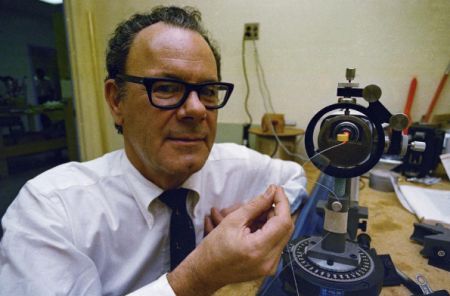
Laser focus: Gordon Gould, at Optelecom in Farmingdale.
Finally, in October 1977, 20 years after he started his notebook, the U.S. Patent Office – citing the handwritten notes as evidence – awarded Gould his main patent on the “optical pumping of lasers.”
Instantly, companies across the then-$200 million laser industry panicked – cries amplified by the grumbles of academic luminaries whose halos were suddenly tarnished. More legal street fights would follow, with multiple companies supported by scientists whose Nobel Prizes suddenly looked less noble. Final judgement was delayed another 10 years.
Our patent system is a technical innovation that grants a temporary monopoly on an invention, in return for teaching the rest of us how to build on it. Part of the reasoning is that it usually takes a large part of a patent’s life to commercialize the invention, so the bulk of the financial rewards will likely occur later, as new products are developed based on the original idea.
When Gould was at first denied his laser “monopoly,” it was a happy accident of patent timing. If his patent had been promptly granted, he would have earned an estimated $100,000 or so. The three-decade delay ultimately earned him a $30 million payday – chump change in what’s now a global $15 billion laser-tech market, but still not bad.
Gould made good use of the proceeds: From his home in Southampton, he endowed an eponymous chair at his alma mater, Schenectady’s Union College.
Tom Mariner is the chief operating officer of Stony Brook-based SynchroPET, the founder of Bayport-based Kommercialization LLC and the “web guy” for the Benefit Fund Conference.