By TOM MARINER //
Videogame sales are a $179 billion industry these days, more revenue than the global movie ($100 billion) and North American sports ($75 billion) industries combined. Names like Microsoft, Sony and Nintendo rule. None were there in the beginning.
 But Long Island was – in fact, an early mainstay of the industry, Mattel’s Intellivision console, was invented here.
One of the first videogame demonstrations was at Brookhaven National Laboratory, when William Higinbotham programmed an analog computer to display a “Tennis for Two” game on a lab oscilloscope. A public show in 1958 attracted plenty of attention – lines were out the door.
It’s well-known that Nolan Bushnell started videogame giant Atari in 1972. Bushnell asked an employee, Alan Alcorn, to turn the videogame concept into an arcade console, resulting in the groundbreaking Pong machine, which ate up quarters in bars and other public spaces.
Bushnell also thought the concept would work at home, and approached Hicksville-based General Instrument Microelectronics about embedding Pong’s electronic guts into an integrated circuit. GI Micro agreed – with the proviso that when sales volumes reached a certain level, it could market and sell its own home consoles.

Tom Mariner: Intelligent vision.
The company started developing more capable integrated circuits, requiring new programming and a “Television Interface Circuit.” A friend of mine knew about the venture and looked me up, and I was immediately intrigued.
I’d helped write the mainframe operating system for real-time banking in the United States; at the time, I was advising national hospitals on the integration of new computer systems, and that was getting boring. Instead, I would contribute the programming for the new videogame venture.
Every year since 1967, the big players in consumer electronics take booths at the Consumer Electronic Show to entice buyers. When I hitched my wagon to GI Micro’s star, I was unsure where the videogame industry was going, so when I attended the next CES, I set up a system that contained a crude “personal computer,” a new videogame, a communication console and an accounting system, with a quick animated display explaining it all. (My initial attempts at animation elicited laughter and even some ire from GI Micro Board of Directors, so I hired a Hanna-Barbera animator to get it right.).
Also at that particular CES was American multinational toy company Mattel, which became curious about how the GI Micro integrated-circuit system compared to the custom chips and software Mattel had spent millions developing with California-based integrated-circuit manufacturer National Semiconductor (now part of Texas Instruments).
What would become the Standard Television Interface Chip was, at the time, a cabinet filled with non-integrated circuits, all “blue wired” together on foot-square boards. Mattel sent a newly hired engineer to judge GI Micro’s integrated-circuit system, and we hit it off right away.

This IS your grandfather’s videogame: Mattel’s trendsetting Intellivision console, a Long Island native.
He told me about Mattel’s plans for a football videogame, at the time a big animation-graphics innovation. While the rest of the CES hardware geeks were showing off their chip-filled boards, I got busy right away, committing the crude animations to computer memory.
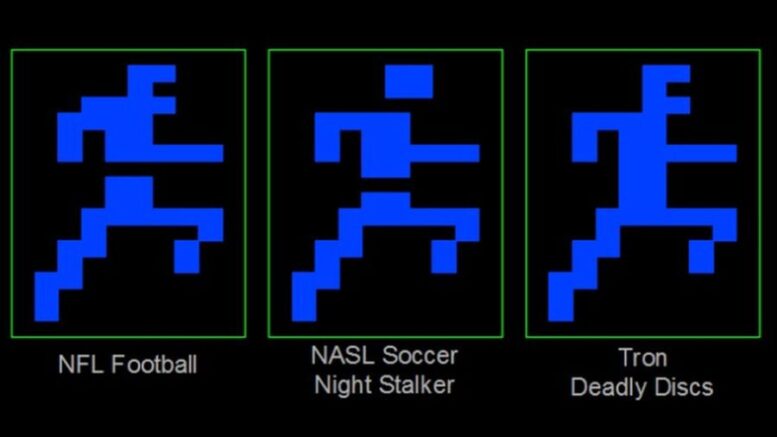
By breakfast the next morning, I’d thrown together some test code – two animated runners, one light blue, one dark blue, on a green background, emulating what I thought was Mattel’s big idea. The little characters chased each other back and forth across the screen, turning around at each edge and starting back the other way (one engineer noted that if I “put some blonde hair on the one being chased, we might have a great game there”).
Soon, a group of GI Micro techies gathered and cheered on the little animated runners. The impressed and excited Mattel guy got his boss on the phone, explaining what he was seeing and the great reaction.
Suddenly, he yanked the handset away from his ear, looked at the phone with a puzzled expression, then sheepishly asked, “What?”
Someone was clearly yelling on the other end, and the engineer turned white as a sheet.
“He says to turn off the unit now,” he croaked.
It turns out the idea for a football videogame, and the animation I had quickly created, were the famously secretive toy company’s biggest secret of all. And they thought it would take months to put together a demonstration like that, not a single morning.
But they’d forgotten to tell their man to keep his mouth shut.
And that turned out to be serendipity for GI Micro, and for me. Within days, we signed the contract to develop what became Mattel’s groundbreaking, wildly popular Intellivision system, one of the foundational branches of the entire videogame tree.
Tom Mariner is the chief operating officer of Stony Brook-based SynchroPET and the founder of Bayport-based Kommercialization LLC.