
By GREGORY ZELLER //
If ever there was a can’t-miss 21st Century business proposition, un-hackable communications networks just might be it.
 Ultra-secure networking is a rock-solid concept with vast potential across virtually all modern industries. Commercializing and deploying this nifty idea – that’s something else entirely.
Brooklyn-based startup Qunnect – which leverages “quantum memory” technology created by Stony Brook University’s Department of Physics and Astronomy and licensed from the Research Foundation for the State University of New York – is on the job.
Scientific co-founders Mehdi Namazi, Mael Flament and Eden Figueroa knew their 2017 startup was on the right track. But one thing was missing: a bilingual team member able to speak both science and business.
The role was originally filled by Robert Brill, a successful Long Island technology entrepreneur and investor who mentored the company through the National Science Foundation’s I-Corps program (and even became a co-founder, helping Namazi, Flament and Figueroa license the technology – all about quantum links, entanglement swapping and exponentially increased computational power – from the SUNY Research Foundation).
Now, the company’s business-development fortunes are in the very capable hands of Noel Goddard, a veteran of science and, critically, the science of startups.
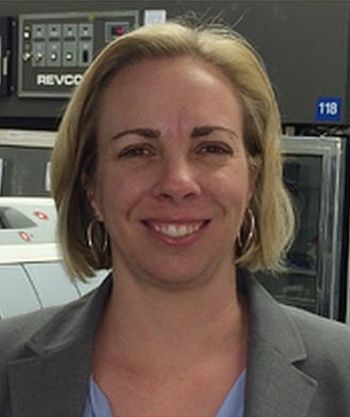
Noel Goddard: Science superstar.
Regular Innovate Long Island readers will remember Goddard as the chief executive of Calverton-based biotech enterprise Goddard Labs, a 2012-2016 R&D startup focused on molecular diagnostics. She also spent significant time as the chief technology officer of New York City-based Symbiotic Health (which has strong gut feelings about gut microbiomes) and is a successful portfolio manager for the Accelerate NY Seed Fund – combined with other executive positions and board seats across the biotech realm, the résumé of a stone-cold scientific superstar.
Qunnect’s Quantum Memory device can store, manipulate and retrieve quantum states on-demand, and integrate them into standard fiber-based telecommunication infrastructures, all at room temperatures. This is a significant advantage over most quantum technologies, which require temperatures near absolute zero (negative 273 degrees Celsius) to do their thing.
While offering clear technological and cost advantages, and despite copious federal support, Qunnect had a hard time selling its promise – until Goddard, who learned about the startup and its quantum ambitions through Accelerate, joined the team.
“With all of the Accelerate companies, if we invest, we also commit to mentoring,” she noted. “I had the opportunity to work closely with the team as they were preparing for their next stage of growth.
“They invited me to be on their board in the fall of 2019, and in January 2020 they invited me to join the team in a management role,” Goddard added. “I felt like Qunnect was a unique opportunity to commercialize an amazing technology, deeply rooted in physics.”
Goddard – who earned PhDs in physics and biology at The Rockefeller University and is a member of Harvard University’s Society of Fellows – would serve as chief operations officer for about three months, before taking the reins as CEO in April 2020. At last, the startup and longtime client of Stony Brook University’s Clean Energy Business Incubator Program was ready for takeoff.
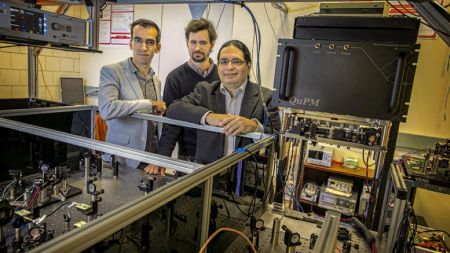
Back in the day: Qunnect scientific co-founders (from left) Mehdi Namazi, Mael Flament and Eden Figueroa knew the lyrics, but not the tune.
The COVID pandemic, of course, would derail that flight plan – though only temporarily, thanks to Qunnect’s unlikely knight in shining armor: President Donald Trump.
“Trump understood that the next global arms race is based on dominance in cybersecurity,” Goddard noted, essentially making quantum technology “COVID-proof.”
“The Chinese are actually ahead of the United States when it comes to quantum communications,” she said. “So even during the pandemic, there were numerous quantum funding opportunities from different government agencies.”
That included a $1.5 million DoE award issued in March 2020, one of several grants and awards that “made the difference between being able to stay open or not” through the pandemic, according to the CEO.
The startup also relocated during the height of the COVID crisis, leaving SBU’s Center of Excellence for Wireless and Information Technology for the Brooklyn Navy Yard, where it signed a lease in July 2020. Since then, Qunnect has built out its experimental spaces and office areas, installed numerous R&D workstations and recruited “two world-class experimentalists and a machine-learning expert,” according to Goddard.
“All of a sudden, the scientific team was twice the size,” she said. “That’s when our in-house intellectual property really ramped up.”
With the new HQ up and running, the team in place and the worst of the COVID pandemic over, Qunnect is finally ready to transform existing telecom fibers into quantum-secure networks.
There are still questions about who its first customers will be (probably the government and “defense researchers,” Goddard said, since they “define the standards that telecom adopts”). But wherever the company goes from here, it couldn’t have gotten there without the guidance of CEBIP and its founders’ long-term scientific vision – and of course, without the right scientist-executive at the helm.
“CEBIP’s value is much broader than just commercializing clean tech,” Goddard said. “A lot of what they do is about educating brilliant scientists and engineers on the value of building a business.
“And Qunnect really is a clean-energy company, just in a really futuristic space,” she added. “The technology doesn’t require cryogenic cooling, like other quantum techs, so it’s inherently energy-efficient.”