
By MICHAEL H. SAHN //
Setting aside questions of public policy and politics, the recent actions of Texas Gov. Greg Abbott and Florida Gov. Ron DeSantis raise serious legal questions about transporting migrants across state lines – and set up a potentially difficult scenario for Long Island.
 Abbott has spent $12 million on “Operation Lonestar,” which has bussed migrants from Texas to Washington, New York City and other cities in “sanctuary states.”
DeSantis has taken even bolder steps, recruiting migrants from Texas, transporting them to Florida and then flying them to Martha’s Vineyard.
Critics have invoked both federal and state laws, raising very real questions about whether the governors crossed legal lines. The main factor determining whether these actions are legal appears to be the concept of “voluntary.”
These are complex issues, but the general consensus among legal authorities is that if the migrants gave “informed consent” to be transported, then the governors’ actions were legal.
Michael Sahn: Governors gone wild.
There are conflicting accounts of the events, of course, leading to different legal determinations.
According to Abbott and DeSantis, the migrants wanted to be transported to other locations and even signed voluntary consent waivers. But some of the migrants reported that prior to being transported to Martha’s Vineyard, they were told they were being taken to Boston, with job opportunities and other resources waiting.
Others stated they were offered fast-food gift cards and promises to be taken to a “sanctuary.”
Transporting the migrants under false pretenses may give rise to potential claims of coercion, which could lead to legal action. It’s a rapidly developing story with new facts coming to light every day, but some commentators are already noting that nonconsensual transportation may be considered kidnapping – even human trafficking.
The migrants transported to Martha’s Vineyard have already commenced a legal action against DeSantis, alleging fraud and violations of their Constitutional rights. Filed in federal court (in Boston), the migrants’ action claims they were induced to agree to transportation based on false promises of “work opportunities, schooling for the children and immigration assistance” – and characterizes the actions of Florida officials as “fraud.”
While calls multiply for a U.S. Department of Justice investigation into the governors’ play, the transportation of migrants to New York City and Long Island is a growing concern. New York City Mayor Eric Adams has instituted several measures to deal with the sudden influx of more than 11,000 migrants, including an Emergency Procurement Declaration to rapidly establish shelters and services for asylum-seekers.
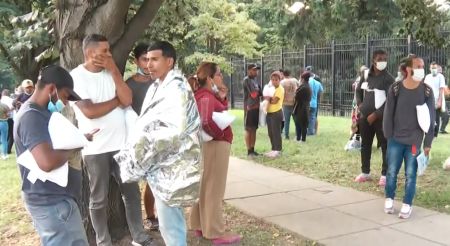
Pawn stars: Thousands of people in search of better life are caught in the political gears.
The mayor has also enlisted the Metropolitan Transportation Authority to transport migrants to shelters and hotels and announced plans for multiple “humanitarian emergency response and relief centers” – airplane hangar-sized tents used for temporary housing.
Even with these efforts, the city is overwhelmed. In July, NYC even violated its own right-to-shelter law when shipped-in migrants were left to sleep on the intake center floor.
There’s a good chance Long Island will be next to receive an influx of migrants. DeSantis can easily send several planeloads to East Hampton Town Airport or Long Island MacArthur Airport, and why not? “The Hamptons” carries equal gravitas with his base as “Martha’s Vineyard.”
How would Long Islanders react? Well, some Island organizations have already been sending resources – including money, food and clothing – into NYC, while others say they are prepared to aid migrants once they arrive in Nassau and Suffolk.
It’s good to know they’re getting a running start. New York City is already dealing with the effects of these publicly motivated political actions – and it looks like it’s only a matter of time before Long Island is, too.
Michael H. Sahn, Esq., is the managing member of Uniondale law firm Sahn Ward Braff Koblenz PLLC, where he concentrates on zoning and land-use planning, real estate law and transactions, and corporate, municipal and environmental law. He also represents the firm’s clients in civil litigation and appeals.