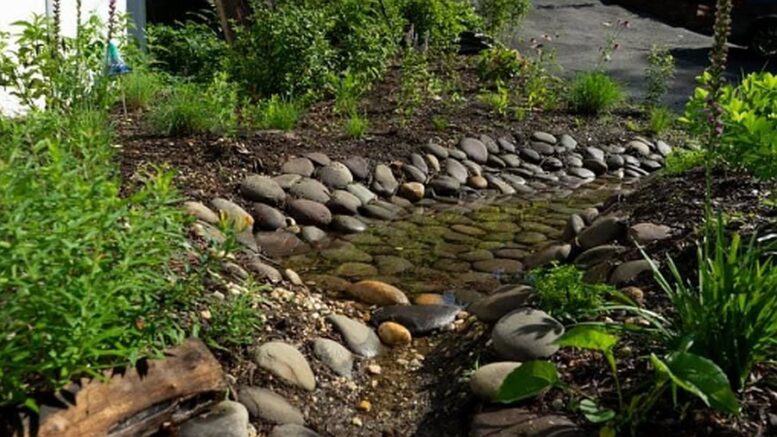
By FRANK PICCININNI //
If humans disappeared tomorrow, nature wouldn’t hesitate.
 Ecosystems would reorganize. Soil structures would rebuild. Fungal networks would re-knit and plant communities would reassemble according to ecological rules that long predate us.
Nature doesn’t need blueprints, drawings or oversight to persist – though ecological restoration efforts often behave like they do.
This is a problem. Not a lack of good intentions, but a fundamental misunderstanding of nature.
Too often, restoration is approached as a design exercise rather than an ecological process, as if landscapes were static objects. Native plants are selected, layouts finalized and details locked long before the land itself has been meaningfully understood.

Frank Piccininni: Going native.
In recent years, native planting has become a powerful symbol of environmental responsibility, and for good reason. Native species support pollinators, reduce water use and play an essential role in repairing fragmented ecosystems.
But planting native species alone does not restore ecological function. In many cases, it produces landscapes that look correct on paper but operate incorrectly in reality.
These failures are rarely acknowledged as design errors. Instead, they’re blamed on maintenance, weather, plant performance – anything but structural failures, which they are.
This distinction is especially clear on Long Island. No such thing as a standard site here – the landscape is a complex patchwork shaped by glacial advances and retreats, coastal deposition and centuries of land alteration.
Shore areas are dominated by coarse, sandy outwash soils that drain rapidly and leach nutrients. Low-lying coastal areas and former wetlands often contain organic, carbon-rich soils with high water retention, while many suburban and commercial properties sit atop layers of mixed sand, subsoil and construction debris that behave unpredictably.
These conditions cannot be standardized, averaged or abstracted without consequence. Even within a single neighborhood, soils can shift from excessively drained to poorly drained. These shifts represent entirely different ecological operating systems and treating them as interchangeable – or assuming they can be engineered into compliance – is why regional restoration efforts struggle.
 This is where conventional design logic breaks down. Architects and engineers excel at creating stable forms from inert materials, but ecological systems are neither inert nor stable. They are dynamic, self-organizing and responsive to disturbance. They cannot be fully specified in advance. They do not behave according to drawings. Nature is not built in a CAD file.
Soil resists this kind of thinking. It’s a living biological infrastructure with its own unique texture, structure, pH level, nutrient availability, drainage capacity and microbial communities determining whether plants can root, exchange nutrients and form the symbiotic relationships that sustain ecosystems.
These conditions are discovered by working the land, not drafting over it.
Central to this biological infrastructure are fungal systems that extend far beyond individual root zones, linking plants to nutrients, water and, critically, to one another. These mycorrhizal networks regulate nutrient exchange, influence competition and cooperation among plants and underpin the stability of terrestrial ecosystems.
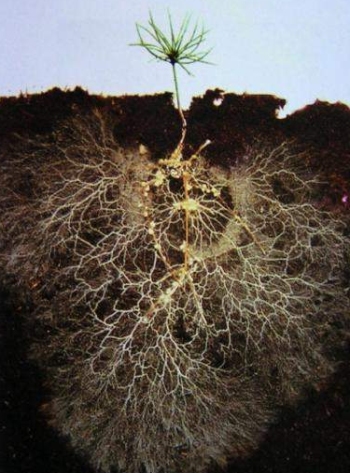
Network news: The mycorrhizal network is the backbone of local soil structure and health.
They do not appear on plans – but they determine whether plans succeed or fail.
Mycorrhizal networks are the primary mechanism by which most terrestrial plants survive and persist. When soil conditions are properly understood and managed, damaged networks can be functionally restored within two to three growing seasons – and at that point, nature resumes much of the work.
But without a functioning soil-fungal network, even carefully selected native species operate at a biological deficit. There is no universal native plant palette that works everywhere, and no drawing that can override local soil biology.
A plant community that thrives in sandy, well-drained soil on the South Shore may fail entirely in the North Shore’s compacted, clay-rich soil. Meadows designed without regard to compaction, nutrient loading or soil biology are often overtaken by aggressive species. In many cases, these outcomes are predictable before planting begins – if ecology is allowed to lead.
Every property has its own ecological niche, defined less by aesthetic intent than by how energy, water and nutrients move through the soil. Before plants are selected, soil profiles, drainage patterns compaction, sun exposure and site history must all be evaluated. Microbial and fungal communities must be assessed, and planners must determine whether ecological function needs to be rebuilt to ensure long-term success.
Expecting durable outcomes without addressing these conditions is equivalent to designing a structure without understanding the ground beneath it. But do it right, and the landscape improves with time. Root systems deepen. Soil structures improve. Water infiltration increases and maintenance demands decline.
This distinction matters as communities, institutions and homeowners invest in sustainability. Restoration that prioritizes drawings over ecology may satisfy short-term aesthetic goals but rarely delivers long-term functionality. Ecological restoration should be treated as a discipline, not a design choice.
Native plants remain a powerful restoration tool, but they cannot do the work we need without functional soils and intact ecological networks. When restoration is guided by ecological understanding rather than architectural or engineering convention, native plantings become more than symbolic gestures – they become durable, self-sustaining investments in long-term landscape health.
Environmental attorney Frank Piccininni is the co-founder and vice president of the Long Island Conservancy and the president & CEO of Spadefoot Design & Construction.