
By JACI CLEMENT //
Let’s talk about truth. Big-picture truth.
 If you only follow the headlines, you’d think the biggest crisis in our information system is that people no longer trust the news.
That’s true – but it’s not the whole truth.
What’s not making the headlines is that the Internet itself is a deeply distrusted information environment. And that matters, because nearly everything we read, watch, buy or believe now flows through platforms and feeds that were never designed to support credibility, accountability or even basic verification.
All of which is another way of saying: Just because something goes viral doesn’t mean it’s true. It doesn’t even mean it’s real.

Jaci Clement: Whole truth, and nothing but.
Trust in traditional news has declined sharply. Gallup reports that fewer than three in 10 Americans say they trust newspapers, television and radio to report the news fully and fairly – a historic low.
Here’s the under-reported part of the story: People trust the open Internet even less.
Recent surveys suggest Americans believe only about 40 percent of what they see online is accurate or even created by real people, and majorities say they trust the Internet less now than in the past – driven largely by misinformation, deepfakes and artificial intelligence-generated content.
At the same time, roughly four in 10 Americans say they actively distrust AI, even as it becomes embedded in search, social feeds and content-creation tools.
So, while people may be skeptical of journalism, they are even more skeptical of the digital environment where most information now lives. That includes journalism.
This creates a dangerous misdiagnosis. We talk about a “crisis of trust in news” as if journalism were the only institution struggling with credibility, when in reality the public is signaling something broader: They don’t trust the system that now delivers almost all information.
That goes far beyond not trusting news.
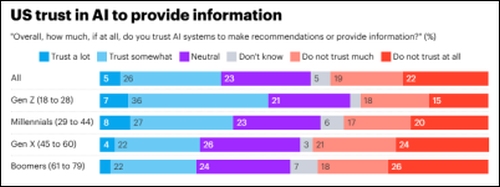
Not buying it: The American population is instinctively dubious of artificial intelligence. (Source: YouGov)
They doubt reviews.
They doubt videos.
They doubt what’s real, what’s manipulated and what’s synthetic.
By zooming out, we see that declining trust in journalism is a symptom of something much bigger.
We don’t just have a trust problem with news. We have a trust problem with the system delivering almost everything we see.
The Internet has become a place where suspicion is rational. And that changes the meaning of trust.
In the online world, our default expectation now is manipulation, which means visibility no longer equals legitimacy. (Did it ever? Perhaps we were too innocent when faced with the novelty of the Internet to truly know.)
Being everywhere online doesn’t make you more trusted – now, it simply makes you more suspect.
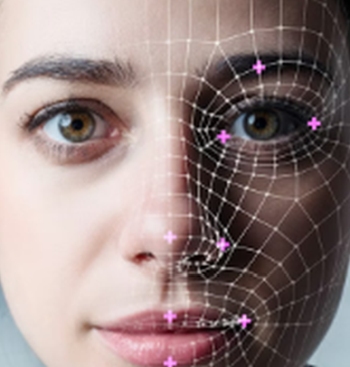
Don’t believe her eyes: Deepfakes are just one of the causes for AI concern.
For organizations that value trust, the implication is straightforward: Your credibility lives in channels you control, not inside someone else’s platform.
And for news organizations, the question is even more uncomfortable. If trust is a problem, does it make sense to lose control of your brand and build your identity inside platforms that the public already distrusts? Or is it time to re-center journalism around direct relationships, strong brands and accountable communities – not just distribution?
Ironically, while people say they distrust “the media,” they still tend to trust the specific outlets they rely on – especially local ones – more than the Internet as a whole. That suggests the problem is bigger than just journalism. It’s the environment journalism now operates in.
Technology has changed how information moves, but not what human trust requires. Trust is built through consistency, accountability, predictability, transparency and relationship. None of those are native features of algorithmic feeds.
So, while confidence in news has unquestionably eroded, the deeper reality is this: Trust in news still exists. The same can’t be said for the Internet, or what appears on it.
And that reframes the challenge ahead, doesn’t it?
Jaci Clement is the CEO and executive director of the Fair Media Council. This article was originally published by the Fair Media Council and republished with permission.