
By MARILYNN ELIE //
For Arielle Bryan and Mike Garofalo, the disconnect between groundbreaking science and commercial success is impossible to ignore.
 Brilliant biotechnology ideas often live and die inside research labs, conference rooms and investor meetings – not because the science isn’t strong, but because big scientific thinkers can’t always translate clearly why it matters.
Over years of work in diagnostics and life-sciences enterprises, Bryan and Garofalo saw this play out repeatedly: incredible innovation struggling to gain traction, because research, commercialization and communication weren’t aligned.
In response, they launched Patchogue-based MABG Consulting Group, a consultancy specializing in commercialization strategy, scientific communication and business development, specifically for biotech and diagnostics companies.
“We kept seeing incredible science that wasn’t reaching its full commercial potential,” Garofalo said. “Not because the ideas weren’t strong enough, but because the communication wasn’t aligned.
“The science exists,” he added. “The market need exists. What’s often missing is the strategy, the plan and the path connecting those worlds.”
Bryan, who holds a Ph.D. in molecular genetics and microbiology, experienced that disconnect firsthand throughout her career, repeatedly realizing that “commercial teams and science teams were often speaking completely different languages.”
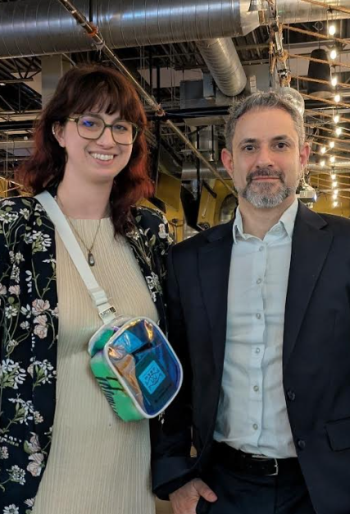
Say what: Bryan (left) and Garofalo are expert at translating complex science into meaningful messages for layman audiences.
“Researchers are talking about technical milestones and assay performance,” she told Innovate Long Island. “The customer wants to understand how this actually improves outcomes, saves time or solves a problem.
“You can have groundbreaking work, but if nobody understands why it matters or how it applies to real life, it stagnates.”
With this in mind, MABG positions itself as a strategic partner intent on helping organizations communicate highly technical science in ways investors, physicians, healthcare systems and end users can readily understand.
The entrepreneurs officially launched the company earlier this year after building long careers in adjacent biotechnology and diagnostics fields. The Long Island natives first crossed paths while working for Finland-based Medix Biochemica, a multinational biotech known for supplying antibodies, antigens and other raw materials to international in vitro diagnostics markets.
They were already intimately familiar with Long Island-based biotechnology. Bryan, who earned her PhD at Stony Brook University, logged two years as senior forensics manager at Stony Brook-based DNA-research pioneer BNB Plus Corp. (formerly Applied DNA Sciences), among other high-level scientific gigs; Garofalo’s lengthy résumé includes a long (and ever-climbing) run in the sales department at Farmingdale-based labeling and detection expert Enzo Life Sciences.
At Medix Biochemica, Garofalo interviewed Bryan for a scientific role; neither realized that conversation would eventually evolve into a business partnership rooted in innovation, progressive communication and shared values.
While both are Geminis (aligning their personalities and working styles), their divergent professional backgrounds – the scientist and the commercialization-strategy expert – complement each other and strengthen their science-communication enterprise.
“It’s been very natural from the beginning,” Garofalo said. “We approach problems differently sometimes, but ultimately with the same mindset.

Get to the point: If the science is brilliant but nobody outside the lab understands it, does it really make a sound?
“There are moments where I second-guess myself … [Bryan] is very good at reminding me to trust my instincts.”
Bryan describes the partnership as collaborative, grounded and empowering, noting that “Mike sees people’s strengths and creates space for them to lead.”
“That trust allows both of us to fully operate in what we do best,” she added.
This mutual support has proven critical as the cofounders navigate entrepreneurship for the first time.
For Bryan, building MABG represented a major shift after years of following a more traditional academic and corporate path, leaning into the “freedom to build something that aligned more with my values, creativity and working style.” For Garofalo, it was a matter of rechanneling confidence and redefining leadership skills.
“When you work for a company, there’s usually external validation attached to your work,” he noted. “Entrepreneurship is different because you have to believe in yourself before anyone else does.”
These mindsets have shaped what the cofounders describe as the company’s “human philosophy.” They firmly believe that people matter, and “we want to work with companies that genuinely care about the impact of their science and products,” Garofalo said. “Not just the bottom line.”
That same humanistic approach generally defines better science communication, according to Bryan, who points to celebrity scientists like Bill Nye The Science Guy as good examples of effective science communication.
“There’s this idea that if you’re not a scientist, you can’t understand science,” she said. “But people are capable of understanding incredibly complex concepts when they’re communicated properly. Making science accessible doesn’t mean making it less intelligent. It means making it understandable.”
This is central to MABG’s mission – and key to the future of Long Island’s biotechnology ecosystem, which according to the cofounders is bigger and bolder than what most people currently see. Long Island doesn’t yet have the visibility of larger biotech hubs like Boston and San Diego, but Bryan and Garofalo say the talent and innovation are already here.
And while the entrepreneurs plan to expand – not only into different biotech sectors, but additional geographic regions – Bryan also hopes to help young scientists see more and better opportunities to build careers here on the Island, rather than believing they must leave the region to make their mark.
“There’s too much potential here,” the geneticist said. “People don’t have to leave Long Island to succeed.”