By GREGORY ZELLER //
A new Long Island Association study examining the socioeconomic benefits of regional offshore-wind projects is generating unanimous praise from regional lawmakers – well, nearly unanimous.
 The in-depth study, released Tuesday by the LIA, finds that the South Fork Wind and Sunrise Wind offshore farms will ultimately generate more than $460 million in economic impact across Nassau and Suffolk counties during their construction and early-operations phases, ranging from 2022 to 2027 – with a recurring $20 million in annual economic impact to follow.
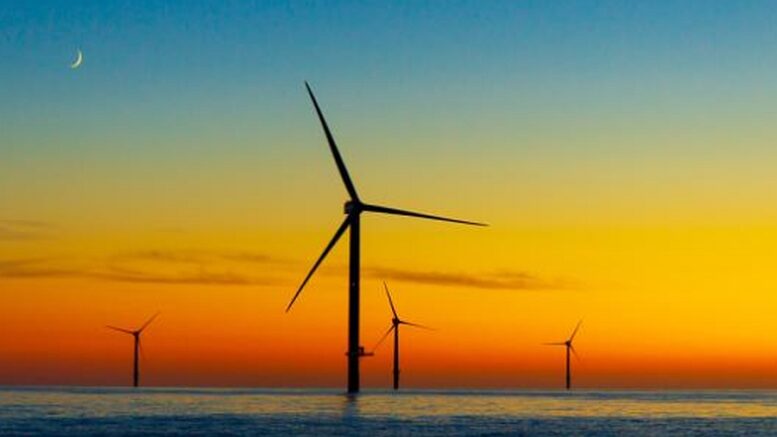
According to the study, those lofty numbers include $350 million in construction-related economic impact from Sunrise Wind – which, upon completion in 2027, is slated to produce enough electricity to power nearly 600,000 homes (the equivalent of 20 percent of Long Island’s electrical load) – and $95 million in construction-related economic impact from South Fork Wind, which became the nation’s first utility-scale offshore wind farm in 2024 and currently generates 132 megawatts of electricity (enough to power approximately 70,000 New York homes).
The estimates also factor in $20 million in economic activity generated by the construction and function of a regional Operations and Maintenance Hub rising in East Setauket.

Stacey Sikes: Future focus.
And the dual wind farms are projected to generate an additional $200 million in “host community” payments over the next quarter century – including the Town of East Hampton’s Hamlet of Wainscott, where the South Fork Wind transmission cable comes ashore, and the Town of Brookhaven’s Hamlet of Holbrook, where Sunrise Wind’s transmission system connects to a regional power grid substation.
The study – which employed an economic model created by North Carolina-based data-cruncher IMPLAN, considered the “gold standard for regional economic-impact analysis,” according to the LIA – speaks for itself, insofar as economic and environmental offshore windfalls, according to Long Island Association Acting President and CEO Stacey Sikes.
“Long Island’s future depends on having an energy system that is reliable, affordable and capable of supporting continued economic growth,” Sikes said Tuesday. “This study demonstrates that offshore wind is already delivering meaningful economic benefits for our region while contributing to a reliable energy grid.
“As demand continues to increase, these findings reinforce why the LIA has consistently supported an all-of-the-above energy strategy that expands supply, strengthens grid efficiency and positions Long Island for long-term economic success,” Sikes added. “Energy is the foundation for economic growth.”
Other regional rainmakers – including Long Island-based U.S. representatives, county and municipal officeholders, state officials and Nassau/Suffolk labor leaders, many of whom were quoted in the LIA’s official press release announcing the study – have lined up behind the report.

John Durso: Common sense, not politics.
New York State Energy Research and Development Authority President and CEO Doreen Harris applauded “the real benefits we have already seen from the construction of South Fork Wind and Sunrise Wind,” while Suffolk County Executive Edward Romaine noted that “continuing to explore alternate methods of generating energy is critical to our region’s economy.”
Patchogue-based Congressman Andrew Garabino (R-2nd Dist.), meanwhile, said the report “reinforces what we’ve known for years” – and labeled it “another clear reminder that we need to keep these offshore-wind projects moving forward.”
Town of Brookhaven Supervisor Daniel Panico, Town of East Hampton Supervisor Kathee Burke-Gonzalez, Long Island Power Authority Chief Executive Officer Carrie Meek Gallagher and Long Island Federation of Labor (AFL-CIO) President John Durso – who stressed that “we must stop letting politics derail common-sense public policy” – also cheered the LIA study.
“It is generation projects like South Fork and Sunrise Wind, coupled with transmission and distribution projects like Propel NY (Energy), that are necessary to deliver a more affordable, reliable and increasingly clean energy economy for all Long Islanders,” Durso added.
Not joining the chorus was Nassau County Executive and Republican gubernatorial candidate Bruce Blakeman, who was nowhere to be found in the Aug. 18 press release – and, despite the clear economic and environmental advantages, has railed repeatedly against New York State’s offshore-wind projects.
Taking his marching orders from President Donald Trump, an unrepentant champion of fossil fuels and unflinching enemy of renewable energy, Blakeman has repeatedly vocalized his opposition to offshore-wind, solar-energy and battery-storage projects, which he’s collectively labeled a “green scam” on the part of Gov. Kathy Hochul.
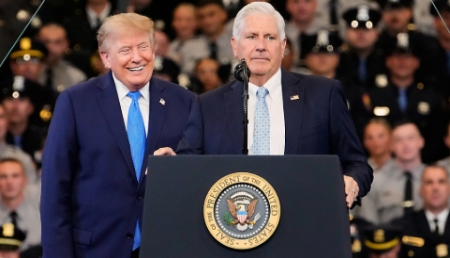
Low energy: Trump (left) and Blakeman ignored the offshore-wind elephant in the room during last week’s Nassau County campaign rally.
Sharing the stage last week for a campaign stump at Uniondale’s David Mack Center for Training and Intelligence, Trump and Blakeman carefully avoided the offshore-wind issue, instead focusing on crime rates in Nassau and across New York State. But when the Trump administration halted construction of the 810-megawatt Empire Wind 1 project in 2025 – a wonky U.S. Department of the Interior order quickly overturned by the courts – Blakeman cheered it on.
The Nassau executive called Empire Wind 1 “ill-conceived” and “a money grab,” and last year told The New York Post, “We don’t want wind turbines off Nassau. We don’t want power lines for these facilities running through Nassau.”
Despite Blakeman’s naysaying, supporters maintain that the positives highlighted in the LIA study – including the hefty job creation, the lucrative economic activity and the much-needed energy boost – are too important, and too obvious, to ignore.
“This study shows that offshore wind is producing tangible economic returns for local businesses, workers and communities while becoming an increasingly important part of a balanced, diversified energy portfolio that will help meet Long Island’s future needs,” LIA Board Chairman Lawrence Waldman said in a statement. “For Long Island to remain competitive, we must continue investing in the infrastructure that powers our economy.”