

By BRAD CARLSON //
On the heels of another fabulous U.S. Open, I find myself thinking less about baseline dropshots and more about the invisible armada of hardware quietly stripping humanity of its oldest sports pastime: screaming at the referee.
 How would Johnny Mac even make a name for himself today?
From officiating to athlete tracking, professional sports are driven by a sophisticated network of hardware and code. It’s wild to see how quickly these technologies are deploying, where they operate today and where they’ll inevitably invade next.
Imaging has decided photo-finishes in horse racing since 1881, marking the earliest documented snapshot of a nose-to-nose dash. It took more than a century for instant-replay videos to arrive in the NFL, which they finally did in 1986 – 105-year gap before admitting that a sideline ref with vintage bifocals might need a second look.
Four decades later, sports tech has evolved far beyond pointing a camcorder at the field. It’s an intricate mesh of multimodal sensors and algorithms processing high-velocity data to augment officiating, track live biomechanics and monitor conditioning.

Brad Carlson: Good sport.
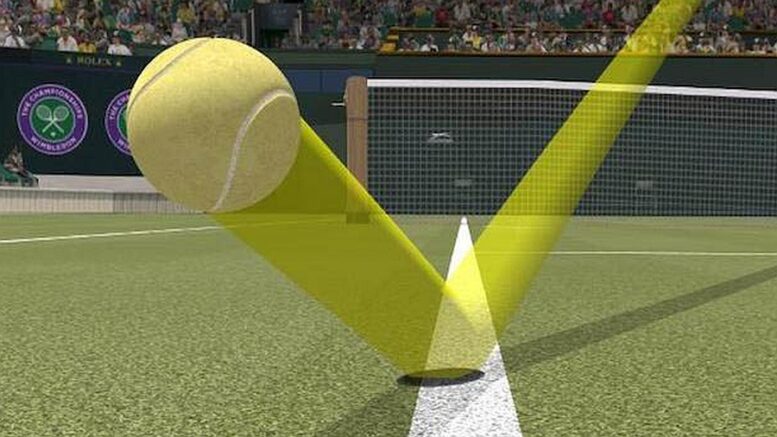
Take the Hawk-Eye electronic line-calling used at the U.S. Open. Rather than relying on simple line cameras, it deploys a dozen-plus synchronized high-speed cameras feeding a computer-vision algorithm that reconstructs a tennis ball’s trajectory through 3D space in real time. Calibrated to court dimensions, Hawk-Eye determines whether a shot caught the line with an accuracy margin of five millimeters or less.
Yet, as this year’s U.S. Open proved, even silicon has off days: Because officials failed to follow a manual-override protocol after a glitch occurred, a bad call stood.
Down at my local tennis club, we recently installed the Zenniz system. It pairs ultrasound transceivers with video cameras to automate line calls – a practical architecture delivering reliable ball-impact localization at a fraction of Hawk-Eye’s budget. Best of all, it keeps amateur matches civil.
All of this relies on sensor fusion: combining data from multiple disparate sensors to construct a single, far more accurate model of an environment than any individual sensor could provide alone.
Think of your nervous system – your eyes, ears and vestibular balance canals work together to tell your brain where your limbs are and how fast you are moving. Rely solely on your eyes, and an optical illusion sends you stumbling over a coffee table; rely only on your ears, and a sudden noise disorients you.
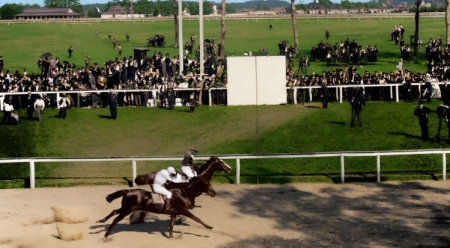
The start of finishes: Horse racing’s very first “photo finish” has been lost forever, but this famous 1890 photo shows how far back the sports technology goes.
Sensor fusion is the algorithmic equivalent for machines, synthesizing noisy data streams into coherent ground truth.
While optical imaging grabs broadcast glory, accelerometers, GPS and RFID tags do the heavy lifting under the hood. A prime example is Semi-Automated Offside Technology, tapped by FIFA’s Video Assistant Referee team. (Full disclosure: After 20 years of watching soccer, I finally understand the offside rule.)
SAOT pairs an ultra-wideband accelerometer inside the match ball with a stadium camera network tracking 29 anatomical points per player at 50 times per second. The sensor in the ball detects the microsecond of impact when a pass is struck, while synchronized optical data locks down the spatial coordinates of every limb at that identical timestamp. Fusing these streams creates a dynamic 3D rendering to adjudicate offsides down to an outstretched kneecap.
Unsurprisingly, SAOT was developed by UK-based Hawk-Eye Innovations, the same outfit behind tennis’ ELC.
Baseball is primed for a similar overhaul. Major League Baseball has spent recent seasons evaluating automated ball-strike systems, again harnessing Hawk-Eye optical arrays.

I respectfully submit that you may have erred, fine sir: Those were the days … and thanks to the advent of robotic umpires and other high-tech gadgetry, they may be over.
Calling balls and strikes from behind a crouching catcher has always been an exercise in artistic interpretation, sparking endless angst among pitchers and hitters alike. While ABS currently functions as a challenge system, it is only a matter of time before automated tracking takes over the strike zone full-time, sparing umpires from dodging 100 mph fastballs just to guess at the lower edge of the zone.
The surveillance extends directly into equipment. The NFL leverages active RFID tags engineered by Illinois-based (formerly Long Island-based) Zebra Technologies, embedded into shoulder pads to capture real-time player coordinates, speed and acceleration across the turf. The league also embeds sensors inside the game ball to record exact 3D location. This data actively assists officiating crews in determining whether the ball reached the first-down marker, slowly edging out the antique spectacle of two officials jogging onto the field with a physical chain gang.
Players also leverage biometric sensors to record heart rate for recovery, alongside load sensors registering impact forces to assess injury risks.
My employer, Intelligent Product Solutions, has engineered several multi-sensor platforms of our own, though our hardware generally assists everyday mortals, not franchise quarterbacks.
The Boogio Bionic Foot Sensor incorporates multipoint pressure arrays and six-axis motion sensing into smart shoes for virtual reality, rehabilitation and sports ergonomics. The Vardas system is an active biofeedback wristband designed for stress mitigation by tracking heart rate variability metrics in real time.
We also developed the PGS device, an ankle-worn wearable combining optical heartrate sensing with RF localization monitoring.
As sensor miniaturization, edge computing and algorithm development accelerate, we will see deeper automation across sports officiating alongside granular biometric telemetry for athletes. The net result will be fewer blown calls, faster pacing, safer players and a steady march of record-breaking performances.
The only real casualty will be the time-honored tradition of managers kicking dirt onto an umpire’s shoes – a small price to pay for five-millimeter precision.
Brad Carlson is vice president of technology and business development at Hauppauge-based Intelligent Product Solutions.





Be the first to comment on "No argument: In all sports, sensor fusion beats bad calls"