
By ALLISON SINGH //
Form a corporate entity without naming actual owners? Sure! Just file paperwork with the state, pay a fee and you’ve got yourself a corporation, no questions asked.
 The feds have been complaining for years that this lack of disclosure leads to money laundering and other ills, but states have been reluctant to require greater disclosure. Now, all that has changed.
On Jan. 1, the federal Corporate Transparency Act took effect, requiring companies to submit certain owner identity information to the U.S. Department of the Treasury’s Financial Crimes Enforcement Network.
This legislation was a rare example of Congressional bipartisanship. The bill was sponsored by former New York Rep. Carolyn Maloney (D-12th Dist.), who claimed it would “change the calculus of those who seek to hide or launder their funds through LLCs and other shell corporations.”
The new reporting requirements are directed at companies formed with a state’s secretary of state or similar state office, though there’s a long list of entities that are exempt: public companies, not-for-profit corporations, entities with more than 20 employees and $5 million in annual revenue, inactive or dormant entities and others.

Allison Singh: Owning it.
Still, estimates are that these new requirements will affect more than 32 million entities, the vast majority of which are small companies and family businesses.
Entities formed prior to Jan. 1, 2024, have until Jan. 1, 2025, to file. Those formed after Jan. 1 of this year have 90 days from the filing date to meet the reporting requirements; after Jan. 1 of next year, that deadline shortens to 30 days, with willful noncompliance leading to civil and criminal penalties.
The government is now asking for the name, birthdate and address of each “beneficial owner” of an entity, along with a copy of a government-issued identifying document (such as a driver’s license or passport). A “beneficial owner” is generally defined as one with “substantial control” of the company, or someone who owns at least 25 percent of the company, and the “Beneficial Ownership Information Report” can be completed and submitted online at no charge using the FinCEN website.
Now that the federal government has stepped in, some states have decided to act as well. In December, Gov. Kathy Hochul signed the LLC Transparency Act, creating a database of the beneficial owners of limited liability companies formed in – or qualified to do business in – New York State. The new law will not take effect for another year, but it’s on the books.
This push for transparency is not welcomed by all. Privacy of the collected information is one concern.
According to FinCen, the personal information will be kept in a secure database and not publicly available, though government officials can request access for limited purposes including national security, intelligence and law enforcement. Some financial institutions may also request access, but consent from the entity will be required before it’s granted.
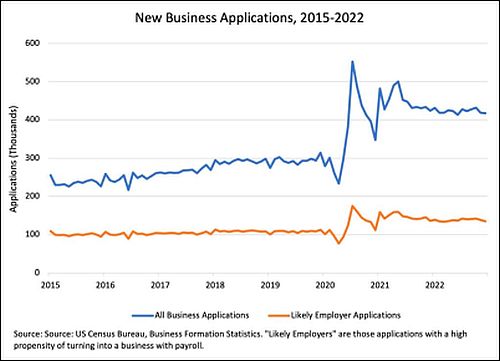
Nothing (and nowhere) to hide: New-business applications have leveled off since the pandemic — and today’s startups face a slew of transparency requirements.
Another criticism of the new reporting requirements is that disclosure could diminish foreign investment in the United States – but proponents suggest greater transparency may be seen as further strengthening the security of the American financial system, and actually encourage international investment. (For the record, Europe has already adopted similar requirements.)
Nonetheless, the National Small Business Association is challenging the new law in court, claiming that the requirements are an unconstitutional infringement on state rights.
The battle lines have been drawn. But Scott Handwerker, chairman of the Corporate Group at Twomey, Latham, Shea, Kelley, Dubin & Quartararo LLP, believes this will soon become par for the business-formation course.
“While submitting ownership information for entities already formed will be an arduous task, going forward these disclosures will be a routine part of entity formation,” Handwerker says. “And it will not require significantly more time or effort on behalf of attorneys forming entities for their clients.”
Allison Singh is of counsel and a member of the Corporate and Intellectual Property groups at Riverhead-based Twomey, Latham, Shea, Kelley, Dubin & Quartararo LLP.