

By TERRY LYNAM //
The dollar amounts are still in question, but it looks like the Biden administration and Congress will set aside significant funding this year to combat climate change and a broad range of environmental hazards making people sick and threatening their way of life.
 That’s good news, even on Long Island. While the health impacts of climate change and environmental degradation are less obvious in the Northeast than other parts of the country – regions that have been decimated by wildfires, heatwaves, hurricanes and other severe weather events – they’re a true public health emergency here, too, simmering below the surface in New York.
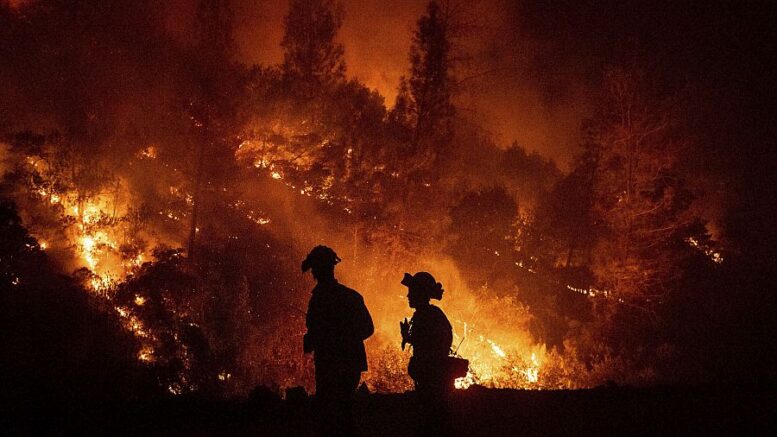
As we saw during the recent flooding caused by the remnants of Hurricane Ida, Greater New York is hardly immune from extreme-weather events. Another example: Despite thousands of miles of separation, the air we breathe is consistently affected by smoke from western wildfires, carried to the East Coast by jet streams and forcing many vulnerable people – the elderly, pregnant women, people with asthma – to stay indoors.
Meanwhile, various studies estimate that between 90,000 and 360,000 Americans die prematurely every year because of air pollution spewed from factories, coal-fueled power plants, motor vehicles and other sources, causing heart disease, strokes, lung cancer and other chronic respiratory diseases.
Air pollution, of course, ignores borders – and New Yorkers breathe in plenty of contaminants produced by other states. According to an 11-year study by researchers at the Massachusetts Institute of Technology, more than half of all premature U.S. deaths caused by poor air quality are linked to pollutants blowing in from other states. The study, published in 2020 in the journal Nature, found that New York had the nation’s highest death rate from out-of-state air pollutants, with nearly two-thirds of the state’s premature deaths attributable to contaminants produced beyond its borders.
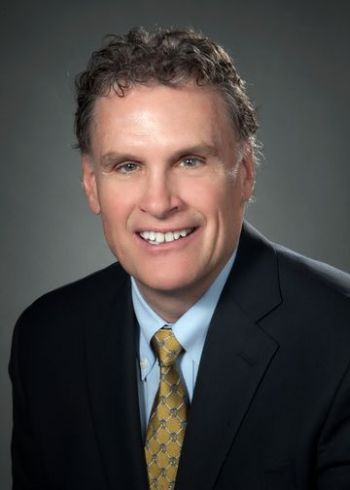
Terry Lynam: Change is in the air.
This week, the World Health Organization released its revised Air Quality Guidelines, noting that the harmful effects of air pollution kick in at lower levels than previously thought – and are as damaging as recognized health risks including smoking and fatty diets. All told, the United Nations’ health agency said worldwide exposure to air pollution causes an estimated 7 million premature deaths annually.
The numbers regarding water pollution are not much better. The U.S. Centers for Disease Control and Prevention estimates that 7.2 million Americans are sickened each year by water-borne diseases, resulting in 601,000 emergency department visits, 118,000 hospitalizations and 6,630 deaths.
These health impacts are not surprising, considering that as recently as four years ago, 22 million Americans drank water from systems that violated health and safety standards of the 1974 Safe Drinking Water Act.
A 2019 report by the New York Public Interest Research Group found that 176 state waterways, servicing nearly 16 million New Yorkers, contained at least one of 30 contaminants flagged by the U.S. Environmental Protection Agency – and Long Island, by far, had the most detections of emerging drinking-water contaminants.
As Islanders know, the most egregious example of local soil and groundwater contamination is the Grumman Plume. Beginning in the 1930s, the U.S. Navy and defense contractor Northrop Grumman used a 600-acre plot in Bethpage for manufacturing, testing and research; among the chemicals in play was a carcinogen called trichloroethylene, used to degrease military-grade engineering equipment.
In 2020, Northrop Grumman agreed to a $104 million settlement – part of a massive $406 million settlement also including the Navy, the largest in state history – to remove the plume from Long Island aquifers. By then, the plume already measured more than 4.3 miles long, 2.1 miles wide and as deep as 900 feet; it’s now estimated that while most of the plume will be removed within 25 years, full remediation could take up to a century.
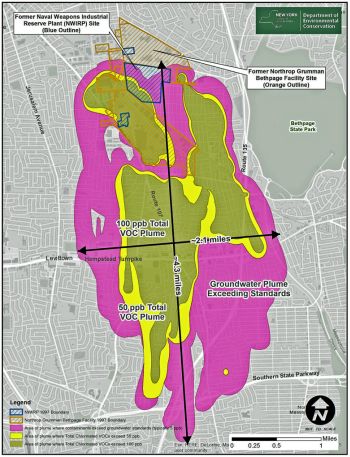
What lies beneath: Decades of denial fueled the dangerous Grumman Plume.
How the environment is shaping our health will be among the topics Northwell Health will be exploring at its inaugural Raise Health Forum, scheduled to be held virtually on Oct. 5. The three-hour event – which will also include presentations and panel discussions on women’s health and health equity – is slated to unite representatives from healthcare, industry, philanthropy, community and faith-based organizations, along with nonprofit and government organizations, all on hand to share their unique perspectives.
The connection between health equity and environmental health is particularly noteworthy in light of the Biden administration’s new Office of Climate Change and Health Equity, which will use the power of the federal government to address the environmental effects of changing weather. Health and Human Services Secretary Xavier Becerra said the goal of the new office is to treat climate change as a public-health issue, with particular focus on health risks disproportionately affecting poor and minority communities.
While climate change is a health risk for all, it’s especially dangerous to those populations, according to HHS Assistant Secretary for Health Rachel Levine.
“Unfortunately, some of the same groups disproportionately impacted by COVID-19 will be the same groups struggling the most with the effects of climate change on our health,” Levine says. “We will use the lessons learned from COVID-19 to address these disparities.”
Terry Lynam is a communications consultant and former senior vice president/chief public relations officer for Northwell Health.




Terry Lynman reminds us, once again, that here on Long Island, our environment and our economy are inextricably linked. As a new grandfather, the reality that we need to leave this place better than we found it, has become very real. Thank you, Terry, for helping to bring this issue to the fore.