
By TOM MARINER //
As I prepare to board a Long Island Rail Road train at Ronkonkoma Station for a quick journey into the city and another hot-button pharmaceutical conference, I can’t help but wonder: Why not a reverse trip for that same conference?
 Why not have it here on Long Island? Even better, how about the attendees flying into beautiful Long Island MacArthur Airport for meetings here?
It’s happening, for sure, but not enough – especially since so much time and effort has been made fortifying the region’s transportation options.
At the very center of Long Island sits the Hamlet of Ronkonkoma, part of the Town of Islip. Islip has always been a transportation innovator. Over the town’s 342 recorded years, travel has been front-and-center – and as railroad, auto and air travel have evolved, they’ve helped Islip grow into an economic-development powerhouse.
Nowhere is this more evident than at the northern edge of town-owned airport.

Tom Mariner: Traveling man.
MacArthur Airport was established in 1942 (as Islip Airport) and began service as a commercial airport in 1960, when now-defunct Alleghany Airlines became the first carrier to operate scheduled passenger flights. In 1978, it was renamed after Gen. Douglas MacArthur, and in 1997, it really took off when Southwest Airlines CEO Herb Kelleher selected MacArthur as a major hub.
Kelleher had an eye on the 1.6 million residents living within a 20-mile radius of the airport, and he was on to something. It’s had its ups and downs, but MacArthur Airport has established itself as a worthy alternative to Queens-based big brothers John F. Kennedy International Airport and LaGuardia Airport. In 2014, MacArthur even became an international airport, of sorts, with the opening of an international arrivals and U.S. Customs and Border Protection facility to service private-plane passengers, including non-U.S. citizens.
Of course, air travel wasn’t the first form of transportation to thrive here. The railroad first came to the Town of Islip in 1844; in 1883, Ronkonkoma Station was built to replace the local Lakeland Station.
Today, Ronkonkoma Station is served by the LIRR, the oldest railroad in the United States that still operates under its original name and the busiest commuter rail line system in the nation. After electrification of the line to Ronkonkoma in 1987, Islip emerged as an ideal choice for NYC commuters, a 75-minute ride straight into Penn Station.
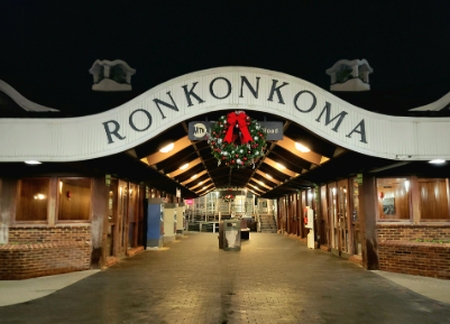
Top stop: Ronkonkoma Station is one of the busiest on the entire Long Island Rail Road.
Which brings us to the present day and current Islip Town Supervisor Angie Carpenter. The 64 previous town supervisors helped shape Islip’s identity, but Carpenter has quite possibly made the biggest socioeconomic difference, supercharging the town with energy and talent and a renewed focus on travel and economic growth.
After 22 years with Suffolk County (as a legislator and then county treasurer), Carpenter’s 10-year Islip reign has included $1 billion in capital investments and the creation of 10,000-plus local jobs, according to the supervisor herself, plus a soaring bond rating (elevated to AAA by Moody’s).
She’s also paid special attention to MacArthur Airport. To make sure the airport could execute her development plans, Carpenter grabbed current Commissioner Shelley LaRose-Arken from Republic Airport in East Farmingdale, where LaRose-Arken had worked for 17 years, including 10 as commissioner.

Angie Carpenter: Successful supervisor.
The airport-administration veteran – who literally earned her wings with commercial instrument and multi-engine licenses – has been the point guard on increasing airlines and routes passing through MacArthur Airport. Landing New York-based JetBlue Airways Corp. in 2024 was a particularly good get.
Meanwhile, other transportation/development opportunities keep coming. In 2012, the Town of Brookhaven awarded Ronkonkoma-based Tritec Real Estate Co. the contract to redevelop the area north of the LIRR station for mixed-commercial use, including 1,450 residential units.
Brookhaven Town and Suffolk County understood the trillion-dollar value of the Meetings, Incentives, Conferences and Exhibitions market, leading to designs for an industrial hub south of the train station, adjacent to the airport’s northern terminal.
In 2018, Chicago-based Jones Lang LaSalle became the master developer for what would become the $2.8 billion Midway Crossing project, which aims to transform the site with a mix of entertainment, hospitality and medical-research uses.
With Woodbury-based Cameron Engineering (now IMEG) in charge of planning and engineering, an early phase of the development included a new arena for the Islanders (they eventually built a beauty next to Belmont Racetrack). The pandemic brought fresh attention to biotechnology, and the vast market for medical and related conferences became evident, and the project migrated in that direction.
Earlier this year, citing a lack of progress, Suffolk County cut ties with JLL. But the county insists the development will proceed – with state-level involvement and no housing.
With Carpenter in the mix, you can bet that whatever shape Midway Crossing takes will be a winner. And I may yet see my dream of Long Island-based bio conferences come true – there’s no doubt many industry colleagues would appreciate the region’s beaches and wineries, and it sure is easy to get here.
Tom Mariner is the executive director of Bayport-based Long Island Bio.