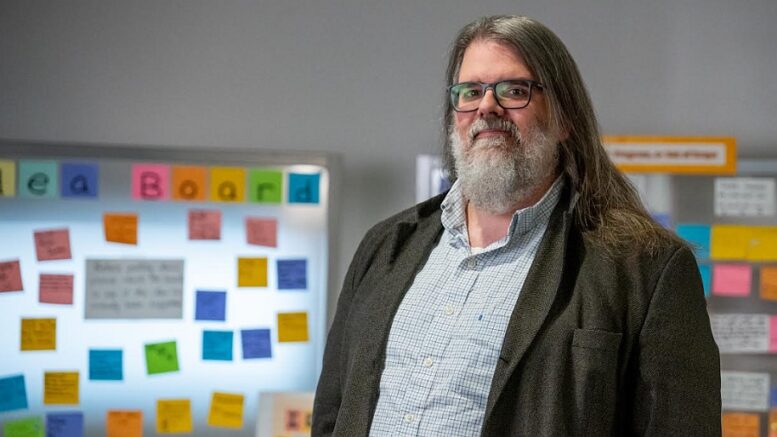
Adelphi University has many thriving hubs. Among its most active and progressive is the Adelphi University Innovation Center, a pulsating nerve-point of high-tech presentations, hands-on workshops and interactive demonstrations (with a surprisingly low-tech “heart”) that leverages cutting-edge computing and impressive faculty expertise in three critical areas (artificial intelligence, extended reality and digital studies) to supercharge creativity and empower students. It’s very much a team effort, but leading the charge is Innovation Center Director Lee Stemkoski, who earned a PhD in mathematics from Dartmouth University in 2006 and has been an Adelphi professor of mathematics and computer science ever since. The center, which opened inside the university’s Swirbul Library in 2020, is a mecca for individual achievement – but collaboration is key, according to its enthusiastic director.
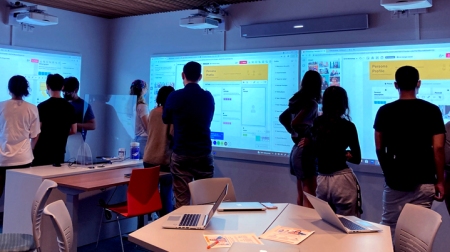
AI for all: Students, faculty and a plethora of visitors — ranging from high-schoolers to corporate leaders — work together inside the Adelphi University Innovation Center.
Game on: I’ve taught courses across the curriculum from calculus to artificial intelligence, but my specialties are computer graphics and videogame development. I’ve done consulting work and written multiple textbooks in these areas.
GPUbiquitous: One of the most exciting innovations I’ve seen in computer science is how [graphics processing unit] programming, originally designed for rendering 3D graphics quickly, has been adapted for general parallel processing tasks, paving the way for scientific computing and artificial intelligence applications.
It’s a process: Increases in processing capability have greatly expanded the scope of what students can accomplish with their own personal computers. Keeping pace with technology, the complexity of their assignments has increased as well. In a data science course, I can have students analyze real-world, context-rich datasets containing millions of records in an instant. In a computer graphics course, I can have students create interactive 3D environments with simulated physics that update in real time. Assignments like these would have been impractical just a decade ago.
De-generative: The major challenge facing college students is resisting the temptation to always turn to generative AI for quick answers. Although summarizing the contents of a text document or an audio recording of a meeting can be a time-saver, actively engaging with a task provides a depth of understanding that can’t be achieved when a result is handed to you on a silver platter. There is value in the experience of exploring, prototyping, testing, observing, refining and trying again.
Enter the nexus: The Adelphi University Innovation Center is the nexus for inspiring, supporting and showcasing innovation and interdisciplinary activities within the university and in cooperation with industry and community partners.
Bright ideas: The Idea Board is a wall of colorful Post-it notes that is the heart of the Innovation Center. Everyone visiting the center is encouraged to write down either a topic they would like to learn about, a project they would like to work on, or a suggestion for an event. The Idea Board drives the direction of the center and ensures we are staying on task: providing resources and hosting events that serve our community.
Life of its own: Most of the initiatives we pursue have originated from the Idea Board – from the topics chosen for discussion groups to the reestablishment of 3D-printing services at the university. Ideas are reviewed continuously by the staff and responses and plans for support are featured on a secondary board nearby. Over the past year, the Idea Board has also become an informational hub where people share questions, reading recommendations and even inspirational quotes.
Come one, come all: (The Innovation Center) has been providing presentations and interactive demonstrations on leading-edge topics such as artificial intelligence and virtual reality. Students can drop in to listen to a lecture, participate in a discussion or try out the technology themselves.
Faculty, too: We have supported faculty with specialized technical instruction in areas such as running large language models on local computers, recording and sharing 360 videos, and incorporating virtual reality experiences into the classroom. We also frequently create 3D-printed materials for students and faculty, such as educational manipulatives and lab equipment.
Future Panthers? Being part of a university, many of our outreach efforts are naturally centered around education. For example, we offer field trips (called “group visits”) for high school classes. They come to campus for an interactive workshop and learn about the core concepts underlying various AI algorithms. We also partner with TeenHacksLI, Long Island’s premier high school student-led hackathon, hosting their main annual event at the university.
Business card: Recently, together with Adelphi’s Willumstad School of Business, we co-sponsored an AI-themed event called “Shaping the Next Big Idea,” bringing industry professionals and advisory board members together with faculty and students for an evening of thought-provoking presentations and discussions. We’ve also met with an international educational services provider to discuss creating a holographic telepresence system in conjunction with the Brooklyn-based company Looking Glass Factory, which manufactures the only group-viewable, real-3D display screen currently on the market.
Change is gonna come: Philanthropically, together with Adelphi’s Faculty Center for Professional Excellence, we’ve been happy to host Makers Making Change, an organization that connects volunteer makers and provides instruction and support to ensure that electronic devices are accessible to people of all abilities.
AI is evolving…: We have begun to see AI applications that function as managers, identifying and delegating tasks to specialized subsystems (such as image recognition or code execution) and integrating the results into a single unified response. As systems become capable of a greater variety of tasks with increasingly reliable results, it is likely that we will see these meta-AI systems automating entire workflows.
…but still has a way to go: At this time, a major challenge for AI is generating video and 3D models. Achieving temporal consistency (for video) and spatial consistency (for 3D models) is difficult, and it is not clear if this requires new theoretical models or simply higher quality training data combined with much greater computational resources.
Holodecks, coming soon: Once these technologies have been established, we anticipate that their combination – volumetric video generation – will have a tremendous impact on virtual/extended reality systems.
Center of progress: We have a few additional research-and-development projects we’re working on, including augmented-reality software designed for simple deployment and an AI-powered avatar system. We’ll continue to use our Idea Board for communicating with our community. And we’re always looking for new partnerships and opportunities for collaboration – it’s the best way to move forward.
Interview by Gregory Zeller