By GREGORY ZELLER //
The heart-rending memorial ceremonies are over, the “never forget” reminders have ceased, the calendar moves on – and once again, the brutal and shattering terrorist attacks of 2001 recede to the corners of our collective consciousness. That is human nature.
 But for many, 9/11 never fades. And not just for the thousands of families across the nation who lost loved ones; to this day, healthcare providers continue to monitor and treat populations exposed to toxic debris on that fateful day, and many days after.
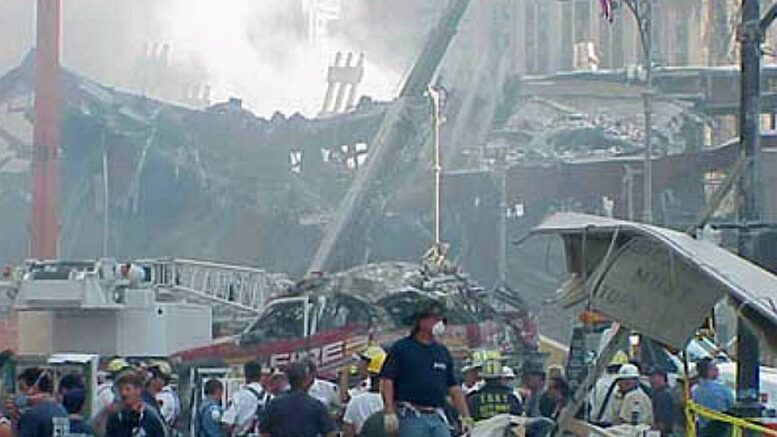
The afflicted range from direct victims of the attack to heroes who rushed into the flaming buildings to selfless volunteers, from all walks of life, who worked “The Pile” at Ground Zero for weeks afterward.
On the 20th anniversary of the nefarious attacks, patients and providers associated with Northwell Health’s Queens World Trade Center Health Program gathered in the shadow of One World Trade Center, the gleaming tower standing in stark defiance of the cowardly monsters who brought down its predecessors.
The heroes gathering there Friday also personified defiance.
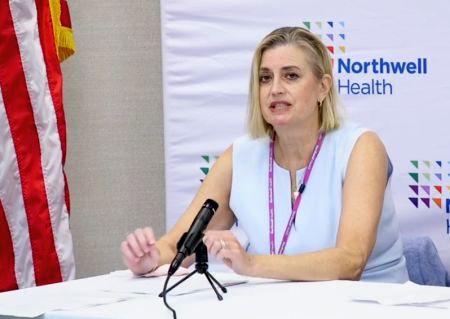
Jacqueline Moline: Still serving the victims of 9/11.
Founded in 2011, Northwell’s WTC Health Program currently treats 6,000 enrolled patients, addressing a range of serious health conditions – lung disease, asthma, gastroesophageal disease and various cancers – through thousands of annual visits. Mental health problems, including anxiety and depression, are also on the chart.
Jacqueline Moline, Northwell’s vice president of population health and director of the WTC Health Program, actually began treating patients affected by their Ground Zero exposure way back in October 2001 – a decade before the health system formalized its 9/11-related services with the WTC Health Program.
Ten years from that launch and 20 from the attacks, Moline’s research shows that efforts like the WTC Health Program provide unmistakable benefits for patients. According to the doctor, mortality rates among the 110,000 WTC patients treated by Northwell since 2011 are 28 percent lower among cancer patients and 36 percent lower overall, compared to Ground Zero populations not enrolled in the program.
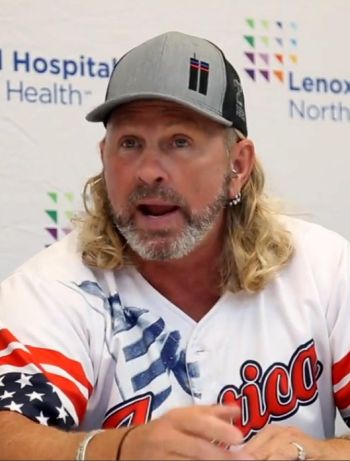
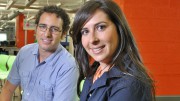
Scott Bartels: Dark memories.
Moline led an emotional Sept. 10 press conference at Northwell’s Lenox Health Greenwich Village facility in Manhattan – at once a memorial for the 9/11 attacks and a celebration of ongoing recovery efforts like the WTC Health Program.
The conference included testimonials from health system patients who survived the attacks, lost family members or worked The Pile. Some checked off multiple boxes.
Among the special guests: Rockaway Beach resident Scott Bartels, now 52, a steel welder who volunteered his professional expertise for weeks after the attacks, and came away with both post-traumatic stress disorder and a rare form of blood cancer.
“I will never forget the sounds and the smells that came off The Pile,” noted Bartels, who credited the WTC Health Program – and his service dog, Adolf – with getting him this far.
“We can never forget what happened there,” he said.
Brooklyn actress Christina Huie, 32 at the time, rushed downtown to help shortly after the planes hit, and ultimately spent two weeks volunteering with cleanup crews. Now 52, Huie – who fought off a case of COVID earlier this year – is also undergoing treatment for a blood-borne cancer, likely related to her time on The Pile.
“I believe we all have to keep fighting,” she said at the press conference. “Just never give up.”
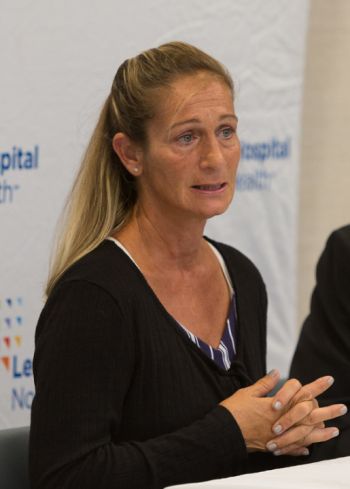
Christina Huie: Fighter.
The widow of a New York City firefighter who died responding to the attacks and subsequently volunteered on The Pile also shared her story – she’s got cancer as well – as did the FBI’s 9/11 chaplain and a Manhattan resident who credited his escape from one of the collapsing towers to a 2000 hip-replacement surgery performed by Northwell.
That surgery, a year before the attacks, allowed him to make an 83-story, 45-minute trek down a darkened World Trade Center stairwell – and rescue another man, who became his best friend, along the way.
“I remember telling Jonathan, who was not injured but in shock, that we would survive,” noted Manhattan resident Fred Eichler, now 73. “As far as I’m concerned, I wouldn’t have been able to save myself – much less Jonathan – if it weren’t for the hip-replacement surgery.”
Moline, a board-certified occupational medicine specialist and Donald and Barbara Zucker School of Medicine at Hofstra/Northwell professor, has repeatedly testified before Congress to champion support for ongoing 9/11-related medical services. On Friday, she said the heartfelt survival-and-recovery stories – and thousands more just like them – prove the benefit of the WTC Health Program and similar post-9/11 efforts.
Thousands of brave souls who rushed to the scene as the buildings fell – that, too, is human nature – are dealing now with the repercussions of that heroism. And like 9/11 itself, those heroes must not be forgotten, according to the doctor, even as the ceremonies end and the “USA!” chants fade.
“We know that these programs make a difference by providing state-of-the-art medical treatment with no out-of-pocket expenses,” Moline said. “These programs save lives.”