By GREGORY ZELLER //
Long Island drinking water has the highest concentration of the likely human carcinogen 1,4-Dioxane in the country. Fortunately, the New York State Center for Clean Water Technology is full of sand.
 And woodchips, two key ingredients in the CCWT’s plan to upgrade aging Long Island septic systems with “nitrogen-removing biofilters,” natural remedies designed to eliminate contaminants from drinking-water aquifers.
The Stony Brook University-based center revealed its plans in a paper published in February in the peer-reviewed Journal of Ecological Engineering by CCWT Director Christopher Gobler and associates. The skinny: on-site septic systems packing sand and woodchips – all-natural NRBs – that can filter nitrogen pollution and harmful chemicals out of groundwater, including 1,4-dioxane.
According to the CCWT, NRB-powered test systems installed in Massachusetts and New York removed up to 90 percent of nitrogen from wastewater – thereby keeping it out of the groundwater and protecting underground aquifers.
Further studies have showed the NRB solution can reduce 1,4-dioxane concentration in residential wastewater below New York State standards – an intriguing proposition in a region where the 1,4-dioxane concentration in groundwater is estimated to be 100 times higher than U.S. Environmental Protection Agency standards.
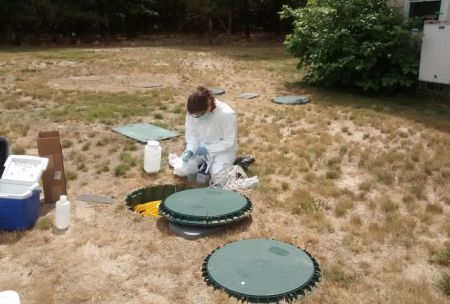
Ground level: Center for Clear Water Technology studies in Massachusetts and New York returned surprising results.
And it could be ready for residential Suffolk County installations as soon as June 2022, according to the CCWT.
“In 2015, we set a goal to develop a septic system that reduces nitrogen from wastewater to less than 10 milligrams of nitrogen per liter,” noted Gobler, the Endowed Chair of Coastal Ecology and Conservation at SBU’s School of Marine and Atmospheric Sciences and head of the university’s Gobler Laboratory. “We’re showing the world we’ve met that goal and can achieve nitrogen levels lower than any commercially available system.”
The CCWT research has also confirmed that large-scale industrial contamination – long the arch-villain of groundwater contamination – isn’t the only member of the 1,4-dioxane rogue’s gallery: Common household products like detergents and deodorants also deliver the likely human carcinogen to the groundwater, according to the center, and threaten regional aquifers.
That breakthrough finding has “important implications for protecting water supplies,” according to Gobler – and with that Summer 2022 debut in mind, CCTW scientists are hustling to turn potential into performance.

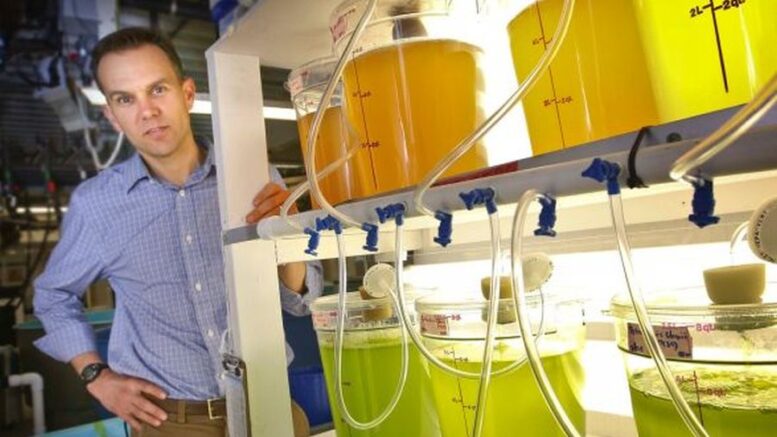
Arjun Venkatesan: Keeping busy.
There’s no doubt the NRBs make for effective filters, but all is not as easy as it sounds. The nefarious 1,4-dioxane is a stubborn out; after passing stringent new water-quality restrictions, for instance, Albany offered water utilities years’ worth of waiver time to obtain the necessary equipment.
Dennis Kelleher, chairman of the Long Island Water Conference’s Public Relations Committee, noted that “much more research will be needed to evaluate [NRBs’] long-term potential as a viable treatment technology for the future.”
“We encourage the continued research on ways to remove 1,4-dioxane from wastewater that is discharged to the groundwater,” Kelleher said in a statement. “In addition, the results of this study may also lead to new technology developments that could remove 1,4-dioxane directly from drinking water.”
The CCWT still has work to do, agreed Associate Director for Drinking Water Initiatives Arjun Venkatesan, who called the study results to date “very surprising and at the same time encouraging.”
“Our team is performing controlled experiments to understand the mechanism by which 1,4-dioxane is removed by NRBs,” Venkatesan said in a statement.
Environmentalists are also encouraged, including Citizens Campaign for the Environment Executive Director Adrienne Esposito, who led the crusade for the state’s new drinking-water standards and said the CCWT research “further validates our four-year battle to ban 1,4-dioxane from products.”
“This type of cutting-edge science will further efforts to protect drinking water and surface water from both 1,4-dioxane and nitrogen,” Esposito added. “Strong, enforceable policies based on good science is the only way we can to continue to protect our aquifer and water resources for future generations.”