By JYOTI JAISWAL //
As an Indian-born businesswoman who has lived in the United States since 1999, I always tell people how proud I am that India is my birthplace – and America is my workplace.
 Technological advancements have grown in my beloved home country since it declared its independence in 1947. The government at the time established a five-year plan to build a foundation of tech-based industries.
India’s destiny as a global powerhouse was thus tied to technology. We launched satellites, embarked on a mission to Mars and initiated an IT boom that will create an estimated $1 trillion digital economy.
Sadly, most people in India cannot afford a desktop computer, which costs on average ₹35,000 (Indian rupees), or about $440. For many, that’s more than their monthly income.
Thankfully, an affordable technology exists: smartphones. According to a recent study by Deloitte, India will soon be the world’s second-largest manufacturer of smartphones and home to 1 billion smartphone users.
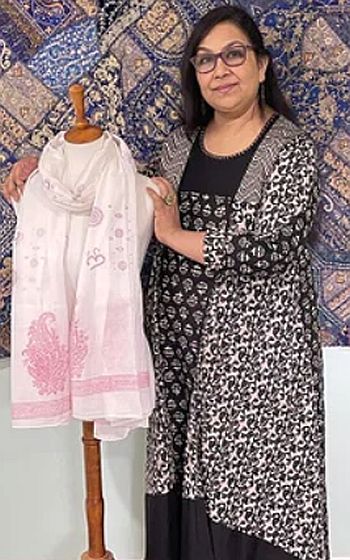
Jyoti Jaiswal: World view.
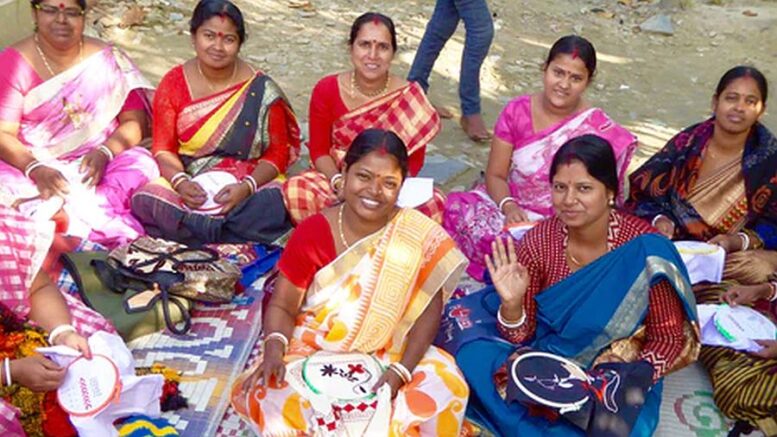
While the future of the Indian economy is now tied to tech, we still cherish traditions dating back hundreds of years – like original, handcrafted items that are sold in urban and rural markets across India. Indian artisans, mostly women, number close to 7 million, according to government estimates.
The tech explosion is now creating a massive market for one of India’s oldest traditions. In years past, Indian artisans sold their wares only as far as they could travel, whether by foot to a neighborhood market or by car to a neighboring village. This limited how much talented artisans earned and how much of the world saw their beautiful creations.
Those days are over, thanks to smartphones and social media apps like Facebook and WhatsApp, which strengthen India’s economy and help handcrafters sell wares around the globe.
I know very well about this dynamic blending of “old and new” when it comes to maximizing technology to sell handmade Indian crafts.
I am a businesswoman, but an artisan at heart. Whenever I visited family in India, I was drawn to public markets where beautiful, handcrafted works were sold – jewelry, scarves, clothing, bracelets, pendants, shawls, blankets and carpets.
When I first started my Syosset-based business in the “old days” of 2008, I would purchase handcrafted items directly from Indian markets, bring them home and re-sell them to customers in the United States. Smartphones and social media helped my business grow; Indian artisans now contact me directly using Facebook Messenger.
We also chat via video using WhatsApp, where I provide “in person” tutorials on creating designs, offer advice on pricing and ensure hardworking crafters are paid their worth.
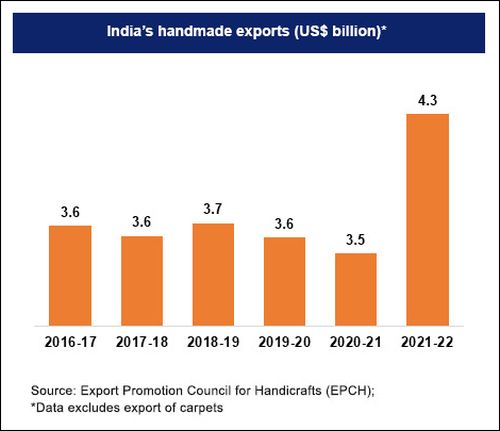
All the world’s a display rack: Indian small-business exports are skyrocketing in the digital age. (Source: India Brand Equity Foundation)
Others ship handcrafted items to our warehouse on Long Island, where I distribute them around the world.
Social media is a critically important lifeline to my business, and in turn a path to support women artists in India that struggle to feed their families, let alone sustain a profitable business on the other side of the world.
The expansion of our business and close technological ties to India also allowed us to create the Karuna (Compassion) Project, which teaches women survivors of trafficking how to become handcrafters. They learn the intricacies of block printing, stitching and jewelry making; most importantly, survivors of horrific crimes against humanity gain independence and earn a living wage.
It’s also no accident that Indian exports of handcrafted goods are estimated to be as high as $4.35 billion this year. A big part of that success is embracing older traditions and merging them with social media and advances in smartphone technology.
Yes, technological advancements have changed the upward trajectory of the overall Indian economy forever and for the better. By bridging our worlds, we strengthened our business, promoted Indian artisans, empowered women and nurtured the environment.
More small businesses should embrace this innovative model around the globe. If they do, imagine how many communities could make their little corner of the world a better place to live – just like we are doing across India and New York.
Jyoti Jaiswal is the owner of Syosset-based clothing and fabric wholesaler OmSutra.