

By SCOTT CHABINA //
As the advisory committees that comprise the New York State Climate Action Council consider public comments and deliberate on the Empire State’s clean energy future, a lesser-known product called renewable natural gas should be on the minds of decision-makers, right next to wind and solar power.
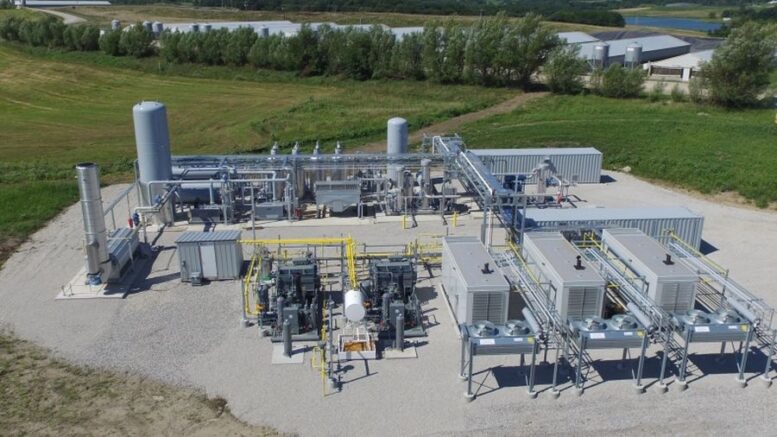
 Renewable natural gas is a resource available today that doesn’t just provide an alternative to fossil fuels, it repurposes food waste, combats harmful methane and carbon emissions, creates clean jobs and offers new economic opportunities for farms and struggling rural communities.
New York has emerged as a leader in the fight against climate change since enacting the nation’s most progressive decarbonization statute, the Climate Leadership and Community Protection Act, in 2019. To reach the law’s ambitious goals, the state must use every tool at its disposal, which means creating a technology-agnostic policy environment that will incentivize investment in facilities that transform waste into clean RNG.
The CLCPA’s pioneering framework mandates zero greenhouse-gas emissions across all sectors of the economy by 2050. To reach this goal, it outlines a process by which specialized panels will report to the recently formed Climate Action Council. Together, these committees, including advocates and stakeholders, are responsible for developing recommendations and crafting policy proposals that will lead the state down the path toward a carbon-free future.
Now that the Climate Action Council members and individual advisory panels have begun holding public hearings, they must consider the many benefits of waste-derived RNG.

Scott Chabina: Methane man.
Though “natural gas” is in the name, RNG is an environmentally friendly resource that is actually made from capturing methane that would otherwise be released into the atmosphere. Renewable natural gas is harvested from repurposed food, agricultural wastes and wastewater-treatment facilities. It also acts as an effective waste-management system – and could provide an indispensable revenue stream to Long Island and Upstate New York’s integral agricultural communities.
Without considering RNG as an immediate solution to reduce carbon emissions, New York will miss out on a crucial and readily available weapon in the battle against climate change.
Another top threat to achieving New York’s climate goals is vehicle exhaust. With multiple major cities and many highways crisscrossing the state, transportation is the single-largest air pollution source in the state, responsible for 72.75 million metric tons of greenhouse-gas emissions. It is imperative that proposals considered by the Climate Action Council substantially displace on-road diesel fuel use.
Policymakers can look to California for solutions. The Golden State has successfully implemented a Low-Carbon Fuel Standard, which focuses on replacing transportation fuels with lower-carbon renewable energy sources – including RNG derived from captured methane.
This smart policy has helped California avoid millions of metric tons of carbon emissions. If New York is to achieve its lofty carbon goals, an LCFS program must be implemented to focus on the transportation sector versus solely the power sector.
Due to the pandemic, New York also faces public-health and economic-recovery demands. Smart solutions, such as the LCFS, will provide a lifeline in uncertain times and ensure the state’s future resiliency. Implementing an LCFS will support the renewable energy sector and generate much-needed opportunity in an industry that has already created thousands of well-paying jobs.
And when offered as an option as a transportation fuel, RNG can also provide cost-savings for cash-strapped families. And this is just one application; RNG also heats homes and provides renewable power to the grid.
With so many obvious public benefits, including mitigating harmful carbon and methane emissions, it’s a no-brainer for lawmakers and the Climate Action Council to advocate for policies that will unlock RNG’s potential. Implementing the LCFS in New York is a crucial first step to ensuring this currently available, environmentally friendly and economically lucrative product attracts the level of investment it deserves.
The future depends on transitioning away from our fossil-fuel dependence. As both a renewable-fuel and innovative waste solution, RNG is uniquely positioned to be a transformational energy source to a brighter, greener New York.
Scott Chabina is a Nassau County resident and the founder and CEO of New York City-based Chabina Energy Partners.





How exciting to hear the Climate Action Council get involved with RNG. It is critical that “Governmental Policy Makers” and “Environmentalists” such as the Sierra Club become introduced to this “available now” Renewable Fuel. RNG is mixable with fossil natural gas in any proportion. There is no “over night” solution to Climate Change, but RNG is a great place to start. As a transportation fuel, it can immediately replace diesel in heavy duty trucks by converting existing Internal Combustion Engines to run on RNG rather than diesel. RNG is the only “Carbon Negative, Zero Emission Fuel.” Total Electric Vehicles can work great as cars and small trucks that have a limited daily range–especially if the car can get charged enough at “home” during the night so there is no need to charge during the day. That won’t work for over the road heavy duty trucks. Westport Fuel Systems HPDI technology is available TODAY to give “par” performance to diesel using existing Internal Combustion Engines. Diesel is the “enemy” to Climate Change, not the Internal Combustion Engine when it is converted to use a Carbon Negative, Near Zero Emission fuel like RNG or Green Hydrogen. HyGEAR has an “on site” facility that can convert RNG to Green Hydrogen at filling stations or industrial sites that use hydrogen. RNG can be produced at any identifiable organic waste site (animal waste, municipal waste, landfil gas, food or organic industirial waste by collecting the released biogas and converting it to RNG that can be directly injected into the existing natural gas pipe lines and storage infrastructure. The recently released Biostream unit by Xebec Adsorption is an “on site” unit that is premanufactured and delivered by flat bed trailer to the waste site. It is capable of performing at smaller waste sites (smaller farms) where it is not fiscally possible to use the large existing RNG production units. Besides removing diesel from transportation, RNG can also be used to produce “Renewable Electricity” from power plants that now run on fossil natural gas. The percentage of RNG in the pipeline can be increased incrementally as the volume of RNG production is ramped up with no need for a full blown replacement of infrastructure and expensive building of massive wind/solar farms that would be necessary for Total Electrification and, especially Total Electric Transportation. RNG is an efficient and effective fuel for heating homes, cooking, and all other present uses of fossil natural gas. We have only ONE chance to get it right. Total Electrification is NOT the answer.