By GREGORY ZELLER //
A decade-old technology has been re-tasked for a decidedly 21st Century mission.
 Or maybe 23rd Century: beaming doctors from one location to another, allowing a remote specialist to provide real-time, on-the-spot care as needed.
There’s no teleportation involved. Although even that doesn’t seem too far off with Vision Beyond, the new platform by New York City-based OpticSurg.
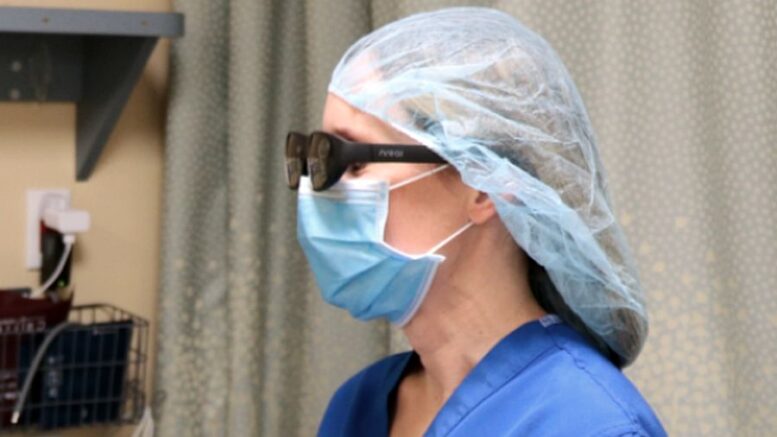
Not much bigger than your best Ray-Bans, the tech involves augmented reality-enabled goggles that transmit the wearer’s perspective and a host of real-time data, enabling healthcare providers elsewhere to lend a virtual hand.
OpticSurg brought the product to market with a boatload of help from Hauppauge-based Intelligent Product Solutions, the innovative Forward Industries subsidiary with a long list of hardware and software successes.
Pumping video and other data through head-mounted “smart” goggles is nothing new – Google Glass was doing it 10 years ago, noted IPS Software Engineering Senior Director Danny Aponte.

Danny Aponte: Seeing the future.
And so was IPS: Aponte recalled a “remote servicing” technology involving super high-powered printers – thousands of pages at a shot, maybe a dozen in existence – and “the people who were paid $450 an hour to fly all over the country to repair them.”
The solution was a head-mounted optical display shaped like a pair of glasses, putting the repair specialists right where they needed to be, from somewhere else.
The smart goggles failed “for a number of reasons,” according to Aponte, but mostly because “the world was not ready for it.”
With Vision Beyond, opportunity catches up with the technology. An augmented reality-powered telecollaboration tool for provider-to-provider communication and healthcare education is just what the doctor ordered in the Digital Age – especially with annoyances like global pandemics sporadically stymieing travel and office visits.
The concept is super-simple: Frontline healthcare workers use the Vision Beyond AR glasses to connect instantly with remote providers, who literally see what their colleague is seeing – miniature cameras transmit images every few seconds – on a computer, tablet or phone.
The specialists, team members, etc. can circle a wound, read a vital or otherwise digitally interface.
If the idea is uncomplicated, the technology powering it is anything but. Among many challenges in sprucing up the decade-old science, Aponte highlighted “real-time annotation on video” – for instance, allowing Doctor A to draw a teleprompter-like circle around something in Doctor B’s field of vision, and having it stay in perspective when Doctor B’s camera moves.
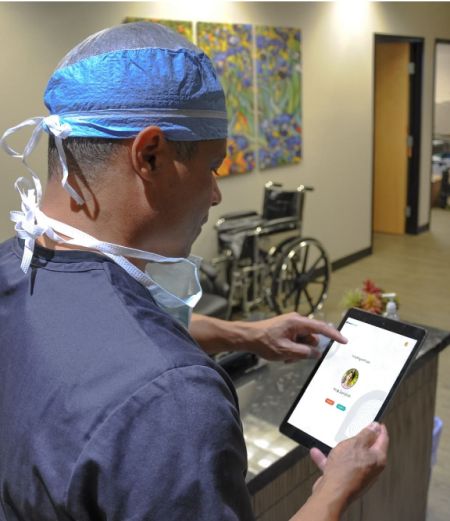
Wide receivers: Team members from just about anywhere can be on the field, virtually.
“You have to inject programmatic glyphs and keep them in place while the camera is moving around on someone’s head,” Aponte noted. “On Zoom, the camera is fixed, so you can annotate on the shared-screen portion – but here, the camera’s constantly moving.”
Intelligent Product Solutions was able to solve the problem; the senior software engineer wasn’t about to reveal the “secret sauce underneath,” though he did credit “excellent software development.”
“We innovatively collaborated with our customer and cleared the technological hurdles,” he added.
OpticSurg, meanwhile, has cleared regulatory hurdles and is offering Vision Beyond to doctor’s offices, with operating rooms in its AR sights.
“They’re going to the OR,” noted Aponte, who expects “assisted telehealth” to become exponentially more prevalent over the next five years – especially with the tech growing smaller and lighter.
That simultaneously addresses ergonomic concerns and increases processing power, according to Aponte. He even cited Moore’s Law, which notes that the number of transistors on an integrated circuit doubles about every two years – ostensibly, doubling the circuit’s capabilities.
“We’ve seen it in action,” Aponte said. “On the same piece of silicon, the number of transistors doubles every two years.
“Which means you get that much more powerful,” he added. “Eventually, it will just be a pair of glasses with microchips.”
Where Vision Beyond goes from here remains to be seen, though bringing it where it is has been “very exciting for us,” noted Intelligent Product Solutions co-founder and President Mitch Maiman.
OpticSurg and IPS met through a mutual acquaintance: Joe Desiderio, chief executive of New Hyde Park-based pathology reporting ace VoiceBrook, who met OpticSurg CEO Tran Tu Huynh and greased the skids.
That’s precisely the kind of professional networking that makes IPS a cornerstone of Long Island innovation, according to Maiman, while OpticSurg presented exactly the kind of technological challenge the Hauppauge product maker lives for.
“We were on the front lines developing some of the world’s first head-mounted computing technology,” said Maiman, who also referenced before-their-time projects from years past – including one collaboration that saw IPS designing both hardware and software for smart headset produced by Illinois-based Zebra Technologies.
“We were a bit far ahead in aspirations compared with the state of technology and market readiness,” Maiman added. “We are thrilled to see that technology is now ready to enable such applications.”