By GREGORY ZELLER //
A women-led nonprofit kelp farm is leveraging 10,000 years of knowledge to create 21st Century nitrogen-pollution solutions.
 Shinnecock Kelp Farmers, a 501(c)3 organization claiming the mantle of “first Indigenous-owned and operated kelp farm on the East Coast,” has landed a $75,000 grant from The Nature Conservancy earmarked for the expansion of a trendsetting kelp hatchery.
Make that trend-reviving: Shinnecock Kelp Farmers embraces millennia of aquafarming experience to grow kelp – large brown algae that live in cool, shallow waters close to shore – in ecologically restorative ways.
Not only does this boost water quality, underwater habitats and surrounding climates, but Shinnecock Kelp Farmers has long-term designs on environmentally friendly kelp harvests at scale, with ultimate plans for an ecologically safe alternative to conventional fertilizers.
Kelp slowly improves local water quality by absorbing nitrogen, a bane of Long Island coastal waters thanks to runoff from fertilizer-fouled groundwater and toxic septic systems.

Tela Troge: The clock is ticking.
It also helps restore biodiversity by giving little sea critters a home, and buffers coastlines against the worst storm erosion.
Launched in 2020, Shinnecock Kelp Farmers has already benefited from collaborations with “3D ocean farming” pacesetter GreenWave, Stony Brook University’s School of Marine & Atmospheric Sciences (which has made the revival of Shinnecock Bay’s decimated aquatic populations a primary mission) and the Sisters of Saint Joseph (the international religious congregation donated space for a pilot kelp hatchery at its Hampton Bays waterfront villa).
Now enter The Nature Conservancy, which is “honored to support and learn from the innovative work of the Shinnecock Kelp Farmers,” according to Bill Ulfelder, the conservancy’s New York executive director.
Not only does the burgeoning kelp farm provide real-world solutions to modern ecological problems, Ulfedler noted, but it shines a bright light on the historically brutal treatment of the Shinnecock Indian Nation, which once cultivated – and safeguarded – lands stretching from modern-day Brookhaven to the East End but is now relegated to about 1,200 acres on a Shinnecock Bay peninsula.
“It’s important to acknowledge and address past injustices inflicted on Indigenous Peoples,” Ulfelder added. “When we support and promote Indigenous-led conservation efforts like the Shinnecock Kelp Farmers, we help reduce pollution, improve water quality and promote the health and resilience of all nature, humanity included.”
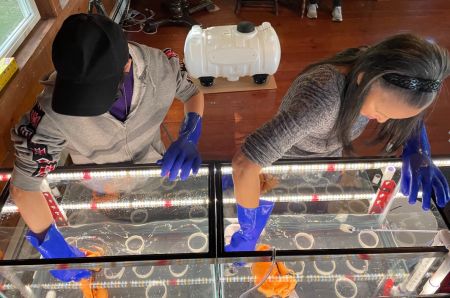
Tanks a lot: Shinnecock Kelp Farmers’ small pilot hatchery is going places.
With climate change already altering ecosystems and coastal erosion picking up speed, “urgent problems can no longer be ignored,” according to Shinnecock Kelp Farmers Director Tela Troge.
And in a world besieged by of modern problems, Troge added, it might be time for some old-school solutions.
“For years, it was projected that by 2050, our reservation would be underwater due to climate change-induced sea-level rise,” Troge noted. “That timeline has since moved up to 2040.
“When we combine traditional ecological knowledge with cutting-edge science, we see leaps and bounds in what we can do,” the kelp farmer added. “We are grateful for this support and partnership with The Nature Conservancy.
“It is a promising start for what needs to be done – considering the time that we have to do it.”