By LEE STEMKOSKI //
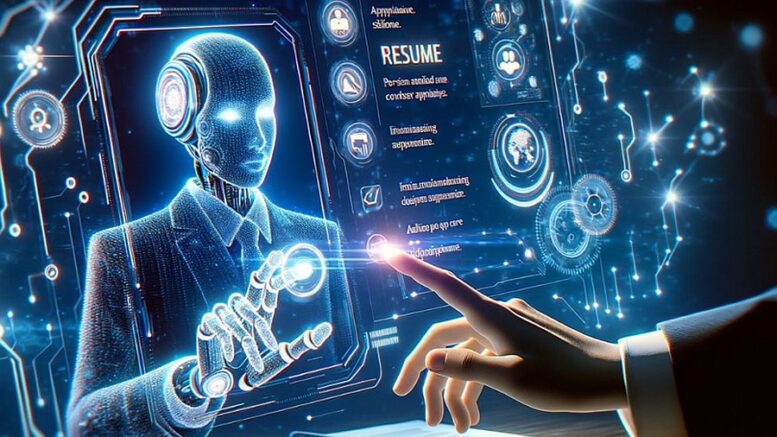
Artificial intelligence is becoming more prevalent in many areas of life – and one growing area of growing concern, at least among employers, is the use of AI during the job-search process.
 Especially during virtual job interviews: Some applicants will covertly set up an AI system to listen during the interview and supply real-time responses, which the applicants then repeat as their own.
Most employers would agree that this is an ethical problem. However, modern communications are saturated with assistive technologies – such as spelling- and grammar-checking systems – that are considered acceptable. Word-prediction technology is everywhere, from your texting app to your word-processing software.
AI use in every field – including the job-search process – exists on a spectrum, and ethical judgments may vary across industries and evolve over time. However, it’s worth examining this issue more closely, because the process of reflecting on these questions helps us understand our own expectations, values and professional norms.
Each phase of the job-search process has a purpose. A résumé provides a list of your skills and experiences. A cover letter conveys your understanding of the role, your ability to relate the role to your experiences, your motivations and your ability to communicate all of this in a clear and compelling manner. An interview demonstrates your listening skills, your ability to synthesize information in real time, your interpersonal skills and situational awareness, and your verbal communication proficiency.

Lee Stemkoski: Search rescue.
Any time applicants misrepresent themselves or subvert the purpose underlying any stage of this process, an ethical line has been crossed.
Tools such as autocorrect are considered ethically neutral because they support clarity without altering the substance of what you’re saying. They polish your expression; they don’t generate content. Using AI to organize your résumé is fine; using AI to generate responses to interviewer questions is clearly not.
And even if using AI-generated content in application materials (such as cover letters) was acceptable, it’s strategically unwise, as the results typically sound generic and flat – a predictable consequence of large language models.
There are many practical and ethical ways AI can be used during the job-search process. It can gather and summarize information about a company – although you should always use services that provide references that can be verified. It can be used to create explanations of technical concepts or glossaries of industry terms for you to reference and study, thus enhancing your actual knowledge. It can be used as a general job coach, responding to questions like “What do hiring managers look for in a cover letter” or queries tailored more specifically to your situation. It can suggest new industries suitable to your background or alternative job titles that match your abilities.
Voice-driven AI systems can be particularly valuable by providing interactive mock interviews, which offer common questions, hypothetical scenarios and constructive criticism for you to consider – improving the clarity of your responses and building confidence that will shine through in an actual interview.
However, even these practical AI uses come with drawbacks. The act of gathering and summarizing company information requires you to search effectively, assess the credibility of sources, reconcile conflicting details, weigh the relative importance of information and synthesize everything into a coherent understanding. These are valuable skills across nearly every profession, and doing this work yourself is what strengthens them.

Them’s fighting words: The sheer weight of input can weigh down content produced by a large language model.
AI may give you a temporary boost in efficiency, but over-reliance will lead to the gradual erosion of these skills. These tasks take time and effort, but that difficulty is precisely why the process has value: Actively engaging with complex issues is the only way we can develop genuine critical-thinking skills.
As AI becomes more deeply woven into the job-search process, the challenge is not simply deciding what it can do for us but deciding what we should still do for ourselves. Striking the right balance will shape our professional growth and provide an enduring foundation of skills that will remain relevant even as technology continues to evolve.
Lee Stemkoski is a professor in the Department of Mathematics and Computer Science in the Adelphi University College of Arts and Sciences and director of the Adelphi Innovation Center.