
By MICHAEL H. SAHN //
In a haunting scene from 1968’s iconic “2001: A Space Odyssey,” sentient computer HAL 9000 turns off two astronauts’ life-support systems so it can assume command of their spacecraft.
 Here in 2023, just the start of the real-life generative artificial intelligence era, the sentient computers are taking it a little slower – though machine-learning systems such as ChatGPT, Sparrow and Microsoft’s VALL-E already have impressive cognitive capabilities that allow them to make decisions, control data access, conduct surveillance and replicate human voices. To think.
There is no playbook on using AI, and the few laws regulating its use are still coming together. Perhaps AI technology cannot be fully regulated, given that it’s continually evolving itself. Perhaps the challenge is to benefit from AI while not letting it eventually govern us.
Several Long Island-based companies think so: They’re developing generative AI systems and taking AI leadership positions. Stony Brook University, Cold Spring Harbor Laboratory and Brookhaven National Laboratory each have their own comprehensive AI programs.
Heavy-hitters like Northrop Grumman are researching AI-supply systems, while Walmart is using AI to monitor real-time store shelves and predict upcoming customer demands, right here on Long Island.

Michael Sahn: Aye yai AI!
Higher up in the corporate world, executives are using AI to make human-resources decisions, predict outcomes of economic investments and access new financial services. AI promises to advance healthcare, scientific discovery, economic productivity and employment – and along the way, all kinds of bottom lines.
And while there are few laws governing AI, machine learning is also hot in the practice of law. AI systems are conducting legal research, performing due diligence and discovery, writing legal briefs – even the courts are using AI, to analyze prior briefs and arguments.
The dark side of AI, of course, is that its vast data can be manipulated. It’s difficult to know true information from false information – or intentional misinformation – conveyed by AI-generated sources.
In the wrong hands, with its amazing sense of authenticity, AI can lead to discrimination in traditional HR functions; it can create pornographic or graphically violent content in all the wrong places; it can easily invade personal privacy.
Highlighting the dangers, a recent Federal Trade Commission report warned lawmakers against using AI systems to combat online problems like bots, financial scams, media manipulation and sexual exploitation, citing concerns over discrimination, inaccuracy and “commercial surveillance creep.”
It’s a Wild West frontier for sure. Even OpenAI CEO Sam Altman recently tweeted that “It’s a mistake to be relying on [ChatGPT] for anything important right now.”
But proposed AI regulations are zeroing in on privacy, misinformation, data breaches and bias prevention.
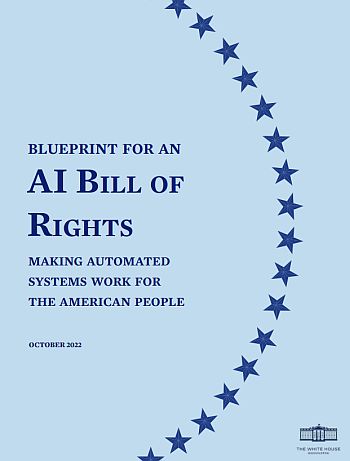
You have the rights: The 73-page AI Bill of Rights lays it all out on automated systems.
New York City adopted a law in 2021 requiring employers that use “automated employment decision tools” during the hiring process to undergo antibias audits. (The city has delayed implementing the law until this April 2023, still defining “automated employment decision tools”).
Numerous states are considering laws or resolutions addressing AI privacy issues. And in October 2022, the White House Office of Science and Technology Policy published the AI Bill of Rights, a blueprint leveraging five AI-governance principles to prevent abuses: safe and effective AI systems, algorithmic discrimination protections, data privacy, full disclosure when AI is in use and human alternatives for all AI interactions.
The challenge of regulating AI comes while the Supreme Court is deciding whether to continue shielding social media platforms like Facebook, Google and Twitter from liability of harm resulting from their content.
It all sounds bad, but the good news is that we have an opportunity to mitigate and manage AI’s risks and adverse impacts – if policymakers act promptly and thoughtfully. Collaboration among government and industry is essential.
One way or the other, the future will be driven by AI, and what we do now. In the end, will we control these incredible tools for the good of all – or will HAL finally take over?
Michael H. Sahn, Esq., is the managing member of Uniondale law firm Sahn Ward Braff Koblenz PLLC, where he concentrates on zoning and land-use planning, real estate law and transactions, and corporate, municipal and environmental law. He also represents the firm’s clients in civil litigation and appeals.