
By TERRY LYNAM //
With obesity rates surging across the nation and millions struggling with eating disorders, it’s clear that Americans have a very complicated relationship with food.
 There are many genetic, environmental, socioeconomic and behavioral factors contributing to this public health crisis, but blame also falls on many food manufacturers, who are deceiving consumers.
While some in the food industry are making legitimate efforts to reduce sugar and artificial ingredients in their products by using organic and natural alternatives, others continue to pursue manipulative advertising and other schemes to falsely promote the nutritional value of the food they’re selling, including copious use of social media influencers.
General Mills, the maker of sugar-packed cereals like Lucky Charms and Cocoa Puffs, owns more than 100 other food brands worldwide. The company has been sending representatives to conferences and events across the country promoting anti-diet research about the harmful effects of so-called “food shaming,” according to an investigation published in April by The Washington Post.
The Post’s analysis showed that the company is sponsoring or providing giveaways to dieticians who promote its cereals and snacks online (using the hashtag #DerailTheShame). Other food and beverage companies are employing similar tactics, using online influencers to promote their products and spread anti-diet messaging with such hashtags as #NoBadFoods, #FoodFreedom and #DitchTheDiet.

Terry Lynam: Feed your mind.
Perhaps even more disturbing, the Academy of Nutrition and Dietetics – a trade association overseeing dieticians and helping to shape U.S. food policy – has accepted millions of dollars in donations from multinational food companies such as Nestlé, Coca-Cola, PepsiCo, McDonald’s and Hershey, according to peer-reviewed research that examined six years of financial documents obtained through Freedom of Information requests.
This symbiotic relationship raises serious concerns about the independence of an influential policy advisor – the AND touts itself as “your trusted source of food and nutrition information” – that provides information to more than 110,000 nationwide dietitians.
Now more than ever, consumers need credible voices when it comes to the foods they should eat – and avoid.
According to the U.S. Centers for Disease Control & Prevention’s most recent data (covering 2017 to 2020), more than two out of every five American adults (41.9 percent) are considered obese, compared to 30.5 percent in 1999-2000. Among children and adolescents ages 2-19, the prevalence of obesity was 19.7 percent – or 14.7 million youths.
For adults, obesity is calculated as a body-mass index of 30 or higher. That equates to 203 pounds or more for the average-height American male (5 feet, 9 inches tall) and 174 pounds or more for the average-height female (5 feet, 4 inches). For children and adolescents, obesity is defined as a BMI at or above the 95th percentile for age and sex.
Over the past two decades, the prevalence of severe obesity among American adults – calculated as a BMI of 40 or higher, or 271 pounds or more for the average male and 240 pounds or more for the average female – nearly doubled, to 9.2 percent of the U.S. population.

Cuckoo for eating that crap: General Mills hires influencers to convince the public that sugar-packed cereals are a healthy choice.
Shaming those who are overweight or obese is certainly offensive. But the misinformation being spread by the anti-diet movement encourages people to continue down a destructive path and puts them at greater risk for many potentially deadly and debilitating conditions, including diabetes, heart disease, stroke and many types of cancer.
A 2022 study estimated that elevated body weight was responsible for nearly 500,000 “excess” deaths per year (observed deaths vs. expected deaths) and lowered life expectancy by nearly 2.4 years.
As obesity rates spike, so do eating disorders such as anorexia, binge-eating and bulimia, resulting in another 10,000-plus deaths annually – making eating disorders the second-deadliest mental illness behind opioid addiction. Researchers estimate that nearly 29 million Americans will have an eating disorder in their lifetime, with the highest prevalence among women ages 20-29.
With two-thirds of Americans saying willpower alone can’t help them lose weight (and keep it off), doctors are seeing an outpouring of requests for weight-loss drugs such as Ozempic and Wegovy. These prescriptions could potentially help millions of people, but the cost of the drugs, the willingness of insurers to pay for them, side effects and patients’ eligibilities limit their availability to many looking for a quick fix.
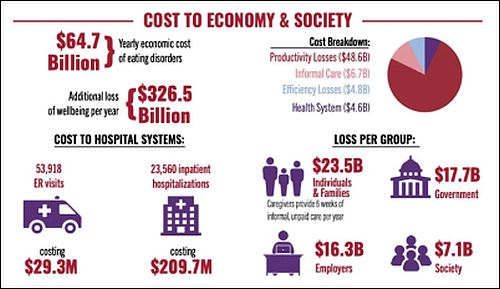
Gut punch: Eating disorders don’t only affect individual patients. (Source: Harvard T.H. Chan School of Public Health)
While medications and clinical options like bariatric surgery may be appropriate for some, America’s healthcare providers need to take a holistic approach to helping people lose weight.
Curbing the nation’s obesity epidemic also requires investments in public health initiatives that promote healthy lifestyles, especially in childhood, which could potentially modify the behaviors of future generations.
It’s also time for regulators such as the U.S. Food & Drug Administration and the Federal Trade Commission – and the professionals who advise them – to hold the food industry accountable for providing consumers with accurate information on exactly what they’re eating and drinking.
Terry Lynam is a communications consultant and former senior vice president/chief public relations officer for Northwell Health.