By DAVID A. CHAUVIN //
While working remotely, the thing I miss most from the office is our spirited discussions – favorite movies, celebrity gossip and, of course, the hilariously subjective debate of ranking athletes.
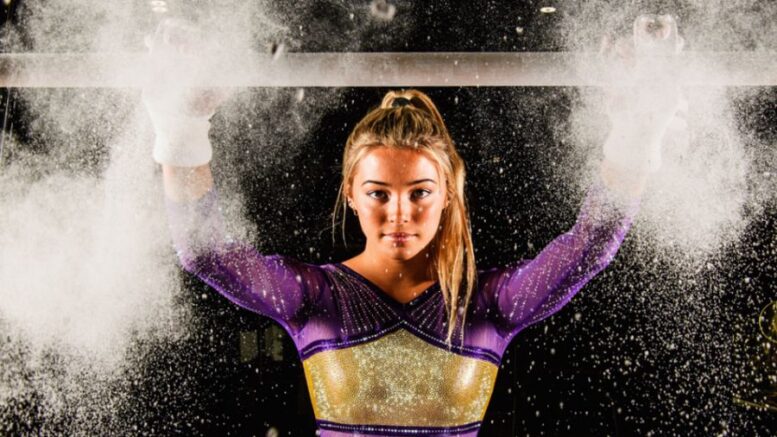
 Some days it’s Jordan vs Lebron (Jordan). Other days it’s whether Eli is a Hall of Famer (doubtlessly). When our office reopens in some capacity this fall, we’ll have to add a new name to the debate roster: a gymnast from LSU, Olivia Dunne, now ranks among the most valuable brands in all of sports.
July 1 marked the first day that, through state legislation or a National Collegiate Athletic Association waiver, every student-athlete in America can finally own his or her brand and control his or her name, image and likeness.
For decades, as college sports exploded in popularity and raked in billions of dollars, student-athletes were restricted from monetizing their celebrity in any form. The claim was that enabling college athletes to make money from being a public figure would taint their amateur status, and that the opportunity to receive athletic scholarships was compensation enough.
The hypocrisy and lunacy of this arrangement has been debated for years. Now, more than 460,000 collegiate athletes are on the market and able to vie for endorsement income – and Olivia Dunne, with her 4 million TikTok followers (@Livvy) and 1.1 million Instagram followers (@livvydunne), is at the top of the list. She’s instantly expected to be worth millions.
Social media changed the game.
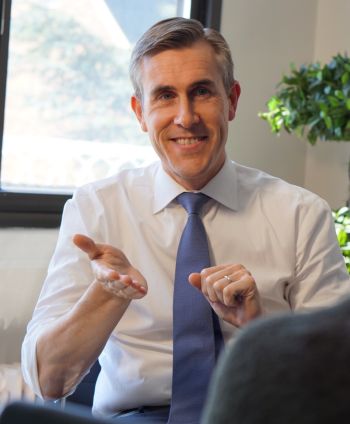
David Chauvin: Collegiate coup.
Before social media, the only people who’d have benefited from lifting name/image/likeness restrictions would be those with mass appeal – football quarterbacks and men’s basketball players. Lesser-known athletes would’ve been left in the dark, as brands would all be fighting over the handful of amateur stars.
Today, thanks to social media, the playing field is more level. In most American cities, college athletes are the biggest stars in town and will be hot commodities when it comes to endorsing the local car dealership or pizzeria. When it comes to national appeal, social media followers are just as important as touchdowns – if not more.
Consider Haley and Hanna Cavinder, twins who play basketball for Fresno State University. Their lucrative sponsorship with Boost Mobile is credited as the first signing of the NIL era, leveraging their 2.8 million-plus TikTok followers and average view counts between 400,000 and 1 million per post. Fresno State has not made the NCAA Tournament since 2014 and neither Haley nor Hanna are ranked among the top players in the game, but they are unquestionably stars of the social media show.
Beyond enriching their own personal wealth, the hope is that their deal will bring more attention to the women’s game – and their popularity will force the NCAA to close the widening gap separating men’s and women’s athletics.
In previous generations, an athlete’s performance on the field made him or her famous, and the idea was to ride the wave of endorsements and royalties. Now, athletes can use social media to build fame on their own – and bring that celebrity status to the field.
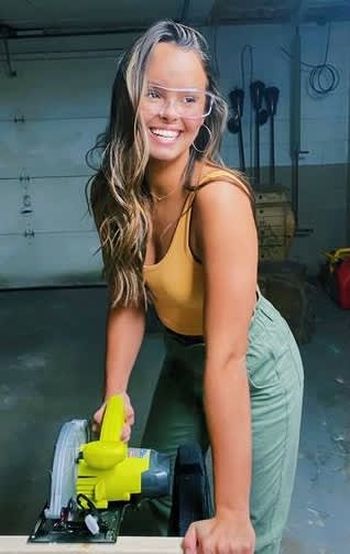
Fine line: Chloe Mitchell, building the pandemic “she-shed” that made her famous.
Chloe Mitchell, a first-year women’s volleyball player at Aquinas University in Grand Rapids, Mich., was a high school senior in 2020 when COVID closed her school and cut her volleyball season short. Like thousands of others, she used social media to document a backyard DIY pandemic project.
Unlike thousands of others, her videos went viral and her audience quickly grew to more than 2 million followers, a meteoric rise that led to partnerships with several companies, which soon sponsored her videos and asked her to promote their products on her channels. Mitchell is now credited as the first college athlete to profit from an endorsement – she promoted a set of golf clubs in an Instagram post showing off the mini-golf course she built in her parents’ house.
NIL rights mean so much more than just becoming a brand ambassador. Collegiate swimmers can now earn money in the offseason giving lessons to kids; football players who moonlight as musicians can play gigs at the local pub.
The rights also come with potentially unforeseen societal consequences, like the over-sexualization and body-image concerns of girls under 18, and the growing mental-health issues specifically tied to emphasizing the importance of a social media presence, en route to becoming a sought-after brand.
But from a simple marketing perspective, with the influencer industry estimated to be valued at nearly $15 billion by 2022, the new NIL rights make college athletes hot commodities for brand endorsement. The restrictions were in place for far too long. It seems they ended at the perfect time.
David A. Chauvin is executive vice president of ZE Creative Communications.