By GREGORY ZELLER //
With its long-awaited Artemis missions, the National Aeronautics and Space Administration is looking to return humanity to the Moon.
 Stony Brook University’s newest interstellar superstar is looking way beyond that.
The State University of New York flagship has been selected as a host institution for the NASA Hubble Fellowship Program, a joint effort of the space agency, the Maryland-based Space Telescope Science Institute and various NASA subsidiaries, including the Chandra X-Ray Center at Harvard University – centerpiece of the Smithsonian Astrophysical Observatory – and the Jet Propulsion Laboratory and Exoplanet Science Institute, both based in California.
The NHFP supports postdoctoral scientists pursuing independent research that contributes to the NASA Astrophysics Division – which houses the administration’s creation-spanning cosmic database – and deepens humanity’s understanding of the universe.
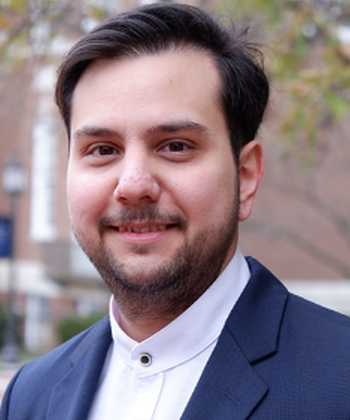
Konstantinos Kritos: Riding gravitational waves.
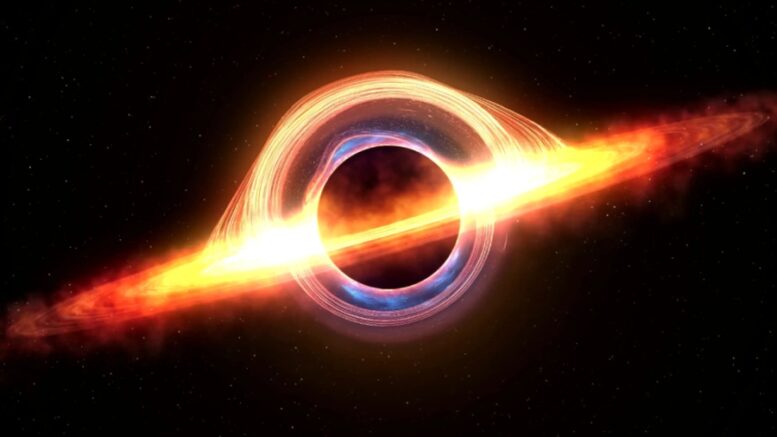
Joining the slate of 2026 fellowships is Johns Hopkins University PhD student Konstantinos Kritos, who’s got an itch for black hole cosmology – and will scratch it as SBU’s first-ever NHFP fellow, beginning in September.
Kritos, a theoretical and computational astrophysicist, focuses on the formation and evolution of black holes by studying gravitational waves and the observable signatures they create. At SBU, he will conduct a three-year research program – funded by an STScI grant – officially titled “Unveiling the Mystery of Massive Black Hole Seeds Through Gravitational and Electromagnetic Waves.”
In a nutshell, Kritos will attempt to square astrophysical theory with gravitational-wave data to better understand black hole populations and other cosmic-structure formations.
The science, needless to say, is super-thick – but it’s par for the course for the STScI, which was established in 1981 and is most famous for guiding operations of the Hubble Space Telescope.
The HST launched in 1990 and still ranks as humanity’s best-known and most productive cosmic observatory – notwithstanding the amazing James Webb Space Telescope, which launched in December 2021 and is just getting its feet wet, astronomically speaking.
The JWST is also co-managed by the STScI – as is the Nancy Grace Roman Space Telescope, NASA’s next-generation infrared observer scheduled for launch late this year or early in 2027.

Rosalba Perna: Lucky stars.
These cutting-edge tools allow researchers like Kritos – one of twenty-four 2026 Hubble fellows NASA introduced Wednesday – to clarify humanity’s future by traveling backward in time, glimpsing light particles that have been traveling through space for millions, even billions of years.
“The 2026 class of the NASA Hubble Fellowship Program is comprised of outstanding astrophysics researchers who will advance NASA’s pursuit of big questions about how the universe works, how it evolved over time and whether we’re alone in it,” NASA Astrophysics Division Director Shawn Domagal-Goldman said in a statement. “Through their compelling research, and by sharing the products of that work with the broader community, this year’s fellows will once again play an important role in creating our future and in inspiring future generations of students to be a part of that future.
“These scientists across the country will enhance the impact of U.S. academic institutions and will further American leadership in space-based astrophysics research.”
Rosalba Perna, a professor in SBU’s Department of Physics and Astronomy and Kritos’ Stony Brook faculty contact, said the university should thank its lucky stars that the PhD candidate and the NHFP selected Stony Brook for an exciting Hubble fellowship.
“I am delighted that Kostantinos Kritos has chosen Stony Brook University as the place to conduct their research supported by the NASA Hubble Fellowship,” Perna said. “I am looking forward to several years of exciting collaborative research on a variety of timely topics in theoretical astrophysics.”