By MICHAEL H. SAHN //
It’s time to adopt new laws that address the plague of drunk driving on Long Island roads.
 Almost every day, there are impaired-driving reports, DWI accidents, more carnage. The National Highway Traffic Safety Administration reports that 37 people die every day in the United States in drunk-driving-related automobile accidents, while here in New York, roughly one-third of all vehicular crash-related fatalities involve drunk drivers.
In 2019, there were 307 alcohol-impaired driving fatalities across the state –with 21 of those victims under the age of 21.
On Long Island, it’s all too common. A tragic May 3 accident that killed two Roslyn Middle School students was allegedly caused by a 34-year-old driver with a Blood Alcohol Content more than twice the legal limit and cocaine in his system, speeding south in the northbound lanes on North Broadway.
Michael Sahn: Enough stalling on tougher DWI laws.
Christie Azzolini – whose fiancé, Kings Park teacher Anthony Mariano, was killed in a wrong-way crash on the Sunken Meadow Parkway in 2020 – bluntly told reporters “the penalties for drunk driving need to be increased” after the man responsible pleaded guilty to a host of DWI charges, including aggravated vehicular manslaughter. He also lost his legs in the crash.
The NHTSA and Mothers Against Drunk Driving agree with Azzolini. Both organizations advocate for lowering the criminal threshold for a DWI charge – currently .08 percent in every state but Utah, the first state to make it illegal to drive with a Blood Alcohol Content level of .05 percent.
Utah’s 2019 action had an immediate and positive impact. Despite protests from Utah’s restaurant and hospitality industries, Utah’s fatal crash rate dropped by nearly 20 percent – without negative impacts on the tourism economy.
Australia, France, Italy and dozens of other countries have already set a .05 percent-or-lower BAC standard.
Albany lawmakers are listening. New York is one of a handful of states considering proposed legislation to lower the BAC threshold for a DWI charge.
In New York, a BAC between .05 percent and .08 percent is currently considered “driving with ability impaired,” or DUI, carrying more lenient punishments than a “driving while intoxicated” offense. A New York DWI convict currently faces a mandatory fine of $2,500, up to one year in jail and a driver’s license revocation, while the most egregious DWI-related charge – aggravated vehicular homicide, involving a fatality – currently requires a BAC exceeding .18 percent.
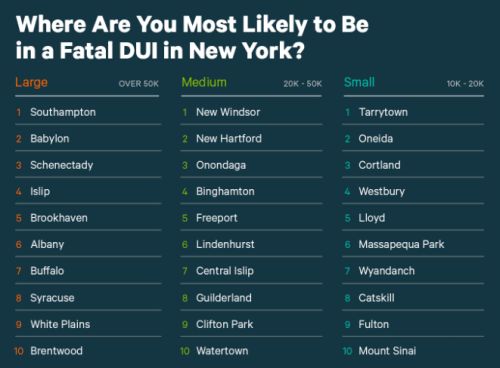
(Source: ValuePenguin by LendingTree)
State Sen. John Liu (D-Bayside) and State Assemblywoman Jo Anne Simon (D-52nd Dist.) officially proposed lowering those triggers in February. Under their proposed law, DWI penalties would remain the same, straight up to aggravated vehicular homicide, a Class B felony carrying a maximum sentence of 25 years in prison.
But the DWI trigger would be lowered statewide to a BAC of .05 percent and the BAC to trigger an aggravated vehicular homicide charge would be lowered to .15 percent.
The proposal is not without controversy. Opposition to the change claims that lowering the legal limit from to .05 percent inches toward zero-tolerance laws and will have negative economic impacts on bars and restaurants.
But precedent suggests change is coming. New York has already enacted the Child Passenger Protection Act, known as “Leandra’s Law,” making it an automatic felony to drive while intoxicated or impaired by drugs with any passenger under 16.
 Meanwhile, organizations like Responsibility.org are pushing for significant legal and technological innovations targeting drunk driving, including breath- and touch-based BAC-testing systems installed in new vehicles and high-visibility law-enforcement programs.
Only time will tell if New York becomes the second U.S. state to lower the legal BAC limit permitted to operate a vehicle – and whether similar laws regarding driving when impaired by drugs follow suit.
The upward trend of drunk driving-related fatalities in recent years should serve as the catalyst. We need to deter people from getting behind the wheel after consuming alcohol – but without a full-fledged call to action, the number of deaths and fatal accidents will only grow.
Michael H. Sahn, Esq., is the managing member of Uniondale law firm Sahn Ward Braff Koblenz PLLCay, where he concentrates on zoning and land-use planning, real estate law and transactions, and corporate, municipal and environmental law. He also represents the firm’s clients in civil litigation and appeals.