By GREGORY ZELLER //
The one-eyed man may be king in the land of the blind, but in a mecca of 21st Century innovation, he’s kinda screwed.
 Dutch Renaissance humanist Desiderius Erasmus, in his circa-1500 collection of classical Greek and Roman proverbs “Adagia,” had his eye on the ball: “In regione caecorum rex est luscus,” original Latin and everything, advising how relative superiority – even flawed superiority – confers power.
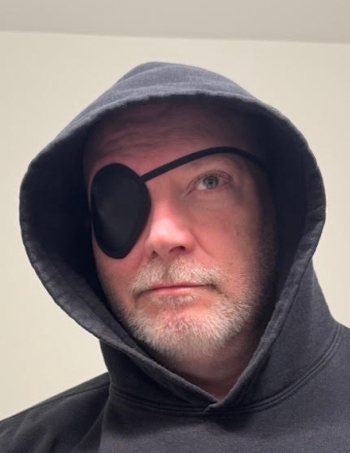
Since undergoing a radical vitrectomy on Dec. 8, I’ve enjoyed an inside perspective on this particular adage, with plenty of opportunity to consider it. The familiar “one-eyed man” phrase has been invoked repeatedly by well-wishers, second only to pirate jokes – an involuntary response, apparently, to seeing someone in an eye patch.
Naturally, I don’t wanna be a pirate. But I understand the visceral reactions to the patch and the rehashing of whatever ancient Roman Erasmus was quoting. It all comes from the same compassionate place. Folks are just being nice, and I’ll never complain about that.
However, in considering the quote – as a one-eyed man, specifically – I realize it’s shortsighted.
Long Island, America and the world are not a land of the blind. In fact, Earth’s eyesight has never been better: The past and the present and even the future, to some extent, are all right there, on our screens, in our hands.
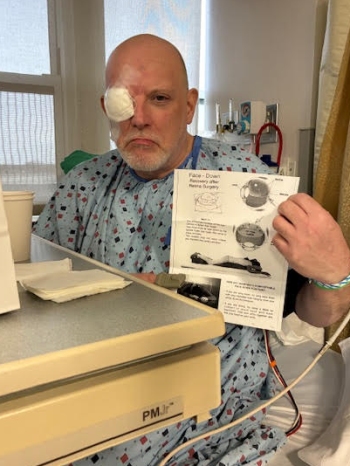
Gregory Zeller: Post-op pouting.
What we do with this gift of sight, that’s less certain; regarding the lessons of history and the disturbing realities around us, selective blindness clearly abounds. But everything we need to know to be educated, to be correct and to be right – not always the same thing – is right there, in 20/20 high definition, for all to see.
When they can.
Five short decades ago, when I was just a Baby Z, a detached retina was a much more devastating diagnosis. Public knowledge was lacking and today’s familiar warning signs (flashers, floaters) were largely ignored. Treatments (inconsistent “buckling” surgeries, newfangled cryotherapy treatments) were limited in availability and effectiveness. Bandages, bedrest and faith that the retina would somehow reattach itself were the most common prescription.
Irreversible vision loss – including total blindness in the affected eye – was not uncommon.
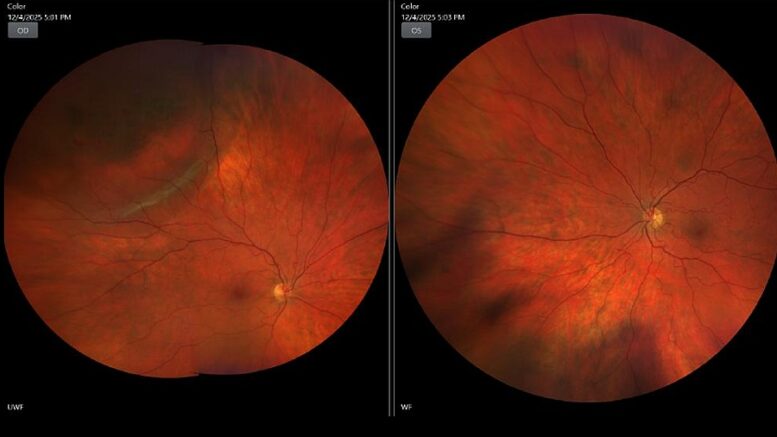
Modern vitrectomy science is mindbogglingly advanced, and fast. Within an hour of reporting blotchy flashes to my optometrist, I’d undergone a cutting-edge on-site examination, consulted with a retina specialist and booked a surgery at Syosset Hospital.
In a nutshell, the surgical team would remove my vitreous humor, a clear-gel substance that fills the back of the eye and keeps the organ shaped right and transmitting light correctly. How my vitreous humor was corrupted is unknown, though science understands this is common among nearsighted men in their 50s and also hereditary – and yep, back in the day, Mama Z also suffered a detached retina.
I’d get some twilight sedation, take a short nap while they injected my eyeball with a numbing agent and be awake for the procedure. As Mrs. Z will readily tell you, I’m a Nervous Nellie by nature, so you can imagine my delight – but they must’ve been pre-gaming something else through that IV, because I was actually pretty OK as we rolled into the operating theater.
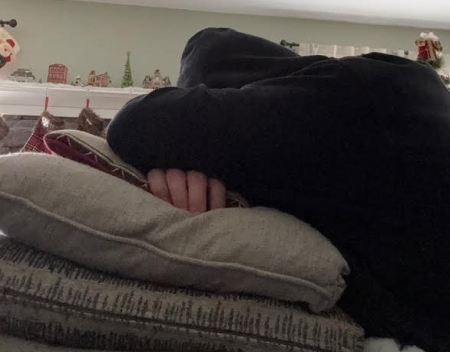
Downward dog: While the surgical response has innovated significantly, the recovery process has not kept pace.
It was bright and freezing in the OR. Christmas carols jingled somewhere. The masked team locked the gurney and tucked me in tight. I was unnaturally calm and quite conversational – “So,” I said to the nearest nurse, “everyone knows it’s the left foot?” – and grooving to Bing Crosby.
Finally, I summoned the courage to ask, “So, when do I get this needle in my eye?”
“Yeah,” the nurse said, “that happened already.”
From there … well, it was a psychedelic trip, man. The surgeon would make a series of 1-millimeter incisions in the sclera (the white of my eye), insert a cutting/suction device to suck out the vitreous, repair the damaged retina with forceps and lasers and implant a tiny gas bubble to hold the retina in place while it healed, finishing with the first-ever stitches of my life.
All righty. But here’s something they leave out of the Radical Vitrectomy and You pamphlet (perhaps because it’s so obvious): Your eye is propped open throughout the procedure.
Yes, Johnny, not only do you get to hear the snipping and sucking (interspliced with “Baby, It’s Cold Outside”), you get to see it all happening in real time: the grasping forceps (suddenly huge), the pointy silhouette of the powered “cutter,” the burning green laser dots, all set against a wackadoo backdrop recalling the last 20 minutes of Kubrick’s “2001: A Space Odyssey” – incoherent flares, wet blotches, inverted colors.
Therapists will make a fortune over the next decade documenting my PTSD. But the invasive and utterly innovative surgery – beyond imagination just a few short years ago – appeared to go well.
 The recovery … that’s been another story.
For seven full days, I was on “couch potato duty,” as the surgeon put it: Face-down for 23 hours a day, on the sofa or in a rented chair somehow built for both deep-tissue massages and medieval interrogations. I could rise to bathe, eat or take a constitutional, and that’s it. No reading, no writing, no Internet scrolling or online chess. Movies were OK, so we uploaded some apps and wedged my phone between pillows, inches from my good eye, which was watery and mostly swollen shut.
Seven days of this. It was unbearable after seven hours.
This led to all that inner dialogue and my Erasmus review and the conclusion that unless he’s lucky enough to land in a land of the blind, the one-eyed man is fairly useless – the one-eyed man, and everyone else removed from our modern technosphere.
The truth of this cold-turkey abstinence hit hard.
I’m a journalist and a news aggregator and a good chunk of my job is reading the day’s breaking news (from multiple perspectives), reviewing old stories, researching scientific facts … cutting off my feeds was, predictably, like cutting off a limb.
But I was stunned to realize how much I habitually travel other digital avenues: instantly accessing loved ones, posting pictures and rants on social media, gaining knowledge on the fly, taking immediate pleasures in baseball statistics and Wordle … these daily routines, all unimaginable those same 50 years ago, are undeniably part of me now.
Staying focused: You can’t keep a good innovation-news website down … back and better than ever in 2026.
Clancy, the great old salt, takes frequent trips to Ireland and never brings his laptop. It’s always tough for a few days, he says – for people who research and write all day, the withdrawal is real.
But then that all goes away, Clancy adds, “and I can breathe.”
I wish this was my experience, too – that after the first couple of days, I didn’t miss the cleansing rage of Trump doomscrolling or the human tragedy of Rob Reiner or the pure joy of texting my son about the Mets.
I wish it got easier to get along without all those digital things – these things we all do now, every day – but it just got harder. And when Day Eight dawned and my couch-potato restrictions lifted, I couldn’t rejoin the grid fast enough.
Limited, of course, in the amount of reading and writing I could do – this facacta eye will take a month or longer to heal – but so relieved to be vertical again, and so damned eager to get to it.
A half-century ago, a detached retina would’ve been the end for my right eye. Decades of innovation wrought the modern surgery that fixed it and the arduous recovery that followed. Both were uncomfortable and restrictive. But they’re a fix and a recovery nonetheless.
This life we lead, with the screens and the endless information and the unparalleled connectivity, is also remarkable – in so many ways, better than what we had 50 years ago. But as is often the case with innovation, it comes with a price.
Gregory Zeller is the editor, publisher and COO of Innovate News Service.