By FRANK PICCININNI //
Across Long Island, we have a quiet regulatory failure hiding in plain sight.
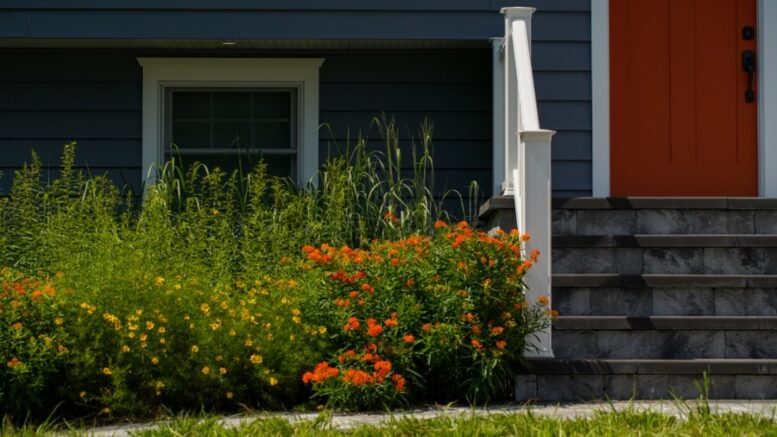
 Municipal codes still treat ecology like neglect. If you let a lawn become something functional – something that supports pollinators, infiltrates water and rebuilds soil – you can get cited. Not because it’s unsafe. Not because it’s unmanaged. But because it doesn’t look like a mowed monoculture.
At the same time, those very municipalities are under legal obligation to improve water quality and reduce stormwater impacts.
That’s not just ironic. It’s a system working against itself.
A conventional lawn is not neutral. It’s a high-input, low-function system – shallow roots, compacted soils, rapid runoff. From a hydrologic standpoint, it behaves more like a hard surface than a living system.
Native plant communities do the opposite. They slow down water, increase infiltration, retain nutrients and support the insects that everything else in the food web depends on.

Frank Piccininni: Code talker.
Nearly 90 percent of native insects require specific host plants to complete their life cycles. Remove those plants, and the system unravels – birds decline, ecosystems simplify and invasive species take over.
On Long Island, where all drinking water comes from an aquifer, this isn’t abstract. What we plant directly affects what we drink. Native systems hold water. Turf sheds it. That difference matters.
Here’s the part that should be driving policy – but usually doesn’t.
The State Pollutant Discharge Elimination System is New York’s implementation of the federal Clean Water Act. It regulates how pollutants, especially stormwater, move off the landscape and into our waterways. Municipalities operate under MS4 permits that require them to reduce runoff, nitrogen loading and pollutant discharge to the maximum extent practicable.
That mandate is not theoretical. It’s enforceable. And it’s getting harder to meet.
Now put those two things together. Municipalities are required to reduce stormwater impacts – meaning they need more infiltration, more nutrient retention and more biologically active landscapes. But they are still enforcing property maintenance codes that penalize exactly those conditions.
So in practice, you get this: A homeowner installs a native landscape designed to absorb and treat stormwater, then the municipality shows up and calls it “overgrown.” That’s not a gray area. That’s a direct conflict.
Municipalities will tell you SPDES is an unfunded mandate, and they’re not wrong. But then they turn around and suppress the most cost-effective, scalable solution available to them: private land managed as functional green infrastructure.
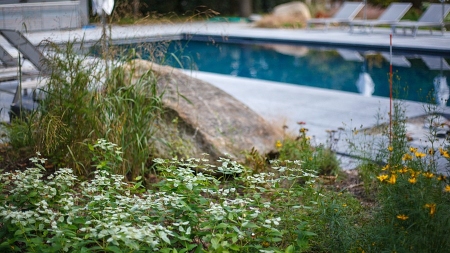
Better approach: A smarter set of municipal landscaping codes would distinguish between neglect and intentional ecological management.
They are, quite literally, enforcing against their own compliance pathway.
We don’t lack knowledge. We lack alignment.
Most local codes still rely on vague “failure to maintain” standards built around appearance – short, uniform turf as the baseline. Anything outside that gets flagged, regardless of ecological function.
So intention doesn’t matter. Outcomes don’t matter. Appearance does. And that’s where the system breaks.
And the inconsistency is hard to ignore. A chemically dependent lawn – propped up with fertilizers, herbicides and irrigation – is considered “maintained,” even when it’s dotted with those bright yellow pesticide warning flags telling people to keep off the grass.
That’s acceptable. That’s the standard. But a functioning landscape – one that filters water, supports habitat and reduces inputs – is labeled “unsightly.”
We’ve normalized toxicity as order and mislabeled ecology as neglect.
Spadefoot Design & Construction developed a model code to close that gap – by distinguishing between neglect and intentional ecological management in a way that’s actually enforceable. It doesn’t lower standards. It clarifies them.
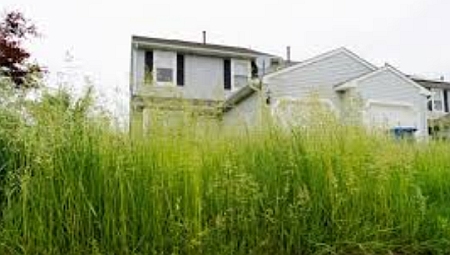
Wild thing: No one is advocating for this … “native” does not mean “unconstrained.”
Landscapes must have defined edges and transitions that signal intent. Invasive species must be actively controlled. Sightlines and safety zones are maintained. Height is regulated where it matters, like front yards and roadways. Stormwater function is explicitly recognized. Sanitation and order are required, not optional.
It also fixes a major blind spot: allowing leaf litter and organic material to remain in place, because that’s how soil systems actually work. And most importantly, it establishes a clear enforcement standard: If a property meets these criteria, it is not in violation.
That’s what turns policy into something usable in the field.
This isn’t about letting properties “go wild.” It’s about recognizing that a managed native landscape is not neglect – it’s infrastructure. Decentralized, low-cost, biologically active infrastructure.
If municipalities are serious about meeting their MS4 obligations, then this has to count. Not as a fringe practice. Not as a pilot program. As part of the system.
Because what we have now doesn’t scale. You cannot meet water quality targets while regulating against the processes that produce them.
The science is clear. The legal pathway exists. The tools are already built. What’s missing is the willingness to update the code.
Municipalities can continue enforcing a visual standard that undermines ecological function, or they can align their regulations with the outcomes they are legally required to achieve.
Protecting pollinators, improving water quality and maintaining neighborhood character are not competing interests. But we have to stop pretending that a mowed lawn is the baseline for all three.
It isn’t. And the longer we regulate as if it is, the further we drift from both ecological reality and regulatory compliance.
Environmental attorney Frank Piccininni is the co-founder and vice president of the Long Island Conservancy and the president & CEO of Spadefoot Design & Construction.