By GREGORY ZELLER //
A public poll circulated by Long Island’s top media watchdog reveals a striking contradiction among regional news consumers, who deeply value professional journalism – but don’t necessarily trust it.
 That’s the disheartening headline from a new survey released last week by the Fair Media Council, the Huntington-based 501(C)3 nonprofit banging a perpetual drum for media accountability.
Titled “The Role of News in Democracy,” the survey quantifies news-consumer opinions on the importance of journalism – not the cacophony of half-baked factoids and personal opinions bombarding our social media feeds, but the sweat- and blood- and ink-stained truths that, once upon our time, gave our republic everything it needed to stay informed and keep national influencers, particularly politicians and powerful business magnates, in check.
Conducted between the last two months of 2025 and the first two of 2026, the survey opens with a reassuring nod to tradition: Nearly 70 percent of respondents still consider news media “very important” in their everyday lives.

Jaci Clement: The system is broken.
But the numbers and opinions grow darker from there.
Roughly three-quarters of respondents – 170 Long Island/Greater New York residents “skewed toward higher education levels,” according to the FMC – said they believe the American democracy has “grown weaker” in recent years. And the lion’s share places the blame for that decline squarely at journalism’s feet.
Two-thirds of respondents described the news media as “weaker” than they’ve been in the past – and nearly 16 percent said news media have lost their sense of “purpose.”
The survey results speak for themselves, according to Fair Media Council CEO and Executive Director Jaci Clement, who suggested that “newsrooms need to get honest with themselves.”
“The surprise – even to me – is how clear the public signals are for not only what they want in news, but how highly they value journalism,” Clement told Innovate Long Island. “Good journalism – not social media masquerading as journalism.”
The lingering value of good journalism is evident in the overwhelming majority of respondents who claimed credibility, not ideology, determines their trust level. A whopping 90 percent said “accuracy” is what they want most from their news reporting, while roughly 70 percent said the quality of a news outlet’s sources is more important than whether the coverage aligns with their personal beliefs.
A further 85 percent of regional news consumers said fairness matters most to them, while 84 percent said they believe a journalist’s role is simply to report facts – sans advocacy, persuasion or opinion.
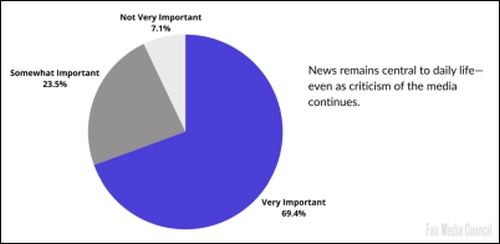
News matters: Real journalism is still important to survey respondents, who are largely disappointed with the current state of the national news media. (Source: Fair Media Council)
Also suggesting that logic still plays a role in 21st Century America is the solid 72 percent of regional respondents who claimed they choose the news outlets that best make sense of important issues – not the outlets that share their values or feature familiar personalities.
“Bias,” meanwhile, ranked as the No. 1 reason why respondents stop following certain news outlets (outweighing even “factual inaccuracies”), while 69 percent of respondents said they desire multiple perspectives in their news sources – and less than 2 percent said they’d be more engaged if news reports simply reflected their own beliefs.
That suggests a deep-seated, somewhat old-school taste for balance – but it might not accurately reflect the current state of American news media or its audiences, with major outlets on both sides of the political spectrum falling over themselves to service their bases, self-interested media moguls trying hard to stack the deck and ratings for television-news programming all over the map.
The biggest takeaway from The Role of News in Democracy may be this: Roughly 70 percent of respondents view the media’s effects on democracy as “predominantly negative” – and that, according to the Fair Media Council, necessitates an immediate rewrite.
“The architecture of news is broken,” Clement said. “And staying true to that system is breaking trust.”