By MARILYNN ELIE //
An intrepid volunteer at Long Island’s most dynamic military-history museum is on a special mission to spotlight the sacrifices of African American service members.
 Nicholas Casseus, an Amityville resident and longtime World War II aficionado, conducts research and living-history presentations that introduce Museum of American Armor visitors to the brave, often untold efforts of African American soldiers.
As the men and women who fought WWII fade away, so do their firsthand stories. Preserving those accounts is the Old Bethpage-based museum’s main mission – and a passion of Casseus, who is not a military veteran but a storyteller whose extensive research, historical interpretations and educational programming give visitors a deeper understanding of military history and the people who shaped it.
“These veterans are unfortunately passing on from our world at a staggering pace, and they can no longer share their stories themselves,” the volunteer docent told Innovate Long Island. “That is why all of us who volunteer find it a great responsibility to speak on their behalf.”
Long before he slipped on his first period-authentic WWII military uniform, Casseus was a kid from Amityville with an endless curiosity about history. Inspired by fictional explorer Indiana Jones, he became fascinated with ancient civilizations, military conflicts and the people whose decisions shaped the world.
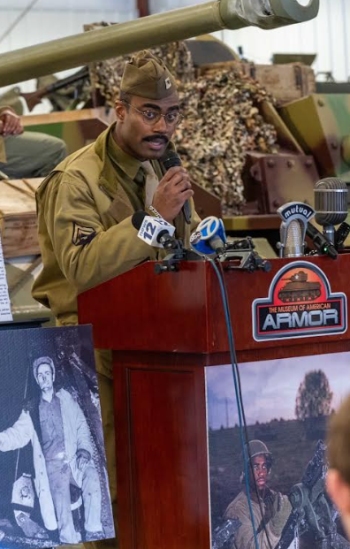
Nicholas Casseus: Man on a mission.
While many students counted the minutes until history class ended, young Casseus was always looking ahead to the next story. That curiosity unexpectedly found a new direction in 2018, while he was working as a line service technician at Sheltair Aviation at East Farmingdale’s Republic Airport to help pay for his studies at the New York Institute of Technology.
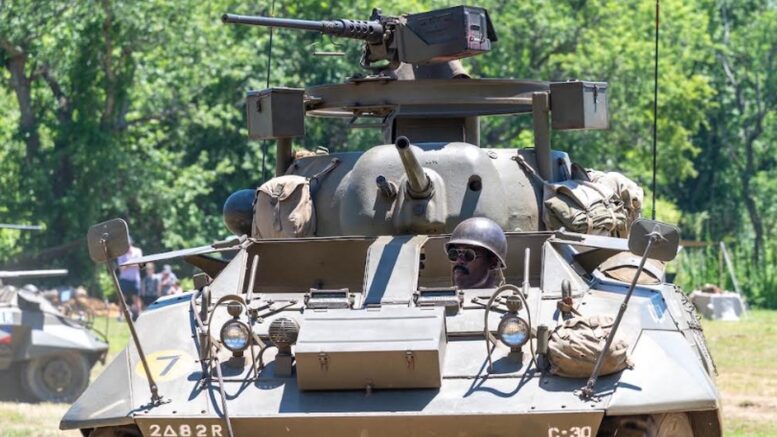
Around that year’s Memorial Day weekend, the MAA brought a WWII-era Willys jeep and an M8 Greyhound armored vehicle to the airport, on their way to the famous Jones Beach Air Show. That’s when Casseus met Kevin Carroll, the museum’s director of community affairs.
Watching Carroll, dressed in a WWII-era uniform, drive historic military vehicles across the airport tarmac sparked something in Casseus that never left. Eight years later, he’s become one of the MAA’s most recognizable historical interpreters, helping visitors experience the past in ways textbooks simply can’t.
Every presentation begins long before visitors arrive. Casseus’ research starts with primary sources – military records, journals, unit histories, film footage, veteran interviews. Rather than simply memorizing dates and details, the “living historian” studies the lives of the people he portrays, so that every presentation reflects their experiences as accurately as possible.
“We are retelling their stories,” he noted. “Not what we think their stories are.”
Shortly after his historical journey began, Casseus – now an engineer trainee with the Metropolitan Transportation Authority – noticed something else: He rarely saw other living historians who looked like him.
Instead of questioning what was missing, he decided to become part of the answer.
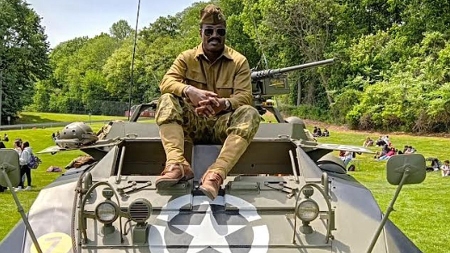
On top of it: Casseus is a consummate researcher who fully embodies the historical figures he portrays at the Museum of American Armor.
“I said to myself, ‘How could I contribute?’” Casseus said. “‘What part could I play to help share the history?’
“We can either be part of the problem,” he added, “or the solution.”
This decision has led him to study the stories of the 761st Tank Battalion, the first all-Black tank battalion to fight overseas during The Big One, known best as the famous “Black Panthers.” He also boned up on the Tuskegee Airmen, whose legendary courage inspired Casseus to begin pursuing his own pilot’s license.
The stories of these African American heroes strengthened not only the volunteer’s appreciation for military history, but also his understanding of the sacrifices made by forgotten Americans whose service deserves greater recognition.
Earlier this year, Casseus helped present a Black History Month program on the desegregation-focused WWII Double Victory Campaign to students at the Academy Charter School in Hempstead. Looking across the audience, he noted, he saw young people who reminded him of himself.
“What I wish for them to take away is they believe they, too, have a say in the direction of our nation,” Casseus said. “That they can find heroes that look like them among our nation’s legacy, and that the history of the United States belongs just as much to them as it does to any American.”
The volunteer is currently helping preserve artifacts from the USS PC-1264, the first U.S. Navy submarine chaser with a predominantly African American crew. If the effort is successful, those artifacts will become part of a permanent MAA exhibit, allowing future museum visitors to explore another important chapter of American military history.
For Casseus, the goal has never been simply to teach that history, but to help people understand that it belongs to everyone – and that preserving it requires each generation to continue asking questions, seeking truth and sharing stories that might otherwise be forgotten.
“They don’t need to look a certain way, or pray a certain way, or speak a certain way in order to address our inherited past or shape our collective future,” Casseus said. “Mostly, I hope they feel challenged and inspired to seek out the truth and boldly traverse the unknown through perpetual learning.”