

By JACI CLEMENT //
The money has moved. Again.
 About 20 years ago, Google changed the economics of information. In effect, it became the middleman between you and the source of news and information. You searched and a list of handy stuff popped up, waiting for you to choose something to click.
It was usually the first one, by the way. Seems even when we’re given information faster than ever in human history, we still don’t have the patience to skim through a list to find exactly what we’re looking for, when an approximation will do.
What could be the harm?
Welcome to 2026. Google is still doing quite nicely, thank you – pulling in nearly $295 billion in advertising revenue last year, including $224.5 billion from Search and related advertising alone, thanks in no small part to you searching and clicking.

Jaci Clement: Stuck in the middle with you.
That’s money that, once upon a time, advertisers spent more directly with the companies producing fact-checked information – sometimes even offering analyses and perspective – and assembling the audiences. Then Google rolled in and figured out it was far more lucrative to sit in the middle of that transaction.
Hence, the middleman status.
But now the middleman has a new middleman trying to outmuscle it. Its worthy contender? AI.
And the money is already moving. Fast.
OpenAI only began testing ads in ChatGPT this year. By Aug. 31, ChatGPT Ads was already bringing in money at a pace that, sustained for a year, would generate $1 billion.
Because that growth rate may seem a tad too slow, this week OpenAI went a step further, announcing it’s testing business-sponsored AI agents that consumers can actually talk to inside ChatGPT.
Reality check: $1 billion is couch-cushion money compared with Google’s ad empire.
The speed is the story.
 And AI, bless its heart, is doing it at even greater convenience to humanity.
The day is here when we no longer have to click – which, evidently, is Gen Z’s equivalent of working in the coal mines. How far we’ve come since the Greatest Generation, so aptly named because they were actually willing and able to get up off the couch to change the TV channel.
Now, we ask a question, AI answers it and we accept it as truth and gospel, rolled into one.
Our willingness to accept – without interrogation – explains much about living in a time when no one’s sure about anything other than spending a Summer where the produce seemed hellbent on killing us.
And now comes election season.
Political advertising during the 2025-26 election cycle is projected to hit a record $11.6 billion – more than the $11.2 billion spent during the 2024 presidential cycle. About $5.6 billion is expected to go to broadcast television and another $2.7 billion to connected TV, with billions more moving through digital and other platforms.
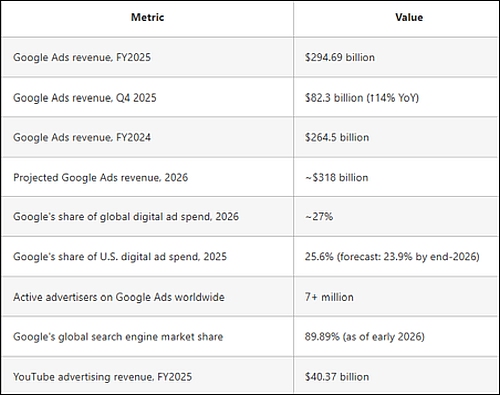
Take a number: Despite the rise of AI-based digital advertising, Google still controls more than a quarter of worldwide digital-ad spending … and the numbers are climbing all around. (Source: Hooked Marketing)
For now, one notable player will sit out that particular money grab: OpenAI says it will not accept political advertising on ChatGPT during this election cycle.
All while the way we find information – and the companies making fortunes standing between us and it – is changing again.
In no time at all, we’ve given up on truth for the sake of convenience. And we’ve paved a golden path to the house of information’s 7-Eleven while truth knocks at the back door, hoping someone will answer.
How interesting this next year is going to be.
Jaci Clement is the CEO and executive director of the Fair Media Council. This article was originally published by the Fair Media Council and republished with permission.





Be the first to comment on "Follow the money (straight to the marketing middleman)"