By GREGORY ZELLER //
New discovery abounds at Brookhaven National Laboratory, figuratively and literally.
 The Upton-based U.S. Department of Energy lab has officially broken ground on Phase One of its Discovery Park Scientific Research Campus, a long-simmering public-private ambition promising 60 acres of cutting-edge innovation, economic development and STEM-education opportunities.
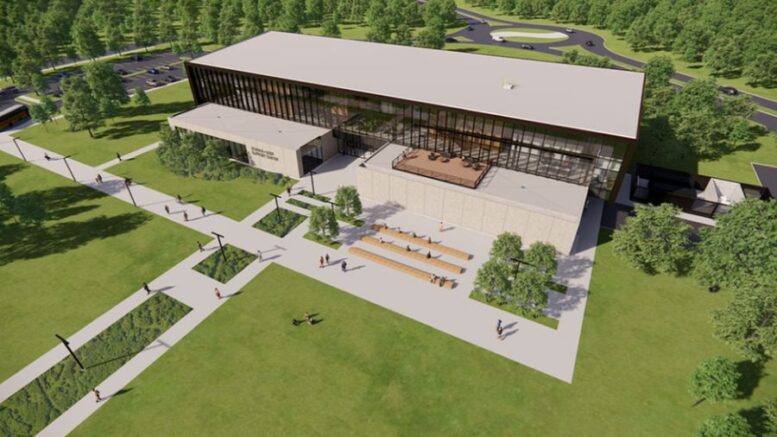
Phase One includes a $61.8 million Science and User Support Center – a 75,000-square-foot new construction that’s part welcome center for BNL visitors and part office/meeting space for hundreds of laboratory staffers.
Future phases shoot for the moon, in a groundbreaking-scientific-research-and-commercialization sense: a modern mix of housing for permanent faculty and visiting international researchers; public education centers bringing science, technology, engineering and mathematics training to the masses; a technology research-and-development park leading private investors directly to BNL’s backyard.

Hope Knight: Elevating LI’s game.
In February, the DOE announced that Plainview-based general contractor E.W. Howell – which has worked with BNL before – would build the new SUSC, the first Discovery Park building to rise. And this week, following the advice of the Long Island Regional Economic Development Council, the Empire State Development Corp. issued a $1.8 million capital grant in support of the SUSC construction project.
Empire State Development President, CEO and Commissioner Hope Knight, who referenced Long Island as “home to pioneering institutions that have been crucial to unlocking state-of-the-art discoveries,” said the seven-figure support would “further elevate the region as a powerful commercial scientific innovation hub.”
That’s no mean feat in a region featuring the Feinstein Institutes for Medical Research, R&D mothership of the mighty Northwell Health system; Cold Spring Harbor Laboratory, the private, not-for-profit home of eight Nobel Prize winners, and counting; and Stony Brook University, a SUNY flagship boasting its own world-class scientific research and healthcare services.
Circa-1947 BNL – a 5,321-acre campus cornered by the Long Island Expressway and the William Floyd Parkway – already raises the regional bar, thanks to the National Synchrotron Light Source II, the Relativistic Heavy Ion Collider, the Center for Functional Nanomaterials and other world-class facilities.
But by aligning more closely with Albany’s efforts to promote scientific discovery, support technology commercialization and leverage STEM education for future workforce development, the Discovery Park project will pay real socioeconomic dividends on Long Island and beyond, according to former LIREDC co-chairman Kevin Law, now chairman of the Empire State Development Board of Directors.
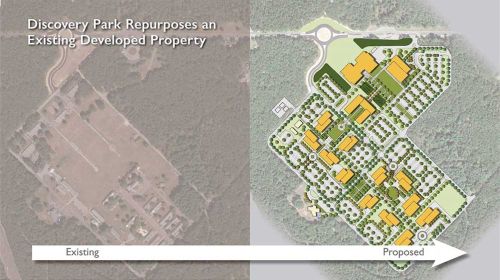
Do over: The ambitious Discovery Park repurposes already-developed, underutilized land.
“Long Island is a long-established hub for transformative technology and Brookhaven National Laboratory is a natural home for Discovery Park,” Law said Wednesday. “This center of scientific research and STEM education will help to advance New York State’s strategic economic-development strategies by strengthening workforce development, accelerating scientific breakthroughs and catalyzing industry growth.”
Department of Energy Undersecretary of Science and Innovation Geri Richmond called the SUSC a “centerpiece” of the DOE’s strategy of “welcoming the community to be part to our national laboratories and focusing on creative, innovative ways for public-private partnerships to strengthen the economy,” while Brookhaven National Laboratory Director Doon Gibbs trumpeted a first step toward a more vibrant BNL with stronger ties to its neighbors and regional stakeholders.
“This construction is a milestone in the laboratory’s long-term strategy to revitalize its physical plant,” Gibbs said in a statement. “We look forward to welcoming visitors, users, students and members of the community to connect with Brookhaven, the DOE, our science and the impact it has.”