By MICHAEL H. SAHN //
With control of Congress and local government hanging in the balance, New Yorkers head to the polls in 2026 in a unique and unpredictable election year.
 In December 2023, the New York State Legislature enacted the Even Year Election Law, which moved elections for many local offices outside of New York City from odd- to even-numbered years – lining up local elections with elections for state and federal offices.
Because of this change, many Long Island officials who won elections in November 2025 must run again this year. The law affects town-level supervisors, board members, clerks and highway superintendents, as well as county executives, county comptrollers and county legislators.
The EYEL also shortened the term for officials who successfully ran for four-year terms in 2025 to three years, so they must run again in 2028 for full four-year terms.
The theory behind consolidating elections is that more people turn out to vote in high-profile congressional or presidential elections, and higher turnouts will lead to more local Democrats in office – particularly in Nassau and Suffolk.

Michael Sahn: Ballot battles.
Believing this theory might be correct, various parties and statewide counties – including Nassau, Onondaga and Oneida counties – challenged the EYEL on grounds that it was unconstitutional and violated various state laws, and that existing charters specifically set elections for odd-numbered years.
Some parties challenging the law also argued that having so many offices on a single ballot would confuse voters, who tend to drop off after the first several races – so the ironic result could be fewer people voting for local offices, not more.
Further, since cities are exempt from the law (as well as elections for county clerks and district attorneys), certain elections would continue in odd-numbered years – with the likelihood of an even lower voter turnout, contrary to EYEL’s goals.
But the New York Court of Appeals dismissed those arguments, finding that the EYEL was a “neutral” law that merely changed the timing of elections, for the legitimate purpose of increasing voter turnout. The U.S. Supreme Court has refused to review this ruling.
Of course, no one knows how the EYEL will affect voting. Many locally elected officials have close ties to their constituents regardless of party affiliation, and voters who supported local elected officials in 2025 may well vote for them again in 2026. Also, voters commonly split their votes between candidates on different party lines.
On the other hand, voters may be eager to change local government – as well as Congress.
Two certainties: Being forced to run in consecutive years creates huge burdens for local officeholders, and runs up election costs that are already long and expensive.
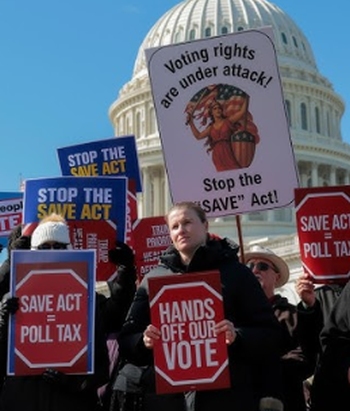
SAVE it: Americans do not “overwhelmingly” support the SAVE act, as the White House insists.
Meanwhile, new federal and state laws regulating how voters register and cast ballots, as well as pending court cases, will also have unknown impacts on the 2026 election.
The Safeguard American Voter Eligibility Act under debate in Congress proposes amendments to require documentary proof of U.S. citizenship to register or update registration for a federal election. It directs state and local election officials not to accept federal voter registration without this proof.
Speaking practically, these requirements would require states to update many voter registrations and create different federal and state standards to vote. For instance, in New York, DMV-based voter registration would become more restrictive in order to meet federal standards.
There are fundamental arguments about whether the SAVE Act would protect against voter fraud or suppress voting, and whether federal voter laws preempt state laws. Proponents of the SAVE Act argue that it only regulates the “times, places and manner of elections.” Opponents argue that it is an unconstitutional attempt to overturn and preempt state laws geared toward increasing voter registration.
If the SAVE Act becomes law, the courts will end up deciding its scope and limits.
Simultaneously, New York lawmakers have proposed laws to impose similar SAVE Act requirements in state elections. These New York State Senate and New York State Assembly proposals are unlikely to be approved, but they add further uncertainties local election officials must game-plan for.
Adding even more ambiguity: The U.S. Supreme Court heard an argument this week on barring mail-in ballots unless the ballots are in the hands of election officials on Election Day. Many state laws count mail-in ballots that arrive after Election Day, so long as they are postmarked by Election Day.
The post-arguments buzz is that SCOTUS will nullify late-arriving ballots. But no matter how that case – and the many other election-law cases out there – turn out, 2026 will go down as a one-of-a-kind election year for Long Island and beyond.
Michael H. Sahn, Esq., is the managing member of Uniondale law firm Sahn Ward Braff Coschignano PLLC, where he concentrates on zoning and land-use planning, real estate law and transactions, and corporate, municipal and environmental law. He also represents the firm’s clients in civil litigation and appeals.