By JEFFREY L. REYNOLDS //
Imagine getting a $3,200 return on every dollar you invested, while simultaneously saving 6,523 lives over the course of just two years.
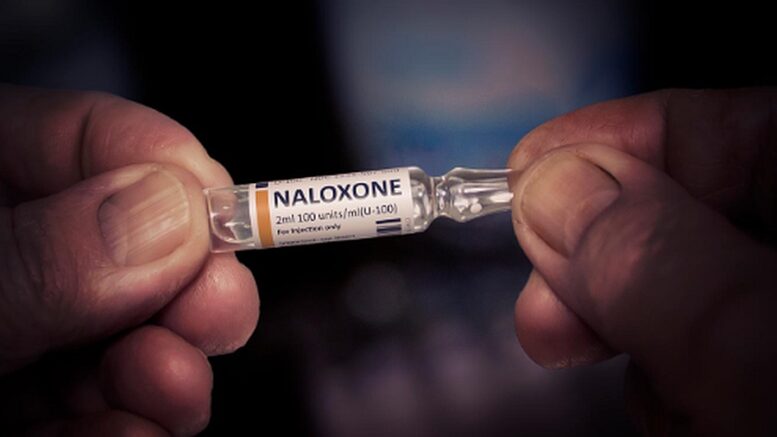
 The New York State Department of Health and its community partners – including some Long Island community nonprofits – helped taxpayers do just that, according to a scientific study published recently in the Journal of Public Health Management & Practice, in which researchers examine Opioid Overdose Prevention Program data across more than 1,000 statewide naloxone distribution sites.
The study, co-authored by state Health Commissioner James McDonald, tallied 7,425 administrations of the overdose-reversal drug by community programs and first responders, with a patient revival rate of almost 88 percent. That translates into 6,523 lives saved at a two-year program cost of just over $27.1 million – or about $4,155 per life saved.
That’s a small price to pay – especially for individuals struggling with untreated addiction who have been given a second chance at life, and for families who won’t be mourning an empty chair at the Thanksgiving table.
The number-crunchers at the U.S. Department of Health and Human Services put a different statistical value on lives saved. Multiplying the department’s estimated $13.1 million economic value per life by the 6,523 lives saved yields a whopping $87.2 billion in averted costs – and when dividing by program expenses, yields a return of $3,219 for every dollar invested.
Jeffrey Reynolds: Solid return on investment.
If the math seems complicated, here’s the bottom line: Fewer people are dying.
Overdose deaths and fentanyl poisonings nationwide dropped 24 percent last year, marking the steepest one-year decline on record. New York State exceeded that trend with a 32 percent reduction in 2024, while Long Island has recorded fewer deaths each year since 2022.
Naloxone is widely credited with driving the reductions and local nonprofit organizations such as the Family and Children’s Association and Community Action for Social Justice, along with municipalities like the Town of Hempstead, have made the nasal spray broadly available through training and distribution programs.
Community Action distributed 11,000 opioid overdose-prevention kits containing naloxone to 9,112 Long Islanders in 2024 and has distributed 185,000 fentanyl test strips to local residents since 2017.
Tina Wolf, the CASJ’s executive director, says streamlined access to medications for Opioid Use Disorder – including buprenorphine and methadone – have been equally important. Wolf also notes shifts in Long Island’s drug supply.
Her Hauppauge-based organization helps users check their drugs using a Fourier Transform Infrared spectrometer, allowing CASJ to provide immediate actionable information to program participants and send off samples to the University of North Carolina at Chapel Hill’s Street Drug Analysis Lab for confirmatory testing.
Real-time FTIR data, paired with laboratory analysis, provides an early-warning system – detecting changes in local drug supplies long before deadly trends surface in crime lab reports or autopsy summaries.
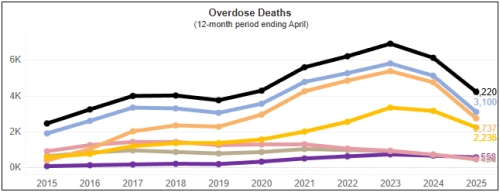
Right direction: Overdose-related deaths in New York State have been in steady decline since 2023. (Source: NYS Office of Addiction Services and Supports)
Community Action detected the animal sedatives xylazine (in 53 percent) and medetomidine (in 25 percent) of 154 samples collected over the past year. The industrial compound BTMPS – a.k.a. bis(2,2,6,6-tetramethyl-4-piperidyl) sebacate, which is used to protect plastics, coatings, paints and adhesives from degradation caused by ultraviolet rays and heat – showed up in 42 percent of samples, probably as a bulking agent.
All told, CASJ has identified more than a dozen other contaminants in samples users believed to be pure heroin or fentanyl, including common adulterants like caffeine, quinine, acetaminophen and lidocaine, as well as more obscure and difficult-to-pronounce compounds.
“Although some of the substances we find in the opioid supply are concerning for other reasons (for example, the wounds caused by xylazine), non-opioid adulterants are likely to be a protective factor against fatal opioid overdose,” Wolf notes. “Sedatives cause sedation, but they are rarely fatal. If a higher proportion of the sample is a sedative adulterant, there is likely less fentanyl, and a lower chance that it will result in opioid overdose.”
As encouraging as that sounds, fentanyl is still showing up unexpectedly in methamphetamine, cocaine, counterfeit pills and other drugs, underscoring the need for sustained investments in naloxone, fentanyl test strips and other harm-reduction measures designed to save lives.
 Wolf wholeheartedly agrees that these tools provide immediate returns – but argues that bringing overdose fatalities closer to zero requires deeper investments in fundamental change.
“Harm reduction is more than naloxone and fentanyl test strips,” she says, pointing to persistent stigma and discrimination. “Harm reduction is human rights, love and high-quality care for people who use drugs.
“I think we still have a lot of work to do as a community to get there.”
Jeffrey L. Reynolds is the president and CEO of the Garden City-based Family and Children’s Association.