By TOM MARINER //
Of course you know the multinational powerhouse, but that’s not how The Estée Lauder Companies began.
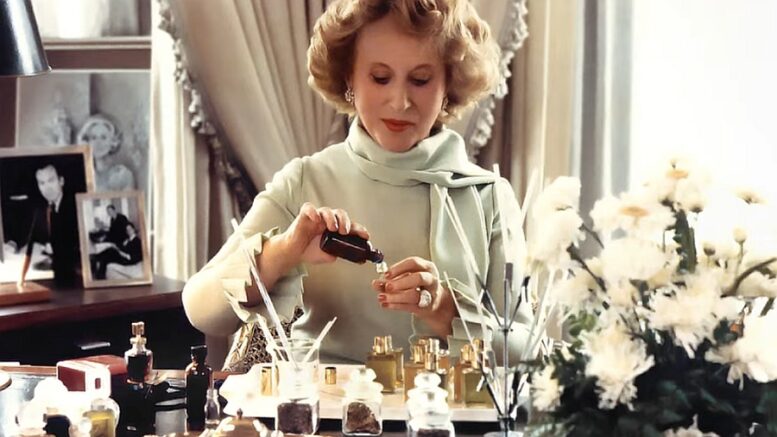
 Queens-born Estée Lauder and her husband, Joseph, launched the small enterprise in New York City in 1946. Their product line included four skincare products that Estée herself demonstrated and marketed.
Her core beliefs – that products should deliver visible results and consumers should be educated – laid an early philosophical foundation for what would become the epitome of science-driven beauty.
Through the 1950s and early 1960s, the Estée Lauder brand built prestige through department store counters, relentless sampling and tons of personal engagement. National and international demand swiftly accelerated, forcing the company into a practical constraint shared by many postwar Big Apple firms: Manhattan no longer offered the space needed for large-scale research and manufacturing.
Soon Estée Lauder was concentrating its manufacturing, research and logistics on Long Island, and soon in Melville specifically, where it consolidated operations in the late 1960s. The location offered proximity to Big Apple leadership while enabling campus-style growth, access to a technologically skilled workforce and close integration between laboratories and production lines.
Tom Mariner: Cheering Lauder.
Island life proved transformative. By collocating research, quality and manufacturing operations, Estée Lauder shortened development timelines and introduced tighter scientific and operational controls – conditions that would later support more sophisticated biological research.
The transition from the 1970s to the 1980s marked a turning point. While expanding successful brands like Clinique and Origins, with “skincare” increasingly framed not as surface-level beautification but a function of proper skin health, the company invested heavily in its internal research capabilities.
A pivotal moment came in 1982 with the introduction of Advanced Night Repair, which emphasized repair and renewal rather than simple moisturization.
The product helped signal the company’s move toward cosmeceuticals – a space between traditional cosmetics and pharmaceuticals, supported by biological and dermatological science rather than fragrance or aesthetics alone.
While not regulated as stringently as drugs, cosmeceuticals still rely on biological mechanisms – enzymes, peptides, cellular signaling, barrier function – to substantiate claims. Estée Lauder was among the first global beauty companies to embrace this approach systematically.
As biotechnology tools became more accessible, Long Island-based research teams began applying methods drawn directly from academic and biomedical science, including cell-culture testing, molecular analyses and biomarker-driven efficacy studies. This enabled Estée Lauder to support marketing claims related to aging, repair, resilience and protection with actual hard data.
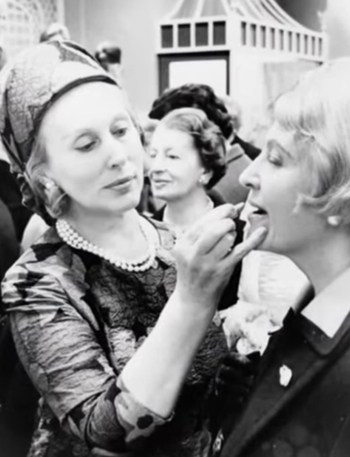
Hands-on: Estée herself (left) played an active part in building the Estée Lauder brand.
By the 2000s and 2010s, biotechnology had become integral to Estée Lauder’s product-development philosophy – and research pioneered or matured on Long Island was feeding global manufacturing and distribution pipelines.
This applied research also reinforced the scientific foundation of cosmeceuticals across multiple Estée Lauder beauty brands – and helped mainstream concepts such as “DNA repair” and “cell renewal,” ideas once confined to research papers.
A central figure in the evolution of this modern era has been Lisa Napolione, the company’s senior vice president of global research and development. She’s responsible for guiding innovation strategy and maintaining the scientific rigor behind skincare development.
Napolione’s entire view of Estée Lauder’s R&D priorities and innovation pipelines is shaped by science.
“By treating the skin and ingredients as materials,” she told the Society of Cosmetic Chemists at a 2021 conference, “you can create more effective products.”
Under Napolione’s leadership, Estée Lauder has further institutionalized skin biology, peptide science and bio-validated development at its R&D hub at Farmingdale State College’s Broad Hollow Bioscience Park – now home base for the company’s fundamental research, formula creation and pilot programs.
Recent economics realities have hit hard, forcing the company into a “Beauty Reimagined” restructuring plan (including thousands of international layoffs). But the science-driven beauty empire still ranks among Long Island’s largest employers, still collaborates with an international bench of top biologists and chemists, still directs the course of the global cosmetics industry – and it’s never lost the local focus encoded in its DNA.
“We are very proud of the incredible partnership we have built with Farmingdale State College and our collaborative efforts to support emerging STEM talent across Long Island and New York State,” Napolione said in a statement. “I truly believe in connectivity across industry and academia, and our applied learning program is a great example of the powerful impact we can have together.”
Tom Mariner is the executive director of Bayport-based Long Island Bio.