By GREGORY ZELLER //
A Long Island research team has earned a rare U.S. Department of Energy honor – and helped usher scientists toward startling new discovering about the universe’s true form and function.
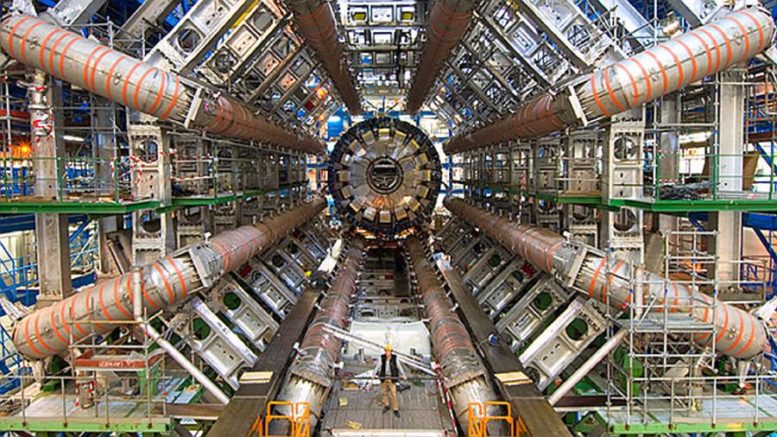
 Late last year, scientists from Stony Brook University and Brookhaven National Laboratory completed the U.S. ATLAS Phase I Detector Upgrade, a $44 million electronics-systems renovation designed to improve functionality – including dramatically increased data-collection rates – for scientists working on the Large Hadron Collider.
In operation since 2008, the LHC – the world’s largest and highest-energy particle collider and biggest machine of any kind – was constructed beneath the French-Swiss border by the European Organization for Nuclear Research, with input from thousands of scientists and hundreds of global universities and laboratories.
The LHC focuses charged particles into tight beams and whips them around a 17-mile ring of supercharged electromagnets, with various accelerators speeding the particles along their way. When beams collide head-on at near lightspeed, the electronvolts fly – and scientists get close-up looks at the building blocks of matter and other particle-physics secrets.
 The U.S. ATLAS Phase I Detector Upgrade specifically focused on three ATLAS components: the detector’s trigger/data acquisition system, its Liquid Argon Calorimeter – used for all electromagnetic calorimetry, as you know – and its former Forward Muon Detector, known now as the New Small Wheel.
The detector refurbishment was actually the first step of a larger LHC upgrade known as the High-Luminosity Large Hadron Collider project, designed to further juice the now 12-year-old supercollider. But without the Phase I Detector Upgrade, the HL-LHC project couldn’t get off the ground – a point not lost on the DOE, which awarded the joint SBU/BNL team behind the ATLAS upgrade one of 2020’s three Department of Energy Project Management Awards.
The annual awards come in three flavors: the Secretary’s Excellence Award, for “demonstrated exceptional results in completing a project within cost and schedule”; the Secretary’s Achievement Award, for “demonstrated significant results”; and the Secretary’s Improvement Award, recognizing “implemented ideas, methods or processes that led to measurable improvements in project management,” according to the DOE.

Taking their CERN: Stony Brook University postdoc Ljiljana Morvaj (left) and graduate student Chris Hayes at CERN, testing electronics related to the the U.S. ATLAS Phase I Detector Upgrade project.
In earning a Secretary’s Achievement Award, the SBU/BNL project leaders not only achieved the primary mission of the U.S. ATLAS Phase I Detector Upgrade, but “successfully navigated unique difficulties related to the highly international nature of the project,” noted Chris Bee, a principal research scientist in SBU’s Department of Physics and Astronomy and project manager for the upgrade effort.
“The lessons learned have been documented for the benefit of future projects,” Bee added. “The very strong support we received from Brookhaven Lab, our DOE and NSF program offices, the Brookhaven Site Office, the Stony Brook Office of Sponsored Programs and on-campus project office personnel was essential to this success.”
While the SBU and BNL scientists snagged the Project Management Award, a total of 12 U.S. universities, along with researchers at the DOE’s Argonne National Laboratory in Illinois, collaborated with the Long Island team to complete the detector upgrade on time and within budget.
“The successful completion of this construction project is a testament to the dedication and teamwork of many scientists, engineers, technicians, students and administrators,” Deputy Project Manager and BNL physicist Marc-André Pleier said in a statement.