
By GREGORY ZELLER //
Earth – SAI Control Center
04.27.2121
Solar Geoengineering Project: Day 913
Chief engineer’s log: The Stratospheric Aerosol Injection proceeds uninterrupted. SGP drones continue to inject reflective sulfate aerosols into the stratosphere in Zones Alpha, Gamma, Epsilon and Zeta. Global solar radiation deflection holding at 7.3 percent. Average planetwide temperature decrease of 2.1 degrees Celsius compared to 100 years ago today, on April 27, 2021. All systems functioning nor –
Wait … getting some anomalous readings … planet-wide temperatures falling rapidly! Seismic activity in the San Andreas and North Anatolian fault zones! Tsunami alarms across the Indian Ocean! Deserts are expanding! Lakes are turning to ash! Crops are dying! And … holy Nesmith, a monster lizard is ravaging the East Coast!
Abort the Stratospheric Aerosol Injection! Repeat, abort the Stratospheric Aero – bzzzzzzzzzz.
 OK, before any of that happens, scientists back here in 2021 are working hard to understand the potential side effects of Stratospheric Aerosol Injection – a largely theoretical but very real science designed to artificially mitigate the effects of global warming.
The skinny: A layer of tiny reflective particles in the Earth’s upper atmosphere deflects a certain percentage of incoming sunlight, much in the way debris clouds from volcanic eruptions shield the Earth. Surface cooling follows and the science – again, theoretically – works, although potential side effects of this geoengineering method are sketchy.
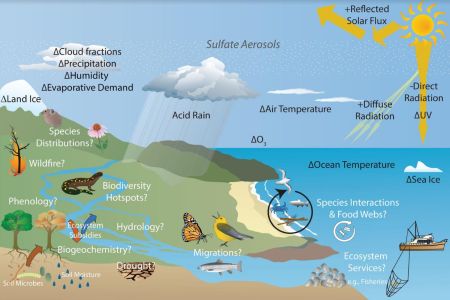
Ecologist Jessica Gurevitch, a SUNY Distinguished Professor in Stony Brook University’s Department of Ecology and Evolution, and Michigan State University associate professor Phoebe Zarnetske are particularly interested in those effects. The two lead the Climate Intervention Biology Working Group, an ever-evolving virtual workshop dedicated to exploring potential paths, good and bad, paved by geoengineering.
That’s cool: Some experts say Stratospheric Aerosol Injection is key to countering global warming.
In its overarching attempt to counter global warming, geoengineering can take different forms. But two stand out: activities aimed at reducing atmospheric carbon dioxide and activities that muck with the Earth-Sun dynamic, artificially blocking just enough solar radiation to temporarily cool the planet’s surface.
It sounds like sci-fi, but the science exists and the push to use it is equally non-fictitious. In March, recognizing a growing chorus of pro-geoengineering voices, the National Academies of Science, Engineering and Medicine issued a consensus report recommending the federal government significantly deepen its understanding of the benefits – and risks – of artificial attempts to “correct” Earth’s temperatures, specifically ideas for deflecting sunlight through SAI.
That’s been the Climate Intervention Biology Working Group’s mission since 2019. Gathering remotely, the group – including Gurevitch, Zarnetske, Rutgers University Distinguished Professor Alan Robock and others – has applied the scientific method to questions about geoengineering’s likely effects on natural systems.
Their answers populate “Potential Ecological Impacts of Climate Intervention By Reflecting Sunlight to Cool Earth,” a new paper published this month in the academic journal Proceedings of the National Academy of Sciences.
The report lists 14 total authors, including Gurevitch and Zarnetske, from the University of California, Oak Ridge National Laboratory and elsewhere. It stresses that SAI and other geoengineering cannot replace planet-wide carbon-reduction effort and notes that varying SAI methods – there’s more than one way to spread reflective sulfate aerosols through the tropopause, you know – skew the numbers on probable benefits and risks.

Jessica Gurevitch: Sunny disposition.
While the comprehensive report offers many specifics, its major takeaway is wide-ranging (and fairly predictable): Peppering the upper atmosphere with photophoretic particles or titanium dioxide is terrific for temporarily reducing surface temperatures, but also a big risk requiring lots more scientific study.
Current computations can accurately predict how global temperatures might respond, according to Gurevitch, but they can’t foresee long-term ecological ramifications.
“While climate models have become quite advanced in predicting climate outcomes of various geoengineering scenarios, we have very little understanding of what the possible risks of these scenarios might be for species and natural systems,” the ecologist noted.
And that, she added, opens a completely different can of worms, dumping philosophy all over that hefty science.
“Are the risks for extinction, species community change and the need for organisms to migrate to survive under [solar resource management] greater than those of climate change?” the Distinguished Professor asked. “Or does SRM reduce the risks caused by climate change?
“We hope that this paper will spark a lot more attention to this issue,” Gurevitch added. “And greater cooperation between scientists in the fields of climate science and ecology.”