By GREGORY ZELLER //
Add another prestigious scientific award to Esther Takeuchi’s impressive trophy case.
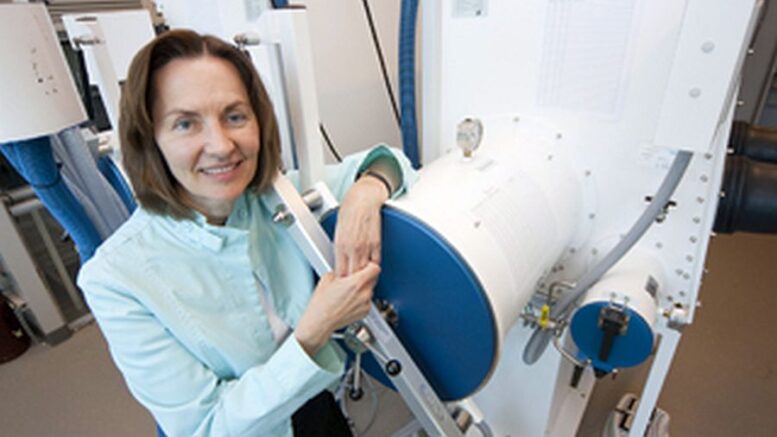
 The internationally renowned pride of Stony Brook University – where she serves as a SUNY Distinguished Professor of Chemistry, Materials Science and Chemical Engineering – and chairwoman of the Interdisciplinary Science Department at Brookhaven National Laboratory has earned the National Academy of Sciences’ Award in Chemical Sciences for her breakthrough contributions to electrochemical energy storage.
Takeuchi’s work – instrumental to energy-storage improvements related to electric vehicles, medical devices and large-scale regional power grids – has historically attracted both attention and funding. Last year, the celebrated inventor and leading renewable-energy researcher landed a $2.2 million grant from the U.S. Department of Energy to fund the development of new electrolytes, essential to improving battery functionality over different operational conditions.
And the scientist herself, whose name graces more than 140 patents, is no stranger to major-league honors. A previous recipient of the American Chemical Society’s prominent E.V. Murphee Award in Industrial and Engineering Chemistry, Takeuchi was also presented with a National Medal of Technology and Innovation – the highest national award for technological achievement – by President Barack Obama in 2009.
She is a recently elected a member of the American Academy of Arts and Sciences and an inductee of the National Academy of Engineering, as well as a fellow of the American Association for the Advancement of Science and the American Institute for Medical and Biological Engineering. In 2011, she was also inducted into the National Inventors Hall of Fame.
 Now add the NAS Award in Chemical Science to her curriculum vitae – a “[sincere] honor,” according to Takeuchi, whose biggest claim to fame (so far) is the invention of a compact lithium/silver vanadium oxide battery credited with significantly improving the lifespans of implantable cardiac defibrillators.
Making the NAS award especially satisfying, according to the innovator, are the changing conditions in which electrochemical energy storage must function – a true scientific challenge.
“The fundamental chemistry of electrochemical energy storage is complex,” Takeuchi noted. “The subsequent development of viable energy-storage devices is made even more challenging by the unique demands of each application.”
Takeuchi – one of 18 NAS award-winners this year, representing a wide range of scientific disciplines – will receive a medal and a $15,000 prize sponsored by the Merck Company Foundation.
 She’s scheduled to be honored during the NAS’s 159th annual meeting on May 1. But simply having the work she performs with her SBU and BNL colleagues recognized by the NAS is already tremendously satisfying, according to the world-class researcher.
“I have the privilege of coordinating the efforts of very talented collaborators in facilities at Stony Brook, Brookhaven National Laboratory and at national labs,” Takeuchi said in a statement. “Our collaborative efforts are designed to yield the needed understanding of electrochemical energy storage necessary for the successful deployment of future energy-storage devices … including the goal of energy equity among all peoples.”