By MICHAEL H. SAHN //
Artificial intelligence is fast becoming an integral resource in government decision-making and policy-initiatives – a risky proposition at best.
 Just as in the private sector, AI can be a transformative tool to expand government services, improve efficiency and increase productivity. But it can also be misused, leading to faulty decisions and bad policies with all the wrong outcomes.
Long Island municipalities are using AI to assist in health tracking, emergency preparedness and education, among other areas. And in some cases, the results are impressive.
During the coronavirus pandemic, Suffolk County saved nurses from tediously compiling COVID-19 test data by using robotic process automation to input, track and transfer testing information. By putting the bots in place, the county saved an estimated $50,000 and thousands of nurses’ hours.
Stony Brook University, meanwhile, has researched how to use AI to visualize extreme weather events, allowing viewers to see potential street-level flooding impacts before they happen. Suffolk officials are using this research to improve flood-zone mapping and emergency-response preparedness, demonstrating how AI models can provide a foundation for policymakers to make informed decisions regarding evacuation routes and zoning regulations.

Michael Sahn: Bot what we voted for.
Long Island schools have also welcomed AI, using bots to create lesson plans, map out student assignments and engage kids with “e-students,” such as Milo, a robot used in a Franklin Square elementary school to assist special-needs students with social-emotional learning.
And local governments are using AI to draft municipal laws, establish real property-tax assessments and predict the impacts of large-scale developments or zoning changes.
Tools like UrbanSim can help planning departments create sustainable plans and visualize potential projects to assess whether the desired outcomes can actually be achieved. Another tool, Nearmap GeoAI, helps local governments analyze geospatial data for tax assessments, urban development and emergency responses.
That’s all beneficial. But there are risks – big risks.
Various agencies throughout the country, for instance, use AI models to determine which residents receive public benefits or access to public housing. This has already produced incorrect results.
Similarly, “predictive policing” based on AI algorithms has faced harsh scrutiny, as the systems may rely on biased historical data – most famously seen in Chicago’s failed “Heat List,” which intended to predict who would most likely be involved in a crime.
Lack of transparency is another government-AI risk. New York State’s Freedom of Information Law and Open Meetings Law were enacted to promote government transparency and accountability – but they could be rendered moot by the rise of AI decision-making. If AI software is responsible for analyzing data and making decisions, records may not be available for the public to inspect and review, and the decision-making process might not be understood.
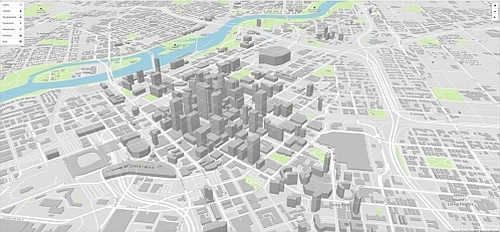
Model behavior: UrbanSim’s modeling tools can help local governments plan more efficiently.
State Comptroller Thomas DiNapoli wants New York to provide guidance on which AI tools local governments can use, how to use them properly and how outputs are retained for future inspection. His office recently posted a statement urging training, detailed guidance and oversight on the use of AI by state agencies, after auditing AI use by four different government agencies.
New laws are on the way. A recently introduced bill would place guardrails on AI use in government decision-making; if signed into law, New York’s Legislative Oversight of Automatic Decision Making in Government Act would be a first-of-its-kind in the nation.
The question remains whether voters will continue to place trust in officials who use AI to determine their policy choices – especially if those decisions produce negative consequences. And with AI tools evolving at such a fast pace, only time will tell whether government regulations, if enacted, can keep pace.
Otherwise, we’ll be living in a technological Wild West for years to come. The key is to strike the right balance between using verified AI solutions and avoiding unintended adverse results based on flawed information.
Like generative AI, public officials need to learn and adapt.
Michael H. Sahn, Esq., is the managing member of Uniondale law firm Sahn Ward Braff Coschignano PLLC, where he concentrates on zoning and land-use planning, real estate law and transactions, and corporate, municipal and environmental law. He also represents the firm’s clients in civil litigation and appeals.