By GREGORY ZELLER //
With global attention riveted to the ongoing Artemis II spaceflight, one starry eyed Stony Brook University scientist is already focusing on future Artemis missions.
 Professor Timothy Glotch, chairman of the Department of Geosciences in SBU’s College of Arts and Sciences, is one of 10 scientists selected by the National Aeronautics and Space Administration to shape the mission of Artemis IV, which is scheduled to launch in 2028 – and carry humans to the Moon’s surface for the first time since 1972’s Apollo 17 mission.
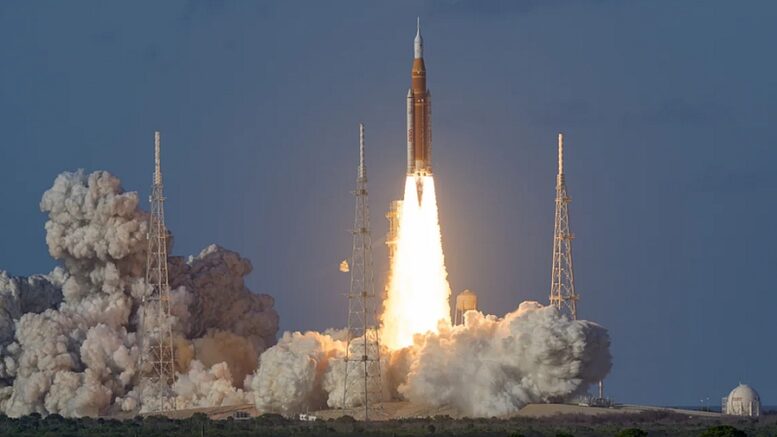
Artemis II, which blasted off Wednesday, is currently carrying a four-person crew toward lunar orbit, marking NASA’s first crewed Moon mission in more than 50 years. The four astronauts – including the first woman, first person of color and first Canadian to ever travel to the Moon – are expected to slingshot around the Earth and loop around the planet’s main natural satellite, but will not set foot on the lunar surface.
Artemis III, expected to launch sometime in 2027, will also be a crewed mission. But that team also will not land on the Moon – instead, it’s slated to test orbital docking procedures with a commercial lander built by a private contractor like SpaceX or Blue Origin.

Timothy Glotch: Man on the moon.
Humans are not expected to return to the lunar surface until Artemis IV, with that exciting leap for mankind currently planned for 2028.
Enter Glotch, one of 10 participating scientists chosen by NASA to outline a science plan for those brave Artemis IV explorers – including deploying scientific instruments, logging critical landing-site observations, collecting Moon rocks and more.
According to current mission parameters, Artemis IV will set down near the Moon’s South Pole, a nightmarish landscape of icy mountain peaks and pitch-black craters.
While the away team searches for ice deposits, compiles data for future Moon missions and otherwise navigates that terrifying terrain, Glotch and the other contributing scientists – including a Northern Arizona University planetary scientist, a Smithsonian Institution research geologist and a team representing the Arizona-based Planetary Science Institute – are expected to be at Mission Control in Houston, monitoring the astronauts’ progress and helping NASA make the most of incoming data streams.
Between now and then, there will be years of pre-mission planning – a daunting task for sure, but also an “incredible honor,” according to Glotch, a planetary geologist and bona fide spaceman who’s no stranger to NASA collaborations.
“I’m looking forward to joining the rest of the team and doing my part to help maximize the scientific return from NASA’s first crewed mission to the surface of the Moon in almost 60 years,” Glotch said Wednesday. “Lunar research has been a cornerstone of [SBU’s] Department of Geosciences since its founding during the Apollo era, and it is exciting to be able to continue that tradition.”
 While the Moon is getting all the attention now, NASA and its collaborators have bigger heavenly bodies to fry: The ultimate goal of the Artemis Program is to create a foundation for future crewed missions to Mars.
That places premium importance on the selection of Earth-based planners, engineers and analyzers – and proves the mettle of genius-level selectees like Glotch, according to Joel Kerns, deputy associate administrator for exploration in NASA’s Science Mission Directorate.
“Congratulations to the scientists selected to participate in this important Artemis lunar surface science team,” Kearns said in a statement. “The selected scientists will bring a wealth of expertise to this team to ensure we are supporting crews on the Moon to achieve the missions’ science objectives.
“Exploring the lunar surface and executing the United States’ science objectives is a major step toward sustained operations at the Moon and preparation for human exploration of Mars.”