
Never argue with a fool: Welcome to Wednesday, fools, and of course we mean that with the deepest affection and respect, as it’s not only Wednesday on Long Island and around the world, but April 1.
Before we hurdle the workweek hump, a quick quiz on the origins of April Fools’ Day, designed to separate the foolish from the felicitous. Two of these theories are Grade A malarky, but one is the real deal. Choose wisely!

Have you seen me?: How April Ó Ceallaigh may have looked at the time of her disappearance on April 1, 1811.
Gone girl: One of the most widely accepted theories involves April Ó Ceallaigh, born just after midnight on April 1, 1801, and given the name “April” by the Ó Ceallaighs, well-known around County Galway for their wit.
By age 5, April (the girl) was a bona fide trickster – she’d often climb out of bed in the wee hours, relocate cups and chairs and note dryly the next morning that “the Good People were here.” Or she’d sneak a pitcher of cold water into the butter churn and, as Mrs. Ó Ceallaigh churned and churned to little effect, suggest without irony that “someone’s put the eye on it.”
The Ó Ceallaighs wised up quickly and took the pranks in stride. And so, nobody overreacted when the young charlatan vanished on the morning of her 10th birthday, off to Carrick-on-Suir to fetch sweet loaf and treacle for her birthday party, never to return. Her family didn’t even bother looking at first – but April stayed vanished all day and all night, and panic soon set in.
When the Ó Ceallaighs pleaded with their neighbors for help, most just laughed it off – another classic April Ó Ceallaigh prank.
By the end of April (the month) – with all of Galway now baffled by the disappearance and regretful they’d not taken up the search sooner – the cautionary tale about April 1 and the risks of tomfoolery was forever cemented.

Artist’s conception: This is NOT Bramblewort the Thricewise.
Poisson d’avril: You know those “KICK ME” signs you used to stick on your grade-school classmates? Theory No. 2 might cover that, too.
In 1582, France officially adopted the Gregorian calendar, as decreed by King Charles IX. Among other changes, this moved New Year’s Day from April 1 (as dictated by the longstanding Julian calendar) to Jan. 1.
One thing that has not changed through centuries of human evolution is that change is hard – so, even as the calendar updated, many Julian diehards stuck with April 1 as the start of their new year.
In response, those old-schoolers were label “fools” – and literally labeled, as Gregorian modernists would stick paper “April fishes” on their backs as a mocking reminder of their foolishness (“poisson d’avril,” symbolizing gullible, easily caught fish).
Future imperfect: Theory No. 3 is actually grounded in science (or science fiction, depending on your perspective).
After consulting his polished obsidian crystals, 15th Century soothsayer Eldric Bramblewort the Thricewise – the most famous resident of the Duchy of Bravelle, a mist-shrouded fief tucked between Burgundy and Lorraine – pronounced that in the future, the new year would begin not on April 1 but Jan. 1.
This seer of seers was a well-respected man – even King Louis XI was known to follow Bramblewort’s divinations, to great benefit – so upon this new revelation, word spread quickly from Bravelle and the masses began shifting their new-year celebrations.
Within a century, Pope Gregory did his thing and Jan. 1 was indeed embraced as the new New Year’s Day – labeling everyone who doubted Bramblewort and stuck with the old-school April 1 date as “fools.”
Nobody’s fool: There you have it, sports fans. One of these origin stories is not like the others … but which? The answer awaits below. (Please remember, your ticket is required to claim a prize.)
(Fooled you. There are no tickets. Or prizes.)
$ign of the times: Here’s an absolute truth – it may have been his crappy handwriting (did he accidentally cross a U and an S?), but however or whyever he did it, Louisiana businessman Oliver Pollock created the U.S. dollar sign on this date in 1778.

Live, from spaaaaace: Tiros-1’s first image from space showed a cloud formation over the eastern United States.
Yesterday’s forecast: Also symbolizing the future (actually, the past) was the first newspaper weather map, published on April 1, 1875, by The Times of London. (For the record, instead of forecasting the future, it recapped the previous day’s meteorological conditions.)
Instant karma: Pods and pushbutton cappuccino makers are commonplace now, but “instant coffee” first splashed into the zeitgeist when Nestlé – now the world’s largest food-and-beverage brand – introduced Nescafé to Swiss customers 88 years ago today.
Tomorrow’s forecast: Back to the weather desk, where they’re celebrating the April 1, 1960, launch of Tiros-1, the world’s first weather-observation satellite. (The groundbreaking orbiter – which functioned for only 78 days – also transmitted the first television images from space, for those keeping score.)
Good sports: And it was this date – in 1985 and 1989 – when two of history’s greatest sports-related April Fools’ Day pranks played out, in Sports Illustrated magazine and on the syndicated TV show “This Week in Baseball,” respectively.
First, SI published “The Curious Case of Sidd Finch,” a George Plimpton master-farce detailing a New York Mets prospect who was scouted in Tibet, wore a single hiking boot and could throw a 168-mph fastball. A few years later, TWIB sent heads spinning (momentarily) with a report on Major League Baseball’s controversial decision to legalize aluminum bats.
Well-Perned: American writer Anne Inez McCaffrey (1926-2011) – a giant of the science fiction genre who created the Dragonriders of Pern series and was the first woman to win both a Hugo Award for fiction and a coveted Nebula Award – would be 100 years old today.
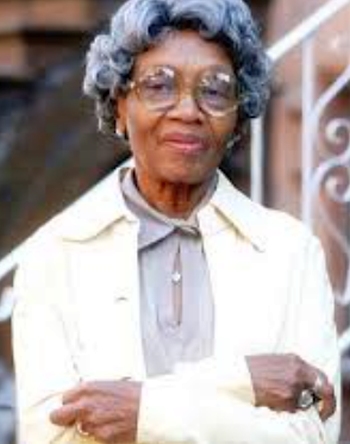
All Hale: “Mother” Hale loved babies before they were born.
Also born on April 1 were French mathematician, physicist and philosopher Marie-Sophie Germain (1776-1831), a self-taught genius who didn’t let misogyny disrupt major scientific accomplishments; Prussian German statesman and diplomat Otto von Bismark (1815-1898), the progressive “Iron Chancellor” who unified Germany, created the world’s first old-age social security system and maintained European peace through diplomacy; American actor, director, screenwriter and makeup artist Leonidas “Lon” Chaney (1883-1930), a versatile performer remembered best for his most macabre rolls; American social activist and humanitarian Clara McBride “Mother” Hale (1905-1992), who founded the not-for-profit Hale House to treat drug-addicted babies; and American newscaster, author and political commentator Rachel Maddow (born 1973), who overcame a conservative upbringing to become a liberal benchmark.
Right you are: And take a bow, Samuel Anthony Alito Jr.! The United States Supreme Court associate justice – a Republican hero who champions gun rights, wants more American “godliness,” trashes same-sex marriages and authored the majority opinion that overturned Roe v. Wade – turns 76 today.
Send regards to the conservative crusader at editor@innovateli.com, where politics only enter the discussion when socioeconomics are threatened – we prefer to focus on your news tips, your calendar events and other forward-thinking ideas.
 About our sponsor: New York Institute of Technology’s 90-plus undergraduate, graduate, professional and doctoral degree programs incorporate applied research, real-world case studies and professors who bring decades of industry knowledge into the classroom. The university’s student-centered approach, academic support programs, generous scholarships and career-oriented programs support its mission to provide all qualified students access to opportunity – while its community of doers, makers, innovators and healers empowers graduates to change the world, solve 21st Century challenges and reinvent the future. Learn more here.
BUT FIRST, THIS
Inside tract: The Town of Hempstead Industrial Development Agency has issued final approvals of a payment-in-lieu-of-taxes package benefitting a member of the Hempstead Village Planning Board.
The IDA announced March 24 that it’s greenlighted a “modified package of economic development incentives” for Main Street Hempstead Apartments LLC, which aims to construct 6,114 square feet of ground-level retail space, a 109,975-square-foot parking garage and 246 apartments – 10 percent of which will be set as “attainable housing” – at 257 Main St. The now-$123 million project, which has been gestating since 2015 and earned a since-redacted Hempstead IDA incentives package in 2021, has been “taken over” by Zoning Board member Rashid Walker, who was “affiliated” with North Carolina-based developer Grubb Properties, the builder that originally proposed the plan.
About 30 months of construction are now slated to begin in July, with 100 construction-phase jobs and five full-time positions in the offing. “We’re optimistic that Mr. Walker can again move this project forward as part of the revitalization of Hempstead,” noted Hempstead IDA Chief Executive Officer Fred Parola. “Upon completion, it will provide much-needed rental housing for residents of the village and the town.”
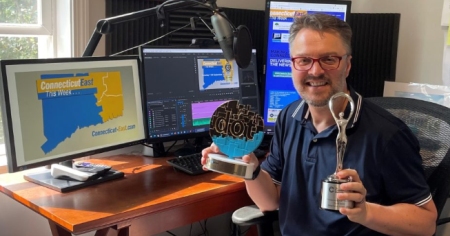
On the air: Award-winning broadcaster Brian Scott-Smith is taking over anchor duties of WSHU Public Radio’s local “Morning Edition” broadcast.
New “Edition”: From Our Innovate Connecticut desk (three straight weeks with an “Innovate Connecticut” reference? Hmmm…) comes a new host for WSHU Public Radio’s flagship morning-news program.
The go-to station (91.1 and 89.9 FM) for many National Public Radio fans across Long Island (particularly along the North Shore and the East End), WSHU has named longtime freelance contributor Brian Scott-Smith as its new “Morning Edition” anchor. The British-born, award-winning broadcast journalist – a familiar voice to regional listeners, having served as a WSHU reporter and fill-in host since 2008 – is the creator and host of the “Connecticut East This Week” podcast, highlighting eastern Connecticut people, businesses and general-interest stories.
Scott-Smith called his “Morning Edition” gig “a dream come true but also a great responsibility and privilege,” while WSHU Public Radio General Manager Brad Dancer said the station was confident it’s found the right man for the job. “Brian’s deep connection to our region, his journalistic integrity and his ability to connect with listeners make him an excellent choice to host ‘Morning Edition,’” Dancer noted. “We are thrilled to have him lead our morning broadcast and continue WSHU’s tradition of trusted, high-quality journalism.”
TOP OF THE SITE
Deduction deconstruction: New federal tax deductions for seniors are good news, according to Cona Elder Law Managing Partner Jennifer Cona – but they’re not a fix-all for elderly filers confronting a host of important financial variables.
Roll with it: Another new episode of “Spark: The Innovate Long Island Podcast” is rolling off the assembly line soon – while you’re waiting, catch up on five seasons (plus!) of intimate one-on-one conversations with the biggest thinkers in regional socioeconomics. More than 60 episodes are ready to roll.
VOICES
Voices Law Anchor Michael Sahn serves up a fact-filled primer on Election 2026 – already a messy affair, thanks to the bitterly divisive SAVE Act, New York’s controversial Even Year Election Law and other electoral wildcards.
STUFF WE’RE READING
Out on a limb: The challenge (and triumph) of creating prosthetics specifically for Africans. The Guardian breaks barriers.
Best defense: Military innovation and production accelerate as Lockheed Martin opens first Rapid Fielding Center. Investing News Network straps in.
This ain’t your grandfather’s moon mission: The Apollo missions are distant memories as Artemis II prepares for today’s scheduled liftoff. The Associated Press counts down.
RECENT FUNDINGS
 + Mars Men, a Texas-based by-subscription men’s wellness brand, raised $27.5 million in Series A funding led by L. Catterton.
+ Centivax, a Florida-based biotech developing a universal flu vaccine, raised $37 million in funding led by Olliver Mulherin and Sam Altman of Structure Fund, with participation from Meiji Seika Pharma Co., Sigmas Group, Kendall Capital Partners and Stripe founders Patrick and John Collison.
+ Sage Health, an Arizona-based primary care and wellness provider for senior citizens, raised $50 million in growth financing. Trinity Capital made the investment.
+ Qodo, a New York City-based artificial intelligence code-review and governance platform, raised $70 million in Series B funding led by Qumra Capital, with participation from Maor Ventures, Phoenix Capital Partners, S Ventures, Square Peg, Susa Ventures, TLV Partners, Vine Ventures, Peter Welender (OpenAI) and Clara Shih (Meta).
+ ScaleOps, a New York City-based Infrastructure Resource Management platform, raised $130 million in Series C funding led by Insight Partners, with participation from Lightspeed Venture Partners, NFX, Glilot Capital Partners and Picture Capital.
+ Starcloud, a Washington State-based space-infrastructure pioneer designing and building satellite data centers, raised $170 million in Series A funding led by Benchmark and EQT Ventures, with participation from Macquarie Capital, NFX, Nebular, Y Combinator, Adjacent, 776 Ventures, Fuse Ventures, Manhattan West and Monolith Power Systems.
Like this newsletter? Innovate Long Island newsletter, website and podcast sponsorships are a prime opportunity to reach the inventors, investors, entrepreneurs and executives you need to know – on Long Island, and soon, across New York State (just ask New York Tech). Gregory Zeller can tell you more.
BELOW THE FOLD (April Fools’ Edition)

Veggie tales: Caution … that’s not the cupcake you’re likely expecting.
The “left-handed Whopper” didn’t even make the cut! From Tinder “height verification” to coffee-flavored creamer, the best-ever big-brand pranks.
Oooh, cake! (Nope): Turn heads (and stomachs?) with this food-related mischief.
All in good fun, mate: Why Australia is cracking down on workplace hijinks.
No fooling: Please continue supporting the innovative institutions that support Innovate Long Island, including the New York Institute of Technology, where they’re always super-serious about preparing students for the future. Check them out.
Fool you twice! April Ó Ceallaigh and Bramblewort the Thricewise are figments of your humble newsletter scribe’s fervent imagination. And while Ancient Rome and two-day Scottish festivals stake legitimate claims, the most widely accepted theory is that April Fools’ Day became a thing after France adopted the Gregorian calendar in 1582 – and naysayers were labeled “April fishes.” Amaze your friends!