


By DAVID A. CHAUVIN //
When James Klurfeld died last week at 81, Long Island lost a giant of local journalism.
 I didn’t know Jim personally and I never had the opportunity to work directly with him. I was still a press secretary when he was making his name – though I worked with many of the reporters, editors and columnists who were his colleagues at Newsday.
But you didn’t have to work with Jim Klurfeld to understand his influence. You could feel it. And, in many ways, we still can.
Jim’s legacy – and that of the remarkable generation of Long Island journalists he was part of – is bigger than any newspaper. They helped define Long Island, which is impressive, when you think about how unusual this place really is.
We sit next door to New York City, the media capital of the world, and are part of the nation’s largest metropolitan area. But Long Island has developed a media identity distinctly its own – an identity that has changed over the years and continues to change as the way people take in news endlessly evolves, via social media and the looming cloud of AI.
Underneath the pillar controversies related to disinformation and hallucinations, the consolidation of information into an AI chatbot could force that change quicker than ever – from reading a local newspaper to understand the implications of a local school board meeting to asking ChatGPT “what should I know about my community?”

David Chauvin: Knows greatness when he sees it.
Through all that change, Long Island is still poised to maintain its own conversation. We have our own news. Our own politics. Our own business community. Our own institutions. Our own controversies. Our own personalities.
And, importantly, our own media, which understand the difference between covering Long Island and actually knowing Long Island. (It doesn’t hurt when a reporter knows how to pronounce “Hauppauge”.)
Klurfeld and his generation helped establish that tradition. Long Island’s complex media landscape creates a regional conversation that couldn’t exist if the Island was simply another collection of suburbs covered from Manhattan.
It matters when a local reporter starts asking questions. It matters when an investigation exposes something that otherwise might have remained hidden. It matters when an editorial board weighs in on an issue directly affecting its community.
For those of us who work here – in communications, in government, in business or civic life – that media ecosystem is part of Long Island’s daily rhythm.
That influence comes with responsibility, and Klurfeld understood that.
He and his generation believed Long Islanders deserved journalism that took them seriously. During a time when neighborhood news faced terrifying obstacles, they understood that local journalism didn’t mean “small journalism” – a zoning battle in a Long Island village might matter most to the people who lived there, but those same readers also cared about what was happening in Albany, Washington and around the world.
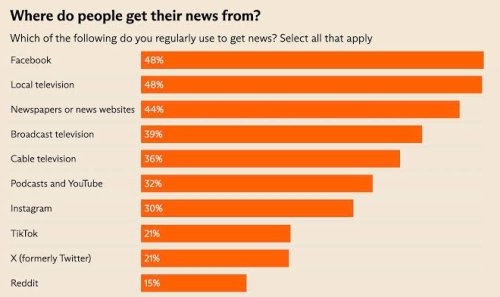
News at 11 (or whenever): How people on Long Island (and everywhere else) consume their news has changed — but the need for quality local journalism has not. (Source: The Argument)
And those forthright journalists understood something else that is just as important today: Living next door to the media capital of the world doesn’t mean Long Island should have to look west to understand itself.
The media world Klurfeld entered in 1968 bears little resemblance to the one we inhabit today. Everyone can publish. Everyone can comment. Everyone carries a camera and a publishing platform in their pocket.
Social media has eliminated the old barriers between audience and publisher, and artificial intelligence can produce content in seconds.
But the fundamentals – the core of good local journalism – haven’t changed.
Know your community. Know the history. Ask questions. Build relationships. Get the facts right. Then tell the story. Those were the standards established by Klurfeld and so many of his colleagues.
Today, the Long Island media landscape is broader than ever. Newspapers have become multimedia organizations. Television lives on phones. Digital outlets cover communities and industries in ways that weren’t possible just one generation ago.

Jim Klurfeld: Standard bearer.
The platforms have changed, but the need for quality reporting hasn’t. Long Island deserves serious journalism produced by people who understand this place and the people who call it home.
I never worked directly with Jim Klurfeld, but I built a career in the Long Island media environment that he and his generation helped shape. I worked with many of his colleagues. I learned from them. I learned what matters to reporters, what matters to readers and, ultimately, what matters to Long Island.
And I still feel it today. You know the questions from local journalists will be thoughtful. You know the local audience is paying attention. And you know that whatever the issue – a major development, a public policy debate, a business announcement or a community controversy – it’s now part of a larger Long Island conversation.
Sometimes, it’s later – way later – when you realize who helped build the world in which you learned your profession. Jim Klurfeld helped build a culture of serious journalism on Long Island, and he helped ensure that a region sitting next to the media capital of the world would always have a voice of its own.
Thanks to him, it still does.
David A. Chauvin is executive vice president of ZE Creative Communications.





Be the first to comment on "Klurfeld is gone – but his local-news legacy lives on"