
By GREGORY ZELLER //
A hefty state grant will support new Stony Brook University research into Alzheimer’s disease, with new potential treatments very much in play.
 The Stony Brook Center of Excellence for Alzheimer’s Disease will continue its battle against the dreaded neurological disorder with the help of the New York State Department of Health, which has awarded the center a fresh $2.35 million research grant.
The five-year grant – actually the renewal of a previous state grant, this one running through 2027 – is an enormous win for the CEAD, an offshoot of the Stony Brook University Neurosciences Institute that actually dates back to 1988, when the program formed as an Alzheimer’s disease assistance center.
In 2016, SBU applied for – and received – status and funding as a Center of Excellence for Alzheimer’s Disease. Today, the CEAD is one of 10 statewide, hospital-based centers of excellence funded in part by Albany, making the new multimillion-dollar grant an ultimate approval of sorts.
All hospital-based centers must meet rigorous annual standards, including cutting-edge diagnostic tools, topflight patient care, rigorous training protocols and meticulous assessment and referral services – in this case, all focused on patients suffering from Alzheimer’s disease or other forms of dementia.

Harold Paz: Growing problem.
Convincing the state Department of Health to re-up on the CEAD is proof-positive of the center’s good work, according to Harold Paz, Stony Brook University’s executive vice president of Health Sciences and the CEO of Stony Brook University Medicine.
“The renewal of this important [Department of Health] grant comes at a time when there are a growing number of people with Alzheimer’s disease in our state, many of whom reside in underserved communities right here on Long Island,” Paz said Tuesday.
The nonprofit Alzheimer’s Association counts 410,000 New Yorkers ages 65 and up living with Alzheimer’s disease, with that statewide number projected to increase to 460,000 within the next three years.
Long Island, meanwhile, has the state’s second-largest population of 65-and-older residents, behind New York City. That’s especially significant when your state’s senior citizen population is bigger than the entire population of 21 other states – and it puts Nassau and Suffolk counties squarely on the front lines of the Alzheimer’s battle.
Nikhil Palekar, the CEAD director who joined Stony Brook Medicine in 2017 and has been instrumental in developing the center’s mission and services, said the threat to regional seniors is very real.
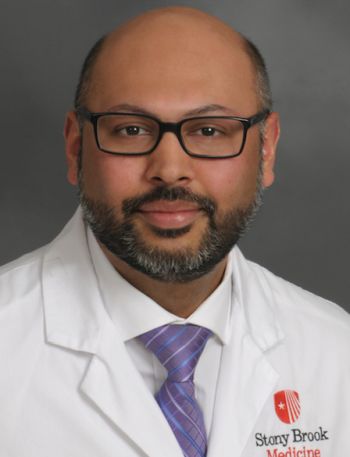
Nikhil Palekar: Brain matter.
“When the brain is unable to function well, your entire health starts to suffer,” Palekar noted. “If you’re having memory issues, you’re probably forgetting to take your medications for blood pressure, diabetes (or) high cholesterol, causing a worsening of chronic medical conditions.”
Among other services directly benefitting Long Island seniors, the CEAD offers free cognitive screening at clinics on the main SBU campus and at Stony Brook Medicine’s Advanced Specialty Care office in Commack. The CEAD staff can also arrange community visits if necessary, with “on the spot” screening results ready to be shared with primary-care physicians and other professional providers, according to SBU.
The center also hosts a number of clinical trials supporting groundbreaking research studies focused on aging, memory and dementia, as well as clinical trials putting monoclonal antibody therapies and other next-generation Alzheimer’s treatments through their paces.
Paz said the renewed state funding “reinforces the strong reputation Stony Brook has built over the years as an expert in (Alzheimer’s disease) diagnosis, care, training and resources,” while Palekar specifically applauded the work of the CEAD’s scientists and staffers.
“We are honored once again to be recognized for all that our team and community partners have accomplished as we continue to serve this vulnerable population,” the CEAD director added.