
By GREGORY ZELLER //
A Stony Brook-based carbon-reduction innovator and a large-scale Canadian utility are proceeding with an ambitious field test that will put a groundbreaking climate-control device through its paces.
 The Thermal Compression Climate Control device – a fuel-flexible heat pump dubbed the TC3 – is the flagship product of energy innovator ThermoLift, shining star of Stony Brook University’s commercialization ecosystem and the first company to graduate from SBU’s Clean Energy Business Incubator Program.
Along with FortisBC Energy, an energy-solutions provider supplying natural gas, electricity and renewable energy to more than 1 million customers across British Columbia, ThermoLift – co-founded in 2012 by current Director Paul Schwartz and international engineering stalwart Peter Hofbauer – is preparing “real-world field tests” that will put the TC3 to work in single-family homes.
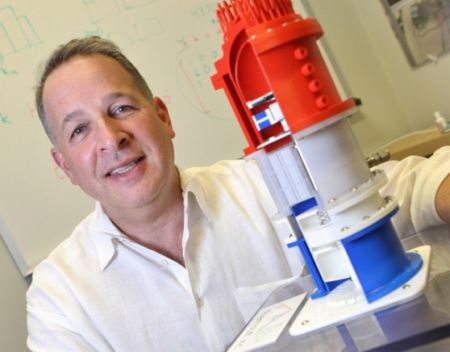
Paul Schwartz: Proof positive.
Billed as the novel heat pump’s first North American pilot program, the shakedown cruise will activate the TC3 in what ThermoLift calls “a cross-section of different residential properties,” carefully selected during a months-long screening process conducted in concert with FortisBC’s Conservation and Energy Management Team.
Installations are scheduled to begin this summer, with final evaluation reports slated for the Fall of 2022. The idea is to test the TC3 – a single unit designed to provide space and water temperature control in both residential and commercial settings – in settings that change with the seasons, proving the device’s year-round cost- and energy-saving capabilities in even the most extreme environments.
“These are the very best proving grounds we could have asked for, where the most fuel is consumed during the winter months,” Schwartz noted.
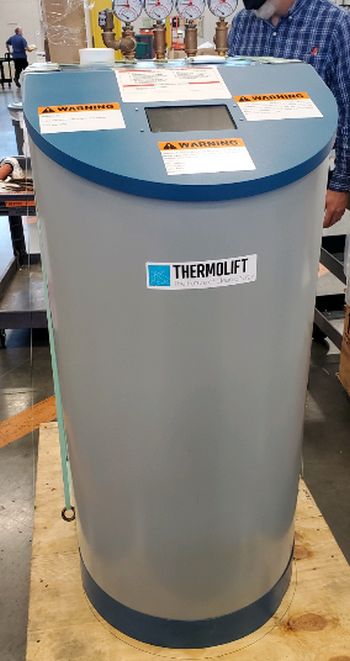
C you soon: The TC3, ready for its closeup.
Powered by hydrogen, biofuels or natural gas, the TC3 is based on the Hofbauer Cycle, a unique thermodynamic cycle named for the ThermoLift cofounder and longtime Volkswagen engineering standout.
The toxin-free refrigerant system functions as a boiler or furnace, a water heater and an air conditioner, and – if it performs as well as it did in several rounds of laboratory testing, including rigourous tests at Tennessee’s Oak Ridge National Laboratory – stands ready to reduce greenhouse gas emissions and traditional energy costs by as much as half, according to the Stony Brook company, a longtime resident of SBU’s Advanced Energy Research and Technology Center.
Among other giant leaps for energy kind, the TC3 could potentially meet the super-ambitious goals of the Pan Canadian Framework on Clean Growth and Climate Change, a Canadian government plan requiring all new residential space- and water-heating systems to operate with 100 percent efficiency (or better) by 2035 – a “tall order” brought within reach by ThermoLift’s breakthrough tech, according to FortisBC Innovative Technology Program Manager Jim Kobialko.
“After seeing how these performed in lab settings, we’re optimistic that these new natural-gas heat pump technologies are going to be key to reaching efficiencies greater than 100 percent and fill a much-needed gap in the marketplace,” Kobialko said in a statement. “We’re really excited to observe how the TC3 performs in British Columbia’s diverse weather conditions.”